Universal scaling law and species abundance distribution in ecosystems
Source:The Hindu ↗
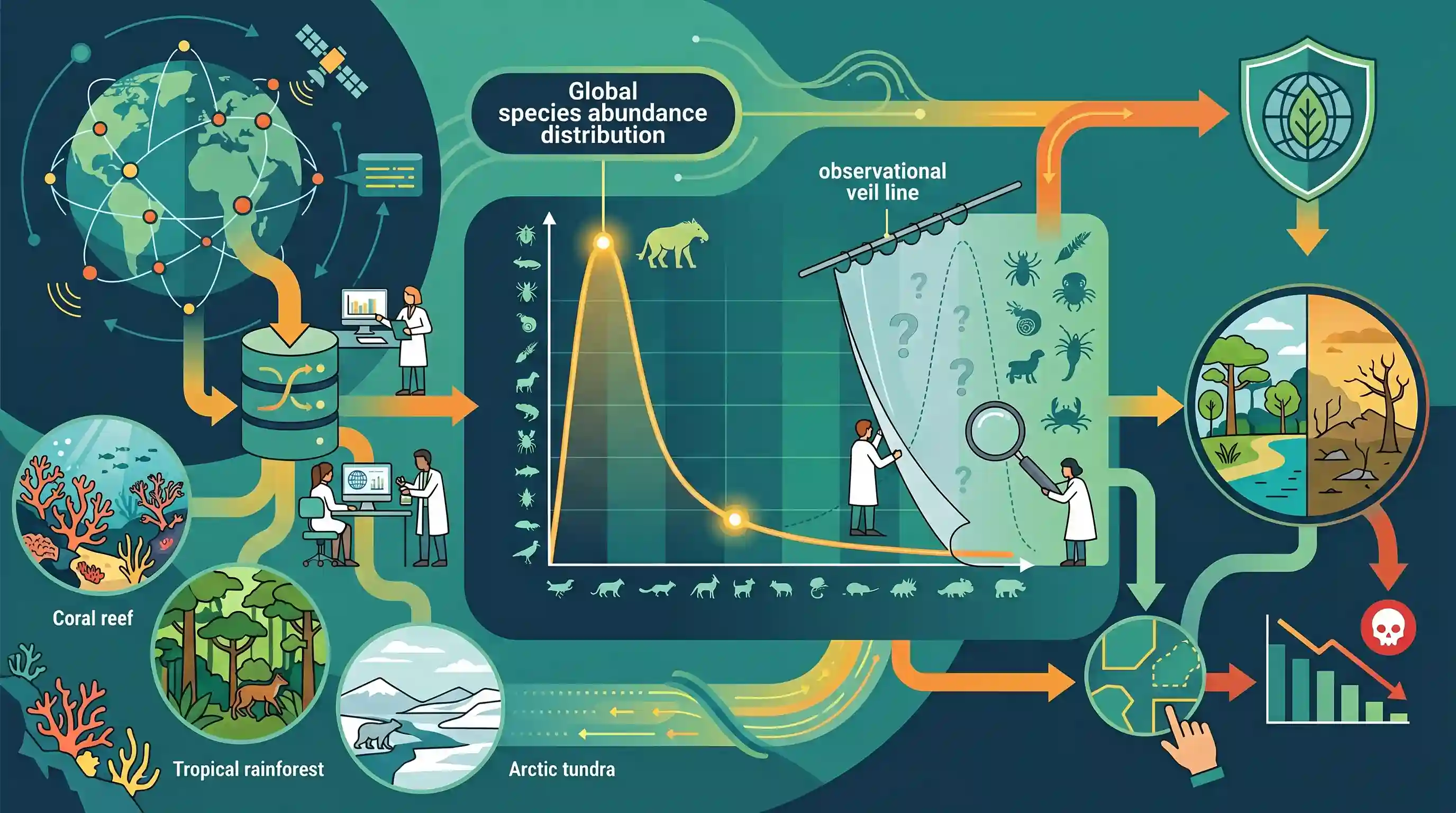
Why It Matters
Understanding macroscopic patterns in biodiversity is crucial for UPSC aspirants, as it connects theoretical ecology with practical conservation strategies. The use of big data to estimate undiscovered species and track extinction rates forms a modern, scientific foundation for environmental policies and GS3 syllabus topics on conservation and biodiversity loss.
Summary
A major ecological study has revealed a common 'hidden' mathematical pattern that orders biodiversity across all ecosystems worldwide. Known as the global species abundance distribution, this pattern demonstrates that the vast majority of species on Earth are rare, while only a select few are highly abundant, forming a characteristic log-normal or hollow curve. By analyzing massive datasets from the Global Biodiversity Information Facility (GBIF), researchers can now estimate the total number of undiscovered species that fall behind the observational 'veil line.' This universal scaling law provides a vital framework for ecologists and organizations like the IUCN to track ecosystem health, target conservation strategies, and comprehend the true magnitude of biodiversity loss during the ongoing Sixth Mass Extinction.
Key Points
- Research reveals a universal mathematical pattern—the global species abundance distribution—that structures biodiversity across all Earth's ecosystems.
- The data confirms a log-normal or hollow-curve distribution, showing that the vast majority of species are exceedingly rare, while only a small fraction are highly abundant.
- This statistical framework helps ecologists estimate the number of undiscovered species by accounting for those hidden behind Preston's 'veil line' of observation.
- The breakthrough was enabled by massive data aggregation platforms like the Global Biodiversity Information Facility (GBIF), underscoring the importance of big data in environmental science.
- These findings provide critical baseline metrics for tracking the scale of biodiversity loss and targeting conservation efforts to combat the anthropogenic Sixth Mass Extinction.
Important Terms
Convention on Biological Diversity (CBD)

A legally binding multilateral treaty from the 1992 Rio Earth Summit focusing on biodiversity conservation, sustainable use, and fair sharing of benefits from genetic resources.
UPSC context
GS-III (Environment); central to international environmental governance and India’s Biological Diversity Act, 2002.
International Union for Conservation of Nature (IUCN)
A global membership union of government and civil society organizations that serves as the leading authority on the conservation status of species and nature.
UPSC context
GS-III (Environment); essential for species conservation status (Red List) and global ecological benchmarks.
Global Biodiversity Information Facility (GBIF)
An international open-data network funded by governments that provides researchers and policymakers with access to species occurrence data across all ecosystems.
UPSC context
GS-III (Environment/S&T); represents digital infrastructure used for tracking biodiversity loss and ecological modeling.
Sixth Mass Extinction
The ongoing anthropogenic extinction event marked by rapid biodiversity loss and species disappearance at rates significantly exceeding natural background levels.
UPSC context
GS-III (Environment); tests knowledge of human-induced environmental change and global conservation urgency.
Species Abundance Distribution (SAD)
A fundamental ecological concept describing how common or rare species are within a community, typically showing that most species are rare.
UPSC context
GS-III (Environment); core theoretical framework for measuring ecosystem health and predicting undiscovered biodiversity.
Veil Line
A statistical threshold in biodiversity sampling beyond which rare species remain unobserved, requiring mathematical modeling to estimate their existence.
UPSC context
GS-III (Environment); relevant for scientific data modeling and understanding gaps in global species inventories.
Prelims Trap
"The global species abundance distribution demonstrates that the majority of species in an ecosystem are highly abundant, ensuring stability."
The universal 'hollow curve' pattern actually proves the opposite: the vast majority of species are exceedingly rare, while only a small fraction are highly abundant.
Static Concepts Connected
What distinguishes the Sixth Mass Extinction from the previous five?
- Anthropogenic drivers: Driven primarily by human activities (habitat fragmentation, pollution, climate change, resource overexploitation) rather than natural catastrophic events like asteroid impacts or volcanism.
- Accelerated rate: Occurring at an unprecedented scale, with current extinction rates estimated to be 100 to 1,000 times faster than historical background extinction rates.
How is biodiversity measured across different spatial scales?
- Alpha diversity: Measures the species richness or diversity within a single, specific ecosystem or local habitat.
- Beta diversity: Measures the change or turnover in species composition between two distinct ecosystems or along an environmental gradient.
- Gamma diversity: Represents the total overall species diversity across a large geographic region encompassing multiple distinct ecosystems.
Cross-Topic Patterns
GBIF + Environmental Big Data
GBIF's open-source architecture connects ecological conservation with digital public goods, showing how global big data and intergovernmental networks are now crucial for tracking multilateral biodiversity targets.
Baseline Rarity + IUCN Red List
Understanding that most species are mathematically 'rare' by default helps refine the IUCN's population-decline criteria, which directly dictates threat categorizations and heavily influences CITES trade restrictions.

Expect a 2026 prelims statement testing the 'majority of species are rare' concept alongside the role of GBIF in global data tracking.
Linked PYQs · 4
Linked PYQs · 4
- 2018PrelimsGS1
The term "sixth mass extinction/sixth extinction" is often mentioned in the news in the context of the discussion of
- 2015PrelimsGS1
Which one of the following is the best description of the term 'ecosystem?
- 2019MainsGS3
Define the concept of carrying capacity of an ecosystem as relevant to an environment. Explain how understanding this concept is vital while planning for sustainable development of a region.
- 2023PrelimsGS1
'Invasive Species Specialist Group' (that develops Global Invasive Species Database) belongs to which one of the following organizations?
