Biochar as a Solution for Crop Residue Management
Source:The Hindu ↗
Why It Matters
Stubble burning is a recurring environmental disaster in Northern India with massive public health impacts. Alternative crop residue management techniques like biochar are critical for Mains GS3 (Environment & Agriculture) and are directly tested in Prelims (e.g., the 2020 question on biochar's agricultural applications).
Summary
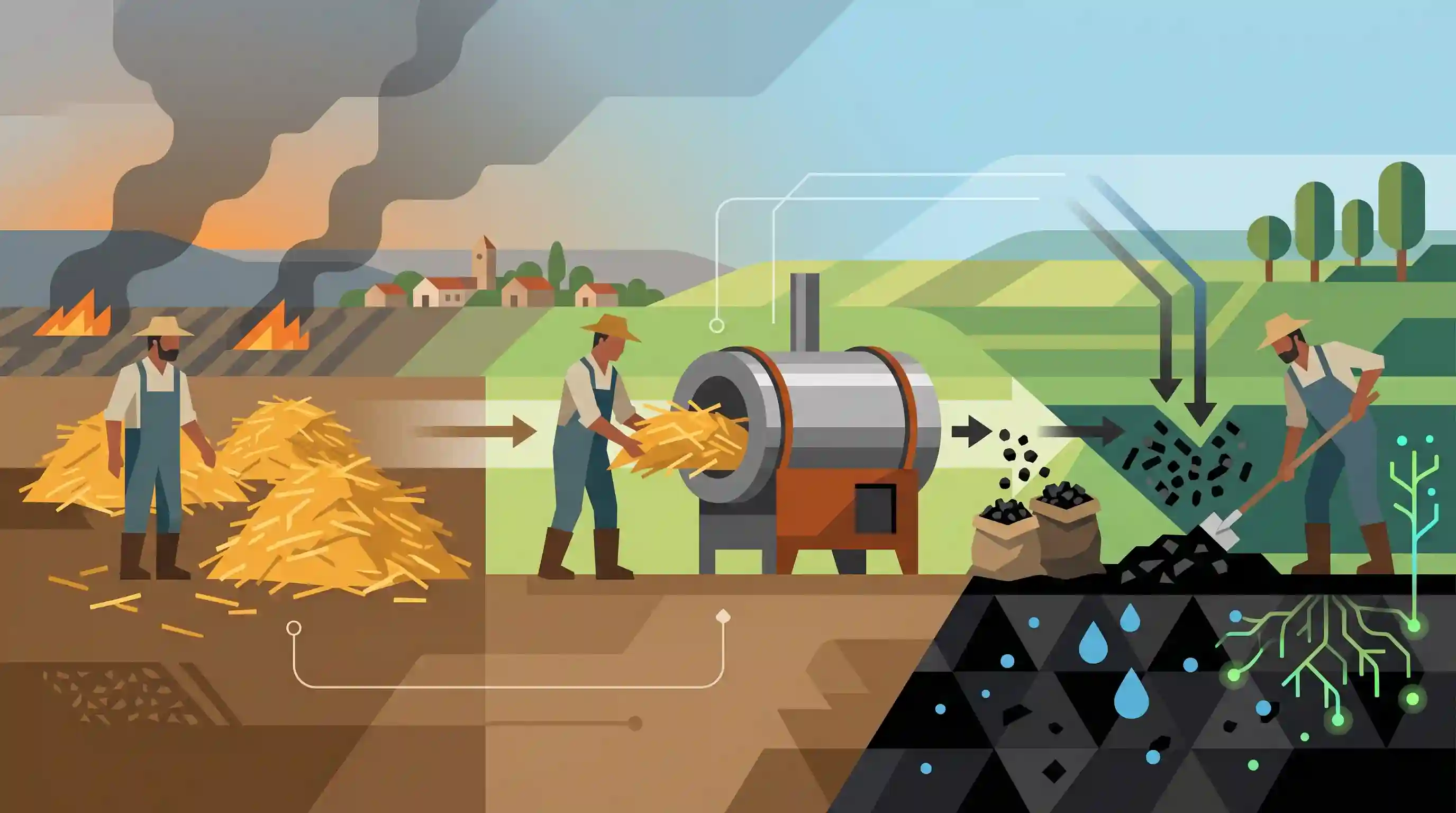
The article highlights biochar as a transformative solution to India's persistent crop residue burning crisis. By using pyrolysis to convert agricultural waste (stubble) into biochar, farmers can prevent the severe winter air pollution that chokes North India. Termed 'black gold', biochar not only mitigates emissions but also significantly enhances soil health by improving water retention and fostering microbial activity. The widespread adoption of biochar production can turn an environmental hazard into a tool for carbon sequestration and agricultural resilience, provided there is adequate policy and economic support.
Key Points
- Open burning of agricultural residue in North India is a major contributor to severe winter air pollution and greenhouse gas emissions.
- Converting crop stubble into biochar through pyrolysis (heating in the absence of oxygen) offers a sustainable alternative to open farm burning.
- Biochar acts as 'black gold' for agriculture by improving soil fertility, enhancing water retention capacity, and promoting beneficial nitrogen-fixing microorganisms.
- The use of biochar serves as a powerful method of carbon sequestration, locking atmospheric carbon into the soil for hundreds of years.
- Scaling biochar production requires decentralized kilns, government incentives, and potential integration with carbon credit markets to make it economically viable for farmers.
Important Terms
Biochar

A carbon-rich, porous material produced by heating organic biomass (like agricultural waste) in a low-oxygen environment; used to enhance soil fertility and store carbon.
UPSC context
GS III Environment/Agriculture; tests sustainable farming techniques and long-term carbon sink strategies.
Pyrolysis
The chemical decomposition of organic matter at high temperatures in the absence of oxygen, producing biochar, syngas, and bio-oil instead of smoke.
UPSC context
GS III Science & Tech/Environment; relevant for waste-to-energy and pollution-free waste disposal technologies.
Crop Residue Management (CRM) Scheme
A Central Sector Scheme providing 50-80% subsidies for machinery to manage stubble in-situ or ex-situ, primarily in Punjab, Haryana, and Uttar Pradesh.
UPSC context
GS III Agriculture; focus on government interventions and mechanization to mitigate the stubble burning crisis.
Commission for Air Quality Management (CAQM)
A statutory body established in 2021 to coordinate, monitor, and implement measures for air quality management in the National Capital Region and adjoining states.
UPSC context
GS II/III; tests institutional frameworks for pollution control and inter-state environmental governance.
Carbon Sequestration
The long-term capture and storage of atmospheric carbon dioxide in biological (soils, forests) or geological formations to mitigate global warming.
UPSC context
GS III Environment; core concept for climate change, net-zero targets, and ecological restoration.
Prelims Trap
Biochar is produced by the combustion of agricultural biomass at high temperatures in the presence of oxygen.
Biochar is produced via pyrolysis, which strictly requires the ABSENCE of oxygen. Heating biomass with oxygen leads to incineration (ash and CO2), not biochar.
Static Concepts Connected
What is the difference between Pyrolysis and Incineration?
- Pyrolysis: Thermal decomposition of materials at elevated temperatures in the absence of oxygen, producing biochar, bio-oil, and syngas.
- Incineration: Thermal destruction of waste in the presence of oxygen, resulting in complete combustion into ash, water vapor, and carbon dioxide.
How does biochar functionally improve agricultural soil health?
- Moisture Retention: Its highly porous, honeycomb-like structure acts like a sponge, significantly improving the water-holding capacity of drought-prone or sandy soils.
- Nutrient Retention: Reduces the loss of essential agricultural nutrients (like nitrogen and phosphorus) into groundwater, minimizing chemical fertilizer runoff.
- Microbial Habitat: The physical structure provides a safe micro-habitat for beneficial soil microbes, including nitrogen-fixing bacteria and mycorrhizal fungi.
Cross-Topic Patterns
Stubble management + Domestic Carbon Markets
Ex-situ crop residue management is evolving from a mere pollution control mandate into a potential farmer revenue stream via India's emerging Carbon Credit Trading Scheme (CCTS).
Biochar + Climate-Smart Agriculture (CSA)
Integrates seamlessly with the National Mission on Sustainable Agriculture (NMSA) by simultaneously building drought resilience (water retention) and creating long-term, stable carbon sinks.

Expect a multi-statement question linking biochar’s pyrolysis process to soil moisture retention and carbon credit eligibility.
Linked PYQs · 3
Linked PYQs · 3
- 2020PrelimsGS1
What is the use of biochar in farming? 1. Biochar can be used as a part of the growing medium in vertical farming. 2. When biochar is a part of the growing medium, it promotes the growth of nitrogen-fixing microorganisms. 3. When biochar is a part of the growing medium, it enables the growing medium to retain water for longer time. Which of the statements given above is/are correct?
- 2015MainsGS1
Mumbai, Delhi and Kolkata are the three mega cities of the country but the air pollution is much more serious problem in Delhi as compared to the other two. Why is this so?
- 2025PrelimsGS1
With reference to 'Direct Air Capture', an emerging technology, which of the following statements is/are correct? I. It can be used as a way of carbon sequestration. II. It can be a valuable approach for plastic production and in food processing. III. In aviation, it can be a source of carbon for combining with hydrogen to create synthetic low-carbon fuel. Select the correct answer using the code given below.
