BIMSTEC potential and strategic role in regional connectivity
Source:Indian Express ↗
Why It Matters
BIMSTEC is India's premier multilateral vehicle for regional cooperation in South and Southeast Asia. Analyzing its operational challenges, FTA prospects, and structural contrast with SAARC is highly relevant for GS Paper 2 International Relations questions.
Summary
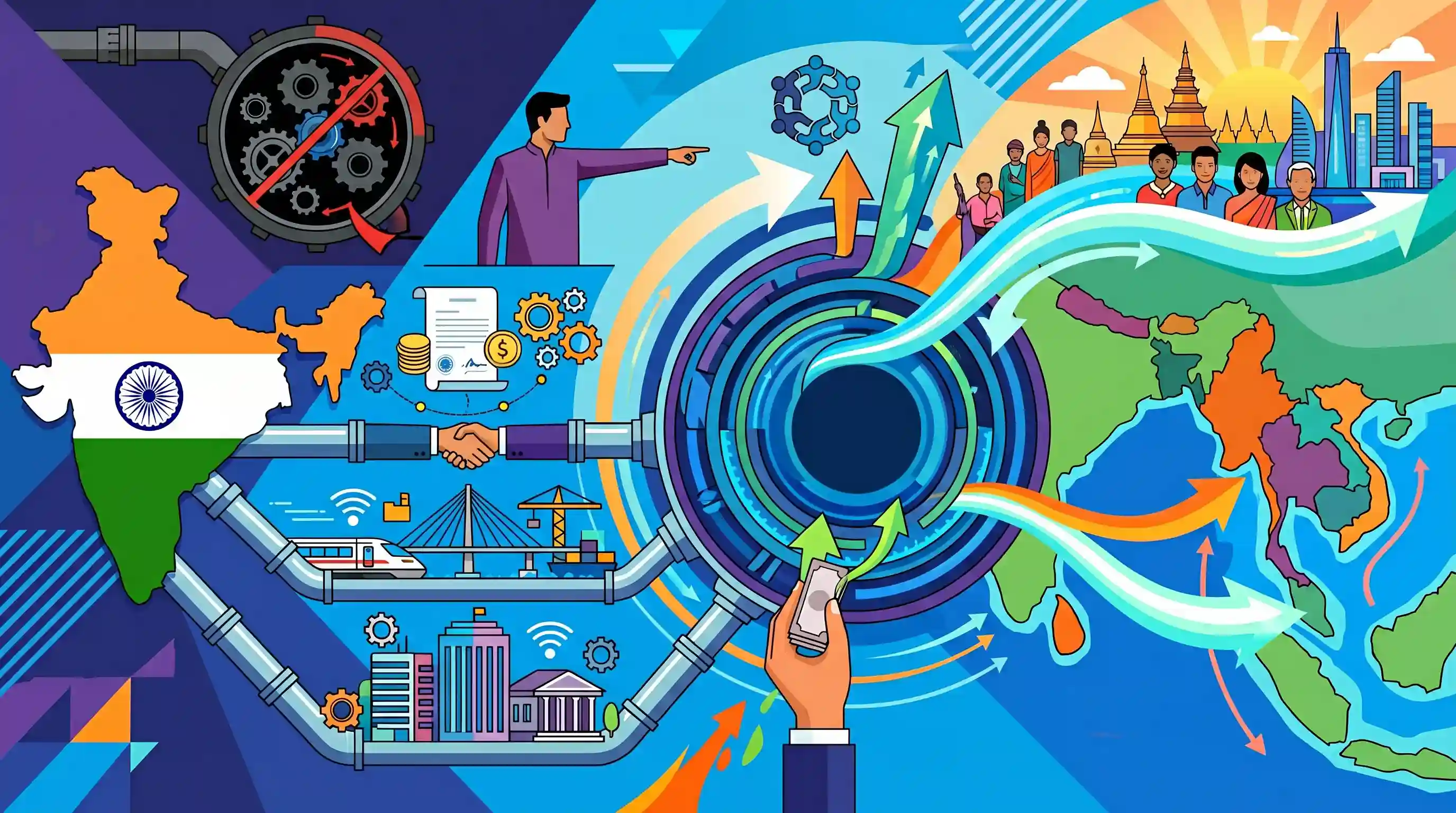
The article evaluates the strategic imperative for India to revitalize BIMSTEC, warning against squandering the grouping's potential due to institutional inertia. With SAARC paralyzed by regional hostilities, BIMSTEC has emerged as the cornerstone of India's 'Neighbourhood First' and 'Act East' policies. However, to transform the Bay of Bengal into a dynamic engine of growth, member states must prioritize finalizing the Free Trade Agreement, building robust regional connectivity, and strengthening the organization's institutional capacity. The piece emphasizes that India must lead by example, matching its diplomatic enthusiasm with concrete resource allocation and sustained political will.
Key Points
- BIMSTEC serves as a pivotal bridge between South and Southeast Asia, acting as a viable and functional alternative to the diplomatically stalled SAARC.
- The article underscores the urgency of finalizing the long-pending BIMSTEC Free Trade Agreement (FTA) to unlock regional economic integration and intra-regional trade.
- Enhancing transport, energy, and digital connectivity across the Bay of Bengal region remains critical to maximizing the grouping's geopolitical and economic potential.
- India is urged to adopt a proactive leadership role, backing its political rhetoric with sustained institutional and financial commitments to prevent BIMSTEC from losing momentum.
Important Terms
BIMSTEC

A regional organization of seven South and Southeast Asian nations bordering the Bay of Bengal, aimed at technical and economic cooperation and regional connectivity.
UPSC context
GS Paper II (International Relations); tests knowledge of regional groupings and India's strategic shift for neighborhood engagement.
SAARC
An intergovernmental organization of eight South Asian nations established in 1985 to promote regional integration, currently largely paralyzed by Indo-Pakistani hostilities.
UPSC context
GS Paper II; evaluates understanding of regional institutional failures and the geopolitical constraints of South Asian cooperation.
Neighbourhood First Policy
India's foreign policy priority to maintain stable, friendly, and connected relations with its immediate neighbors through development assistance and infrastructure projects.
UPSC context
GS Paper II; tests the strategic rationale behind India's bilateral priorities and regional stability efforts.
Act East Policy
A proactive diplomatic strategy launched in 2014 to deepen economic, strategic, and cultural engagement with Southeast Asia and the broader Indo-Pacific.
UPSC context
GS Paper II; assesses understanding of India's strategic reach, the '4Cs' framework, and regional power balancing.
BIMSTEC Free Trade Area (FTA)
A proposed framework agreement to reduce tariffs and trade barriers among BIMSTEC member states to enhance intra-regional economic integration.
UPSC context
GS Paper II/III; tests knowledge of regional economic instruments and the hurdles facing multilateral trade liberalization.
Prelims Trap
"All SAARC nations minus Pakistan are members of BIMSTEC, alongside Myanmar and Thailand."
Maldives and Afghanistan are SAARC members but are NOT in BIMSTEC. BIMSTEC only contains five South Asian nations (India, Bangladesh, Bhutan, Nepal, Sri Lanka).
Static Concepts Connected
What are the major India-led connectivity projects through BIMSTEC nations?
- Kaladan Multimodal: Connects Kolkata port to Sittwe port in Myanmar, integrating maritime routes with inland waterways and roads to Mizoram.
- IMT Trilateral Highway: Connects Moreh in Manipur (India) to Mae Sot (Thailand) via Myanmar, boosting overland trade with ASEAN.
How does a Free Trade Agreement (FTA) differ from a Preferential Trade Agreement (PTA)?
- Tariff Approach: PTAs reduce tariffs on a specific 'positive list' of goods. FTAs eliminate tariffs on most goods, keeping only a restrictive 'negative list'.
- Coverage Scope: FTAs are broader, typically covering services, investment, and intellectual property. PTAs generally focus strictly on merchandise trade.
Cross-Topic Patterns
Maritime Security & SAGAR intersection
BIMSTEC overlaps heavily with broader Indo-Pacific strategies. India's SAGAR vision and Quad-backed maritime domain awareness initiatives directly intersect with BIMSTEC's coastal security and blue economy priorities.
FTAs and Non-Tariff Barriers (NTBs)
The stagnation of the BIMSTEC FTA since 2004 serves as a classic case study in GS3 Economy for how disputes over Rules of Origin and Non-Tariff Barriers derail regional integration.

Expect a 2026 Prelims question mapping BIMSTEC vs SAARC memberships alongside connectivity projects like Kaladan or IMT Highway.
Linked PYQs · 4
Linked PYQs · 4
- 2022MainsGS2
Do you think that BIMSTEC is a parallel organisation like the SAARC ? What are the similarities and dissimilarities between the two ? How are Indian foreign policy objectives realized by forming this new organisation?
- 2011MainsGS2
Compared to the South Asian Free Trade Area (SAFTA), the Bay of Bengal Initiative for Multisectoral Technical and Economic Cooperation Free Trade Area (BIMSTEC FTA) seems to be more promising." Critically evaluate.
- 2025PrelimsGS1
Consider the following statements in respect of BIMSTEC : I. It is a regional organization consisting of seven member States till January 2025. II. It came into existence with the signing of the Dhaka Declaration, 1999. III. Bangladesh, India, Sri Lanka, Thailand and Nepal are founding member States of BIMSTEC. IV. In BIMSTEC, the subsector of 'tourism' is being led by India. Which of the statements given above is/are correct?
- 2016MainsGS2
Increasing cross-border terrorist attacks in India and growing interference in the internal affairs of several member-states by Pakistan are not conducive for the future of SAARC (South Asian Association for Regional Cooperation)." Explain with suitable examples.
