Supreme Court Judges Strength Amendment Bill and Parliament Procedure
Source:The Hindu ↗
Why It Matters
The article highlights the constitutional procedure for altering the strength of the Supreme Court (vested in Parliament) while raising critical governance issues regarding the passage of legislation without debate and the frequent promulgation of ordinances.
Summary
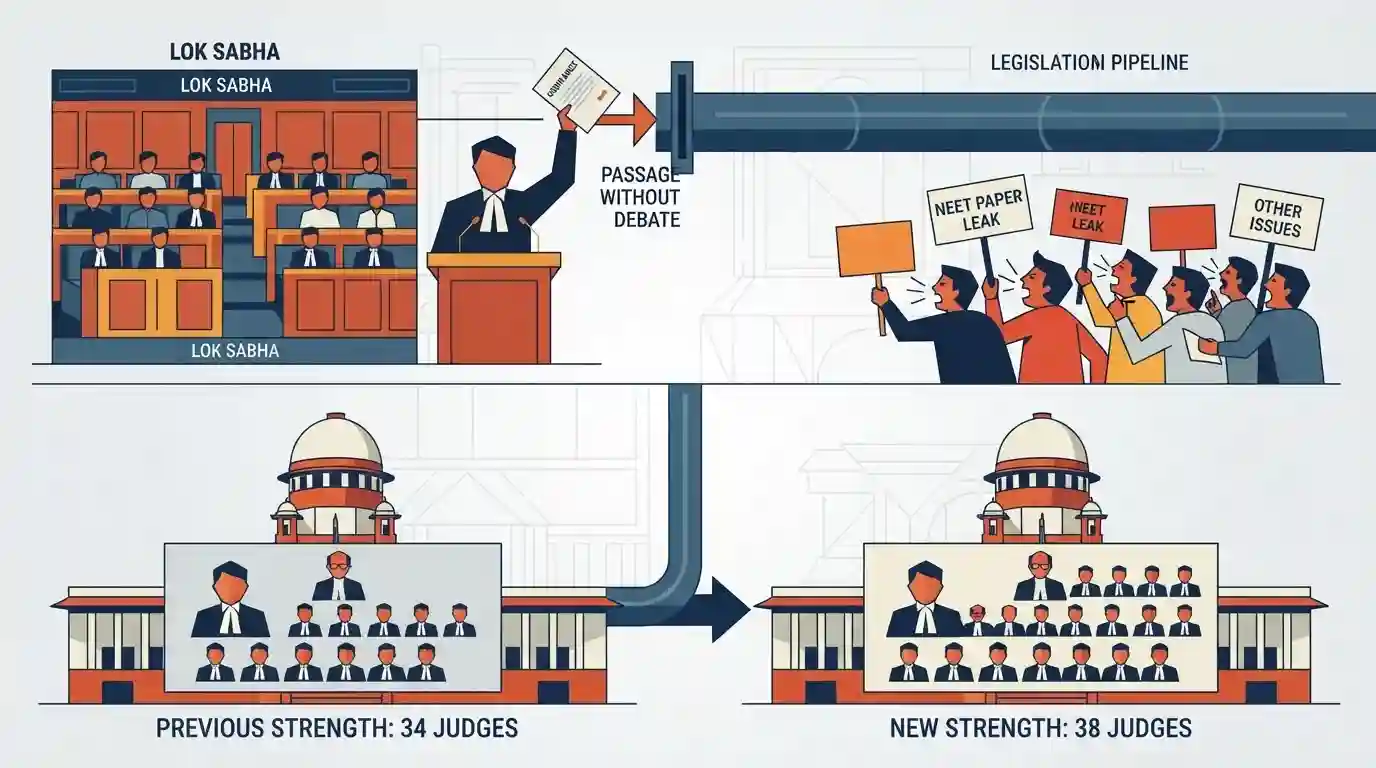
The Lok Sabha passed the Supreme Court (Number of Judges) Amendment Bill, 2026, without parliamentary debate amid opposition protests concerning the NEET paper leak and other issues. The legislation replaces an ordinance to increase the maximum strength of Supreme Court judges from 34 to 38 (including the Chief Justice of India). The passage of bills without discussion and the use of the ordinance route underline ongoing procedural and democratic concerns regarding the functioning of Parliament.
Key Points
- The Lok Sabha passed the Supreme Court (Number of Judges) Amendment Bill, 2026, without any debate amid protests by opposition members.
- The bill replaces a previously promulgated ordinance and increases the sanctioned strength of the Supreme Court from 34 to 38, including the Chief Justice of India.
- Protests causing the disruption and subsequent adjournment were centered around the NEET paper leak controversy and alleged embezzlement of Ram temple donations.
- A statutory resolution denouncing the promulgation of the ordinance was rejected by a voice vote, raising concerns over the frequent use of ordinances and bypassing of legislative debate.
Important Terms
Supreme Court (Number of Judges) Amendment Bill, 2026

A 2026 legislative bill replacing an earlier ordinance, aiming to increase the sanctioned strength of Supreme Court judges from 34 to 38 (including the Chief Justice) to address case pendency.
UPSC context
GS Paper 2 (Judiciary). Highlights Parliament's constitutional authority under Article 124 to regulate the Supreme Court's judge strength.
National Eligibility-cum-Entrance Test (NEET)
A uniform, nationwide entrance exam conducted by the National Testing Agency (NTA) for admission to undergraduate medical and dental programs across India.
UPSC context
GS Paper 2 (Social Justice). Relevant for issues regarding standardized testing, education regulatory bodies, and transparency in governance.
Lok Sabha
The directly elected lower house of India's bicameral Parliament. It introduces and passes federal legislation, holds the executive accountable, and has exclusive authority over money bills.
UPSC context
GS Paper 2 (Parliament). Core polity concept testing the structure, functioning, and legislative powers of the Union legislature.
Supreme Court of India
The apex judicial body in India, established by the Constitution. It functions as the highest court of appeal, a constitutional court, and the ultimate guarantor of fundamental rights.
UPSC context
GS Paper 2 (Judiciary). Essential for questions on judicial independence, constitutional interpretation, and the separation of powers.
Parliament
The supreme legislative body of India, comprising the President, the Rajya Sabha, and the Lok Sabha. It is responsible for enacting national laws and ensuring executive accountability.
UPSC context
GS Paper 2 (Indian Polity). Central to understanding India's democratic structure, legislative processes, and representative governance.
Prelims Trap
Increasing the sanctioned strength of Supreme Court judges requires a Constitutional Amendment under Article 368.
False. Under Article 124(1), Parliament alters the number of SC judges via ordinary legislation. No constitutional amendment is required.
Static Concepts Connected
How is the sanctioned strength of the Supreme Court and High Courts determined?
- Supreme Court: Determined exclusively by Parliament via ordinary legislation (like the 1956 Act), as per Article 124(1).
- High Courts: Determined flexibly by the President of India based on the current workload of the respective court, as per Article 216.
What are the constitutional limits on the Ordinance-making power under Article 123?
- Subject limitation: Co-extensive with Parliament's legislative power; an ordinance can only be issued on subjects Parliament is competent to legislate on.
- Fundamental Rights: An ordinance qualifies as 'law' under Article 13; therefore, it cannot be used to abridge or take away Fundamental Rights.
- Maximum lifespan: Six months and six weeks. It must be approved by Parliament within six weeks of its reassembly to remain valid.
Cross-Topic Patterns
Ordinance Raj & Parliamentary decline
Frequent use of ordinances combined with passing bills via voice vote without debate highlights the circumvention of legislative scrutiny, a recurring mains theme for GS Paper 2.
Judge strength vs. Judicial Pendency
Increasing judge count is a quantitative fix for pendency. UPSC often links this to qualitative structural reforms like a National Court of Appeal or All India Judicial Services (AIJS).

Expect a 2026 Prelims multi-statement question contrasting how SC judge strength (Parliament) vs HC judge strength (President) is determined.
Linked PYQs · 3
Linked PYQs · 3
- 2014PrelimsGS1
The power to increase the number of judges in the Supreme Court of India is vested in
- 2022MainsGS2
Discuss the essential conditions for exercise of the legislative powers by the Governor. Discuss the legality of re-promulgation of ordinances by the Governor without placing them before the Legislature.
- 2025PrelimsGS1
With reference to the Indian polity, consider the following statements : I. An Ordinance can amend any Central Act. II. An Ordinance can abridge a Fundamental Right. III. An Ordinance can come into effect from a back date. Which of the statements given above are correct?
