Sri Lanka Supreme Court Clears Bill to Scrap MP Pensions
Source:The Hindu ↗
Why It Matters
The article provides an excellent comparative constitutional case study regarding legislative privileges versus constitutional rights. For UPSC aspirants, it serves as a strong real-world example for GS Paper 2 (debates around MP privileges and amending powers) and GS Paper 4 (Ethics and Probity in Governance), illustrating how political will can curb unjustified perks to optimize public funds for essential societal services.
Summary
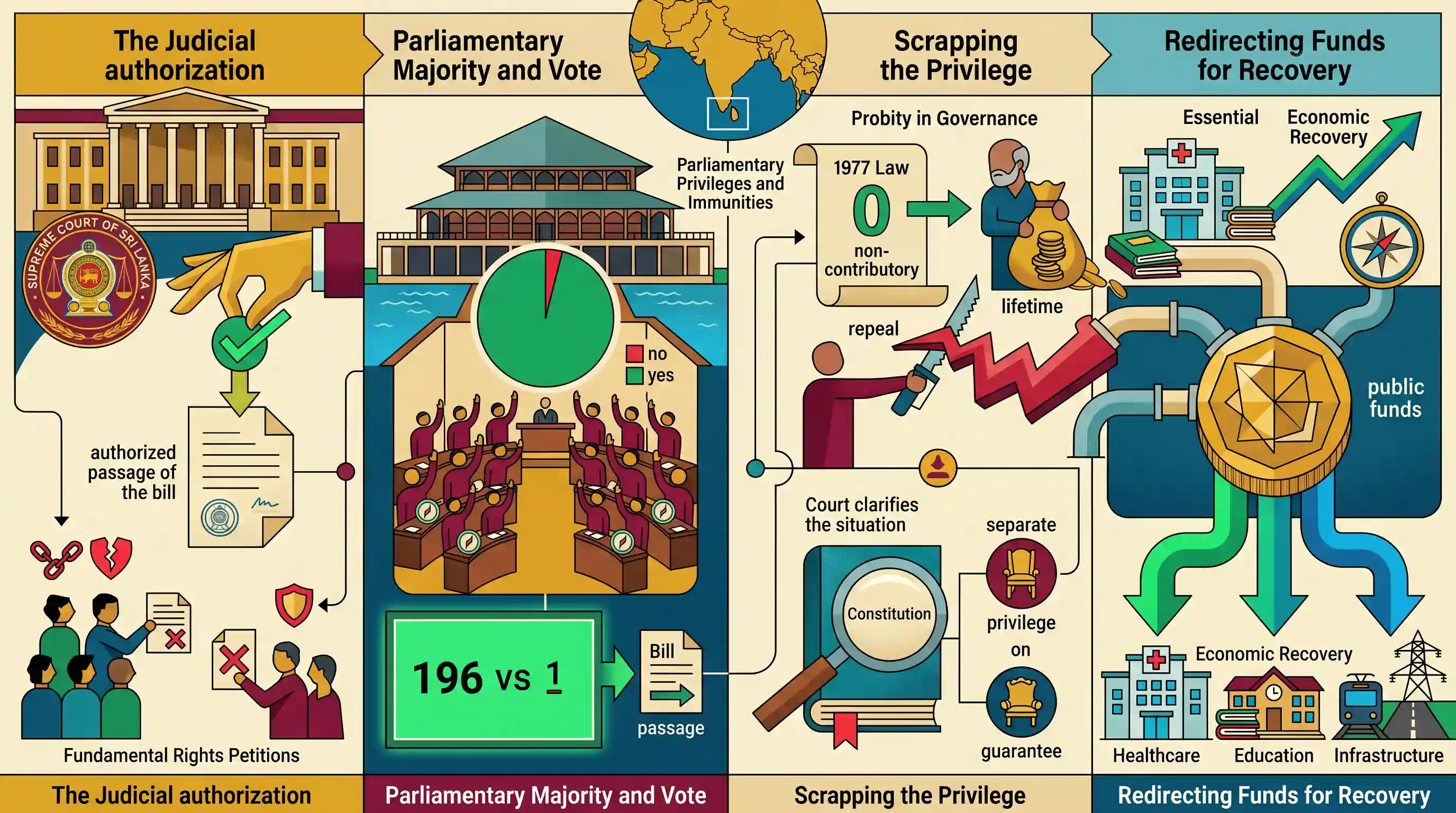
The Supreme Court of Sri Lanka has authorized the passage of the Parliamentary Pensions (Repeal) Bill via a simple majority, rejecting fundamental rights petitions that challenged it. The legislation scraps the 1977 law granting non-contributory lifetime pensions to former MPs, with the Court clarifying such benefits were never a constitutional guarantee. Supported by the ruling NPP's overwhelming parliamentary majority, the repeal fulfills an electoral promise to strip away unjustified political privileges and redirect public funds toward essential services amid the country's ongoing economic recovery.
Key Points
- Sri Lanka's Supreme Court cleared the Parliamentary Pensions (Repeal) Bill, declaring it requires only a simple majority for passage.
- The Bill repeals the 1977 law that provided non-contributory lifetime pensions to former Members of Parliament.
- The Court dismissed petitions claiming the repeal was unconstitutional, noting the Constitution's framers never intended to confer such lifetime benefits.
- Abolishing these pensions fulfills the ruling National People's Power (NPP) government's electoral pledge to end unjustified political perks.
- The financial savings from eliminating these political privileges will be redirected toward essential public services.
Important Terms
Parliamentary Pensions (Repeal) Bill

Legislation enacted in 2026 to abolish non-contributory lifetime pensions for Sri Lankan lawmakers. It fulfills a reformist mandate to reduce political privileges and redirect public funds toward economic recovery and essential services.
UPSC context
GS Paper II (Comparative Constitutions); tests understanding of governance reforms and the impact of economic crises on political institutions.
National People's Power (NPP)
The ruling Marxist-leaning political alliance in Sri Lanka led by Anura Kumara Dissanayake. It rose to power on a platform of anti-corruption and pruning elite privileges following the 2022 economic collapse.
UPSC context
GS Paper II (Neighborhood Relations); crucial for analyzing political shifts in South Asia and their implications for India’s regional diplomacy.
Parliamentary Pensions Law No. 1 of 1977
A 1977 statute that established non-contributory pensions for Sri Lankan MPs after five years of service. Its repeal targeted what the public perceived as an unjust financial burden on a crisis-hit nation.
UPSC context
GS Paper IV (Probity in Governance); useful for discussing the removal of political perks as an administrative reform to restore public trust.
Probity in Governance
The standard of absolute integrity, transparency, and accountability in public administration. It emphasizes using public office and resources solely for the public good rather than for personal or political gain.
UPSC context
GS Paper IV (Ethics); a foundational theme testing the ability to evaluate policies through the lens of moral and administrative integrity.
India and its Neighborhood
A primary UPSC syllabus theme focusing on India’s diplomatic and security relations with nearby states. Sri Lanka’s governance reforms and political stability are vital for India’s "Neighbourhood First" policy.
UPSC context
GS Paper II (International Relations); evaluates how internal developments in neighboring states influence India’s strategic and regional interests.
Supreme Court of Sri Lanka
The highest court in Sri Lanka. It recently exercised constitutional review to rule that parliamentary pensions are not constitutional guarantees, enabling their repeal via a simple majority vote in parliament.
UPSC context
GS Paper II (Comparative Constitutions); relevant for comparing judicial review and constitutional interpretation between the Indian and Sri Lankan judiciaries.
Prelims Trap
The Constitution of India explicitly guarantees and fixes pension benefits for Members of Parliament.
Article 106 empowers Parliament to determine salaries/allowances by law. Pensions are not constitutionally guaranteed but are provided under the 1954 statutory Act.
Static Concepts Connected
How are salaries and pensions of Indian MPs regulated?
- Article 106: Leaves the determination of salaries and allowances of MPs entirely to Parliament by law, rather than fixing them constitutionally.
- Statutory Basis: Governed by the Salary, Allowances and Pension of Members of Parliament Act, 1954.
- Voted Expenditure: Unlike the Speaker or President, ordinary MPs' salaries and pensions are voted upon annually, not charged on the Consolidated Fund of India.
What is the Public Trust Doctrine in governance?
- Definition: The principle that sovereign holds resources and power in trust for the public, not for private political gain.
- Application: Redirecting funds from unjustified political perks (like lifetime pensions) to essential public services exemplifies fiduciary duty and probity.
Cross-Topic Patterns
Comparative Constitution & Privileges
Sri Lanka's judicial ruling that MP pensions are statutory, not constitutional, provides excellent GS2 fodder for comparing legislative self-regulation and conflict of interest in South Asia.
Economic Crisis driving Probity
The 2022 sovereign default acting as a catalyst for ethical governance reforms (scrapping perks to rebuild public trust) directly links GS2 neighborhood economics with GS4 probity.

Expect a GS2 mains question on the conflict of interest in MPs deciding their own salaries, using Sri Lanka's repeal as a case study.
Linked PYQs · 5
Linked PYQs · 5
- 2025MainsGS2
Indian Constitution has conferred the amending power on the ordinary legislative institutions with a few procedural hurdles. In view of this statement, examine the procedural and substantive limitations on the amending power of the Parliament to change the Constitution.
- 2014MainsGS2
The 'Powers, Privileges and Immunities of Parliament and its Members' as envisaged in Article 105 of the Constitution leave room for a large number of un-codified and un-enumerated privileges to continue. Assess the reasons for the absence of legal codification of the 'parliamentary privileges'. How can this problem be addressed ?
- 2022MainsGS2
India is an age-old friend of Sri Lanka.’ Discuss India's role in the recent crisis in Sri Lanka in the light of the preceding statement.
- 2019MainsGS4
What do you understand by probity in governance ? Based on your understanding of the term, suggest measures for ensuring probity in government.
- 2022MainsGS4
Discuss the significance of 'Probity in public life' for effective governance.
