दिल्ली निजी स्कूल शुल्क विनियमन और शैक्षणिक जवाबदेही
स्रोत:इंडियन एक्सप्रेस ↗
क्यों मायने रखता है
Provides a crucial case study for GS Paper 2 on how State governments can regulate the private sector to prevent the commercialization of essential services like education. It illustrates decentralized governance by giving parents veto power, and highlights the transfer of quasi-judicial/executive powers (SDM authority) to administrative officials for stricter policy enforcement.
सारांश
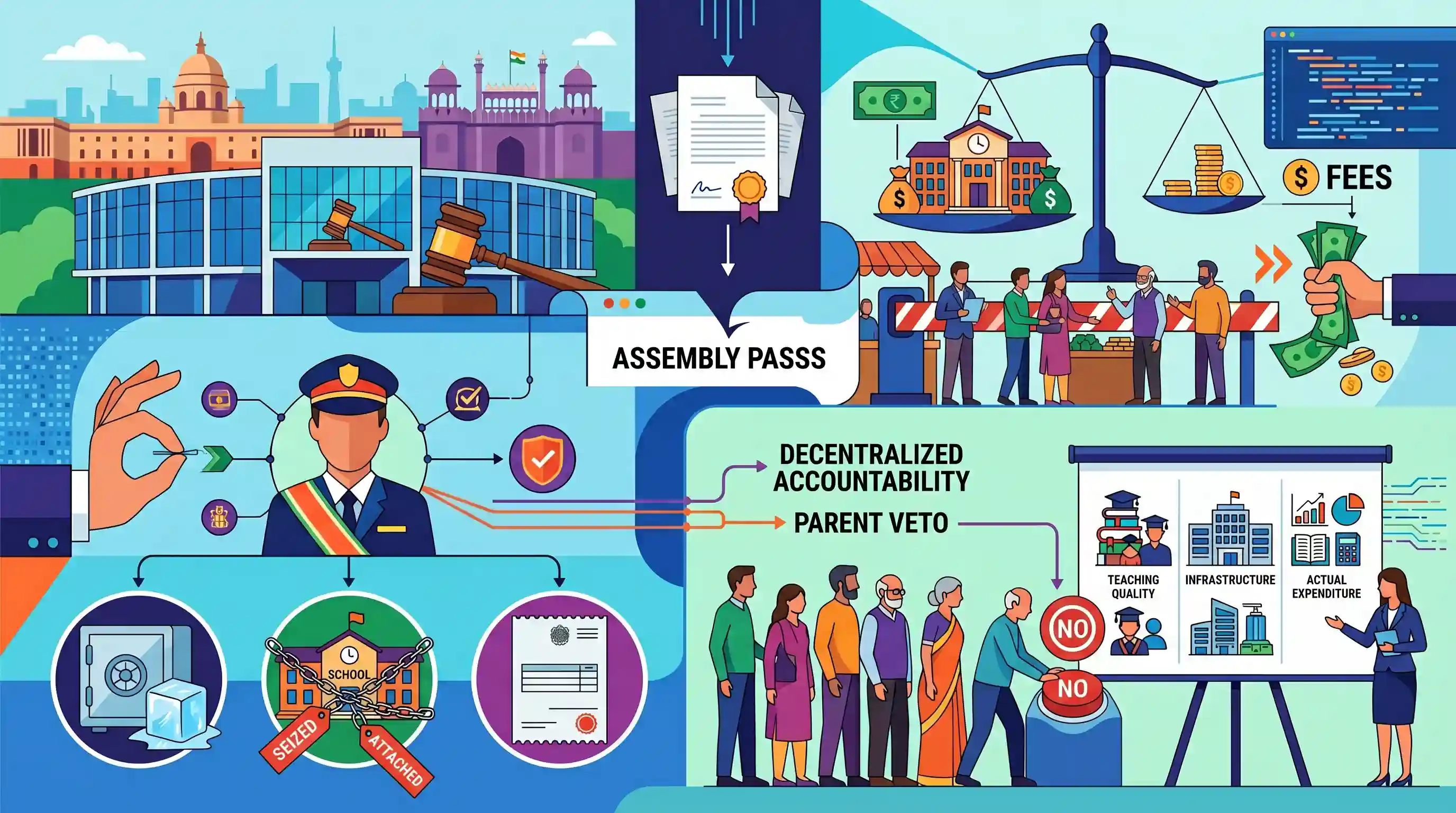
The Delhi Assembly has passed the Delhi School Education (Fee Determination and Transparency in Regulation) Bill, 2025, aiming to curb arbitrary fee hikes and prevent the commercialization of education across 1,733 private schools. To enforce strict compliance, the legislation endows the Director of Education with powers equivalent to a Sub-Divisional Magistrate (SDM), enabling them to freeze bank accounts and attach properties of violating institutions. It also mandates heavy fines for defaults. Crucially, the Bill decentralizes accountability by empowering parents with veto rights over fee increments and mandating that schools justify any hikes based on concrete parameters such as teaching quality, infrastructure, and actual expenditure.
मुख्य बिंदु
- The Delhi Assembly passed a Bill to regulate fees in 1,733 private schools to prevent arbitrary hikes and improve educational affordability.
- यह विधेयक निजी स्कूलों पर लागू होता है, जिनमें दिल्ली विकास प्राधिकरण (DDA) द्वारा रियायती दरों पर प्रदान की गई भूमि पर निर्मित स्कूल भी शामिल हैं।
- The Director of Education is granted Sub-Divisional Magistrate (SDM) level powers to take strict action against non-compliant schools, such as freezing bank accounts and attaching properties.
- Violating schools will face heavy fines ranging from Rs 1 lakh to Rs 10 lakh, which will double in cases of delayed payment.
- अभिभावकों को प्रस्तावित शुल्क वृद्धि पर वीटो पावर (निषेधाधिकार) दी गई है, और स्कूलों को स्थान, सुविधाओं, व्यय और शिक्षण की गुणवत्ता के आधार पर किसी भी वृद्धि का औचित्य सिद्ध करना होगा।
महत्वपूर्ण शब्द
दिल्ली स्कूल शिक्षा (शुल्क निर्धारण और विनियमन में पारदर्शिता) विधेयक, 2025

दिल्ली के निजी स्कूलों में मनमानी फीस वृद्धि पर अंकुश लगाने के उद्देश्य से लाया गया वर्ष 2025 का एक कानून, जो सरकार की पूर्व अनुमति और व्यय, बुनियादी ढांचे (infrastructure) तथा शिक्षण गुणवत्ता के आधार पर औचित्य को अनिवार्य बनाता है।
UPSC context
GS Paper 2: Issues relating to Education, Governance, and Government Policies. Tests understanding of regulatory interventions in social sectors.
Commercialization of Education
वह प्रक्रिया जहाँ लाभ कमाने के उद्देश्य शिक्षा को एक 'लाभ-निरपेक्ष' (not-for-profit) सामाजिक वस्तु मानने के संवैधानिक दृष्टिकोण पर हावी हो जाते हैं, जिससे अक्सर कैपिटेशन शुल्क (capitation fees) और मनमाना शुल्क निर्धारण जैसी स्थितियाँ पैदा होती हैं।
UPSC context
GS Paper 2: Social Justice; Ethics (GS Paper 4). Tests ability to balance institutional autonomy with public accountability.
त्रि-स्तरीय शुल्क निगरानी प्रणाली
A regulatory framework established by the 2025 Bill consisting of school-level, district-level, and state-level (Revision) committees to oversee fee structures and resolve disputes.
UPSC context
GS Paper 2: Statutory and Regulatory Bodies. Tests knowledge of decentralized governance and administrative grievance redressal mechanisms.
Director of Education (DoE) Delhi
दिल्ली शिक्षा विभाग के प्रशासनिक प्रमुख, जिन्हें 2025 के विधेयक द्वारा अनुपालन न करने की स्थिति में खातों को फ्रीज करने और संपत्ति कुर्क करने हेतु अर्ध-न्यायिक शक्तियां (SDM-स्तर की) प्रदान की गई हैं।
UPSC context
GS Paper 2: Executive and Judiciary. Tests understanding of the delegation of quasi-judicial powers to administrative officers.
अभिभावकीय वीटो शक्ति
2025 के विधेयक में एक विशिष्ट प्रावधान जो स्कूल समितियों में अभिभावक प्रतिनिधियों को अनुचित शुल्क वृद्धि को रोकने की अनुमति देता है, जिससे निजी संस्थानों की समुदाय-संचालित निगरानी सुनिश्चित होती है।
UPSC context
GS पेपर 2: नागरिक चार्टर और NGOs/नागरिक समाज की भूमिका। सहभागी शासन और हितधारकों के सशक्तीकरण के ज्ञान का परीक्षण करता है।
प्रारंभिक ट्रैप
Private unaided schools have absolute autonomy over fee structures under Article 19(1)(g), immune from State regulation.
The Supreme Court (T.M.A. Pai case) allows autonomy for a 'reasonable surplus', but explicitly permits State regulation to prevent profiteering and capitation fees.
संबंधित अवधारणाएँ
What is the constitutional framework governing the regulation of private unaided schools?
- समवर्ती सूची: शिक्षा समवर्ती सूची (प्रविष्टि 25) में है, जो केंद्र और राज्यों दोनों को नियामक कानून बनाने की अनुमति देती है।
- अनुच्छेद 19(1)(g): The Supreme Court ruled that establishing educational institutions falls under the right to practice any profession.
- युक्तियुक्त निर्बंधन: The State can impose regulations under Article 19(6) to prevent commercialization, capitation fees, and profiteering.
What does Section 13 of the RTE Act, 2009 explicitly prohibit?
- कैपिटेशन शुल्क पर रोक: स्कूलों को किसी भी प्रकार के कैपिटेशन शुल्क या बिना रसीद वाले दान की वसूली से सख्ती से प्रतिबंधित किया गया है।
- कोई स्क्रीनिंग नहीं: प्रवेश प्रक्रिया के दौरान बच्चों या अभिभावकों के लिए किसी भी स्क्रीनिंग प्रक्रिया, साक्षात्कार या परीक्षण को प्रतिबंधित करता है।
- वित्तीय दंड: उल्लंघन के लिए भारी जुर्माने का प्रावधान है, जो वसूली गई कैपिटेशन फीस के 10 गुना तक हो सकता है।
अंतर-विषय पैटर्न
अनुच्छेद 19(1)(g) बनाम कल्याणकारी राज्य
The friction between private educational autonomy and State efforts to prevent profiteering is a recurring theme in GS2 social sector and governance questions.
समुदाय-संचालित विनियमन मॉडल
अभिभावकों को शुल्क पर वीटो पावर देना RTE की स्कूल प्रबंधन समितियों (SMCs) में देखे गए विकेंद्रीकरण को दर्शाता है, जो सामुदायिक भागीदारी को सीधे जवाबदेही से जोड़ता है।

GS2 मुख्य परीक्षा में निजी स्कूलों की स्वायत्तता और मुनाफाखोरी पर अंकुश लगाने के लिए राज्य के विनियमन के बीच संवैधानिक संतुलन का मूल्यांकन करने वाले प्रश्न की अपेक्षा करें।
संबद्ध PYQ · 4
संबद्ध PYQ · 4
- 2022MainsGS2
The Right of Children to Free and Compulsory Education Act, 2009 remains inadequate in promoting incentive-based system for children's education without generating awareness about the importance of schooling. Analyse.
- 2020MainsGS2
National Education Policy 2020 is in conformity with the Sustainable Development Goal-4 (2030). It intends to restructure and reorient education system in India. Critically examine the statement.
- 2015MainsGS2
For achieving the desired objectives, it is necessary to ensure that the regulatory institutions remain independent and autonomous. Discuss in the light of the experiences in recent past.
- 2024MainsGS2
In a crucial domain like the public healthcare system the Indian State should play a vital role to contain the adverse impact of marketisation of the system. Suggest some measures through which the State can enhance the reach of public healthcare at the grassroots level.
