Delhi Private School Fee Regulation and Educational Accountability
Source:Indian Express ↗
Why It Matters
Provides a crucial case study for GS Paper 2 on how State governments can regulate the private sector to prevent the commercialization of essential services like education. It illustrates decentralized governance by giving parents veto power, and highlights the transfer of quasi-judicial/executive powers (SDM authority) to administrative officials for stricter policy enforcement.
Summary
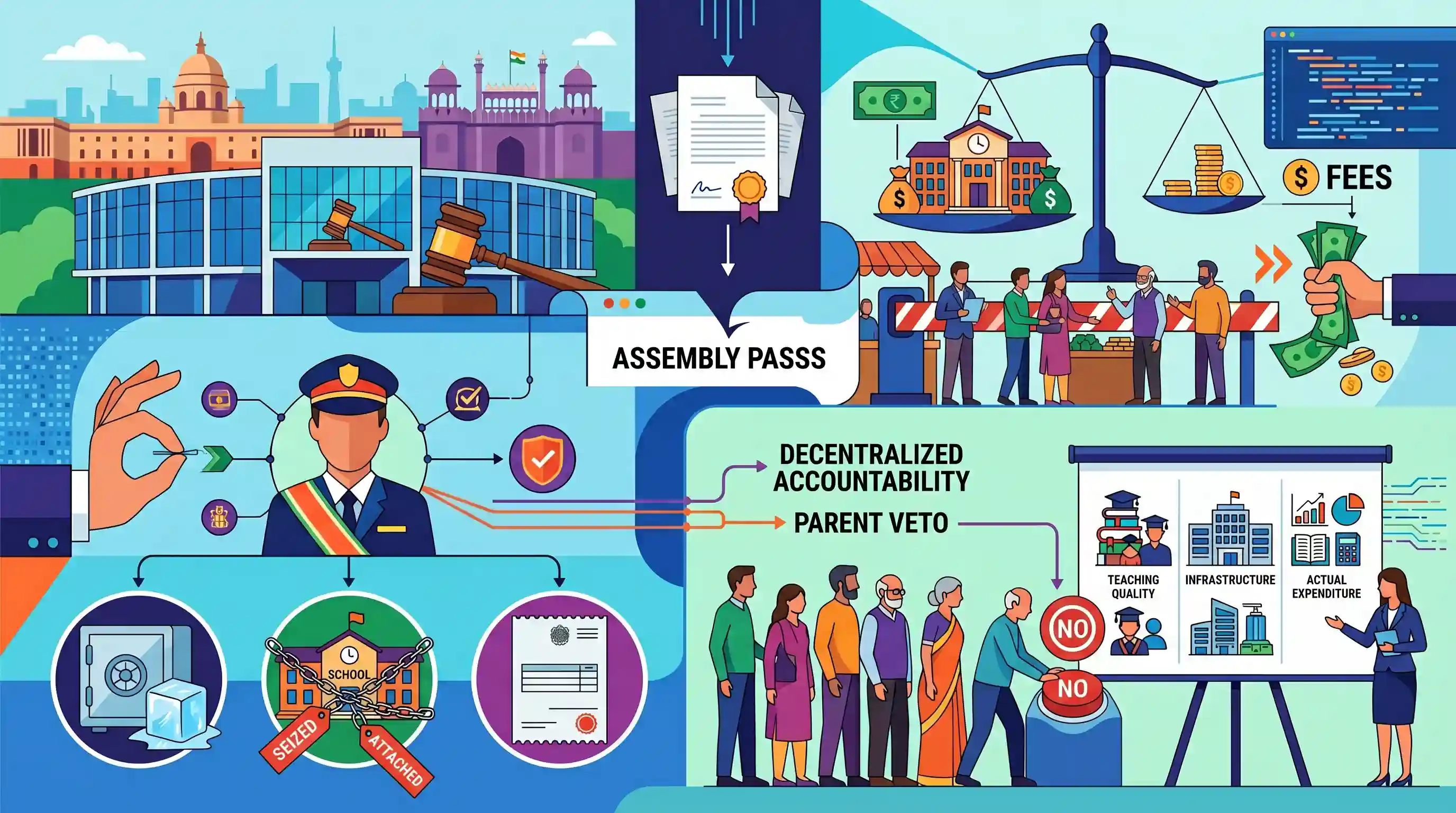
The Delhi Assembly has passed the Delhi School Education (Fee Determination and Transparency in Regulation) Bill, 2025, aiming to curb arbitrary fee hikes and prevent the commercialization of education across 1,733 private schools. To enforce strict compliance, the legislation endows the Director of Education with powers equivalent to a Sub-Divisional Magistrate (SDM), enabling them to freeze bank accounts and attach properties of violating institutions. It also mandates heavy fines for defaults. Crucially, the Bill decentralizes accountability by empowering parents with veto rights over fee increments and mandating that schools justify any hikes based on concrete parameters such as teaching quality, infrastructure, and actual expenditure.
Key Points
- The Delhi Assembly passed a Bill to regulate fees in 1,733 private schools to prevent arbitrary hikes and improve educational affordability.
- The Bill applies to private schools, including those built on land provided at concessional rates by the Delhi Development Authority (DDA).
- The Director of Education is granted Sub-Divisional Magistrate (SDM) level powers to take strict action against non-compliant schools, such as freezing bank accounts and attaching properties.
- Violating schools will face heavy fines ranging from Rs 1 lakh to Rs 10 lakh, which will double in cases of delayed payment.
- Parents are granted veto powers over proposed fee hikes, and schools must justify any increase based on location, facilities, expenditure, and teaching quality.
Important Terms
Delhi School Education (Fee Determination and Transparency in Regulation) Bill, 2025

A 2025 legislation aimed at curbing arbitrary fee hikes in Delhi's private schools by mandating prior government approval and justification based on expenditure, infrastructure, and teaching quality.
UPSC context
GS Paper 2: Issues relating to Education, Governance, and Government Policies. Tests understanding of regulatory interventions in social sectors.
Commercialization of Education
The process where profit-seeking motives override the constitutional vision of education as a 'not-for-profit' social good, often leading to capitation fees and arbitrary pricing.
UPSC context
GS Paper 2: Social Justice; Ethics (GS Paper 4). Tests ability to balance institutional autonomy with public accountability.
Three-tier Fee Oversight System
A regulatory framework established by the 2025 Bill consisting of school-level, district-level, and state-level (Revision) committees to oversee fee structures and resolve disputes.
UPSC context
GS Paper 2: Statutory and Regulatory Bodies. Tests knowledge of decentralized governance and administrative grievance redressal mechanisms.
Director of Education (DoE) Delhi
Administrative head of the Delhi Education Department, endowed by the 2025 Bill with quasi-judicial powers (SDM-level) to freeze accounts and attach property for non-compliance.
UPSC context
GS Paper 2: Executive and Judiciary. Tests understanding of the delegation of quasi-judicial powers to administrative officers.
Parental Veto Power
A specific provision in the 2025 Bill allowing parent representatives in school committees to block unjustified fee increases, ensuring community-driven oversight of private institutions.
UPSC context
GS Paper 2: Citizens' Charters and Role of NGOs/Civil Society. Tests knowledge of participatory governance and empowerment of stakeholders.
Prelims Trap
Private unaided schools have absolute autonomy over fee structures under Article 19(1)(g), immune from State regulation.
The Supreme Court (T.M.A. Pai case) allows autonomy for a 'reasonable surplus', but explicitly permits State regulation to prevent profiteering and capitation fees.
Static Concepts Connected
What is the constitutional framework governing the regulation of private unaided schools?
- Concurrent List: Education is in the Concurrent List (Entry 25), allowing both the Centre and States to enact regulatory laws.
- Article 19(1)(g): The Supreme Court ruled that establishing educational institutions falls under the right to practice any profession.
- Reasonable Restrictions: The State can impose regulations under Article 19(6) to prevent commercialization, capitation fees, and profiteering.
What does Section 13 of the RTE Act, 2009 explicitly prohibit?
- No Capitation Fees: Schools are strictly banned from collecting any capitation fee or un-receipted donations.
- No Screening: Bars any screening procedures, interviews, or testing for children or parents during the admission process.
- Financial Penalties: Imposes heavy fines, up to 10 times the capitation fee charged, for violations.
Cross-Topic Patterns
Article 19(1)(g) vs. Welfare State
The friction between private educational autonomy and State efforts to prevent profiteering is a recurring theme in GS2 social sector and governance questions.
Community-driven regulation models
Granting parents veto power over fees mirrors the decentralization seen in RTE's School Management Committees (SMCs), linking community participation directly to accountability.

Expect a Mains GS2 question evaluating the constitutional balance between private school autonomy and state regulation to curb profiteering.
Linked PYQs · 4
Linked PYQs · 4
- 2022MainsGS2
The Right of Children to Free and Compulsory Education Act, 2009 remains inadequate in promoting incentive-based system for children's education without generating awareness about the importance of schooling. Analyse.
- 2020MainsGS2
National Education Policy 2020 is in conformity with the Sustainable Development Goal-4 (2030). It intends to restructure and reorient education system in India. Critically examine the statement.
- 2015MainsGS2
For achieving the desired objectives, it is necessary to ensure that the regulatory institutions remain independent and autonomous. Discuss in the light of the experiences in recent past.
- 2024MainsGS2
In a crucial domain like the public healthcare system the Indian State should play a vital role to contain the adverse impact of marketisation of the system. Suggest some measures through which the State can enhance the reach of public healthcare at the grassroots level.
