VBSA Bill and Higher Education Regulatory Overhaul
Source:The Hindu ↗
Why It Matters
The VBSA Bill represents a landmark shift in the governance of higher education in India, directly implementing key visions of the NEP 2020. Its introduction touches upon several core UPSC themes, including regulatory reforms in social sectors (education), the functioning of Parliamentary Committees (JPC), the separation of regulatory and funding powers, and ongoing debates over federalism versus centralization in concurrent/union list subjects.
Summary
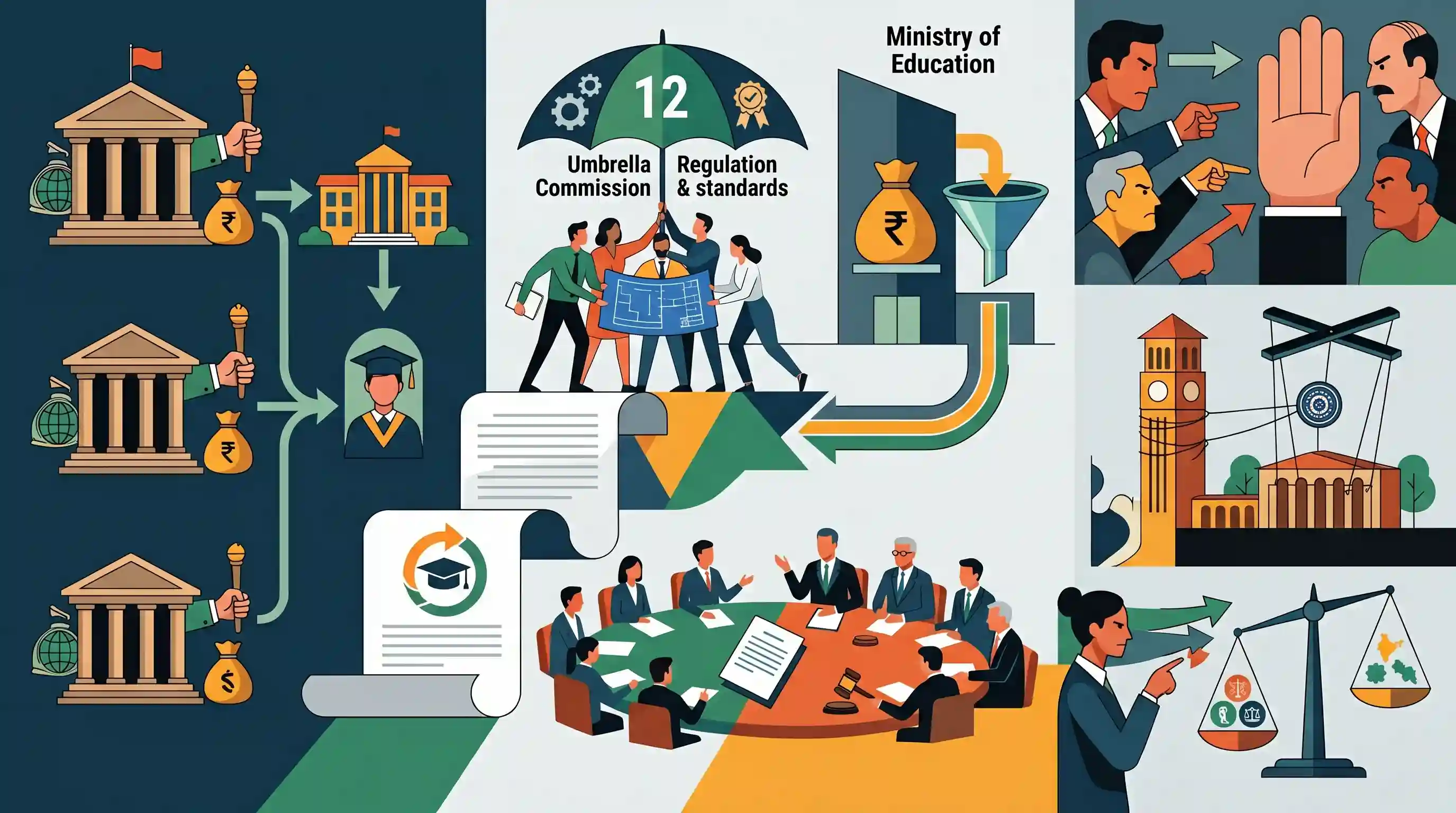
The Union government has circulated the draft Viksit Bharat Shiksha Adhishthan (VBSA) Bill, 2025 among 39 Ministries and departments for discussion, as informed to a Joint Parliamentary Committee (JPC) reviewing the legislation. The Bill aims to overhaul India's higher education sector by establishing a 12-member umbrella commission that will replace existing regulators like the UGC, AICTE, and NCTE. Notably, to avoid conflicts of interest, the new body will not hold grant disbursal powers—these will shift to the Ministry of Education. While rooted in the NEP 2020 and framed under Entry 66 of the Union List, the Bill has drawn criticism from the Opposition for allegedly promoting executive overreach, threatening institutional autonomy, and compromising federalism.
Key Points
- The Viksit Bharat Shiksha Adhishthan (VBSA) Bill, 2025 proposes to replace the UGC, AICTE, and NCTE with a single 12-member umbrella commission for higher education.
- Unlike the UGC, the new commission will lack grant disbursal powers, which will now be handled through mechanisms established by the Ministry of Education.
- The proposed overhaul has roots in the NEP 2020 and is introduced under Entry 66 of the Union List (Seventh Schedule).
- The Bill is being scrutinized by a 31-member Joint Parliamentary Committee (JPC) headed by BJP MP D. Purandeswari, alongside ongoing inter-ministerial consultations involving 39 ministries and departments.
- Opposition parties have raised concerns about executive overreach, intrusive compliance, severe penalties, and the infringement of federal principles.
Important Terms
Viksit Bharat Shiksha Adhishthan (VBSA) Bill, 2025

Proposed legislation to establish a unified higher education regulator, replacing existing bodies like UGC and AICTE. It separates academic regulation from funding, shifting grant-disbursal powers to the Ministry of Education.
UPSC context
GS Paper II/Social Justice: Important for questions on educational reforms, regulatory overreach, and federalism concerns.
Viksit Bharat Shiksha Adhishthan (VBSA)
The proposed 12-member apex commission overseeing higher education. It functions through three specialized councils—Regulatory, Accreditation, and Standards—to ensure academic excellence and coordinated growth across institutions.
UPSC context
GS Paper II/Governance: Understanding the institutional architecture and the "single regulator" model.
Entry 66 of the Union List
A constitutional provision in the Seventh Schedule (List I) granting the Union exclusive power to coordinate and determine standards in higher education, research, and scientific/technical institutions.
UPSC context
GS Paper II/Polity: Tests knowledge of legislative competence and the federal division of powers.
National Education Policy (NEP), 2020
India's current policy framework envisioning a "light but tight" regulatory system. It advocates for a single regulator to promote multidisciplinary research, institutional autonomy, and global standards.
UPSC context
GS Paper II/Social Sector: The foundational policy for all contemporary education reforms.
Joint Parliamentary Committee (JPC)
An ad-hoc committee of members from both Houses of Parliament formed to scrutinize specific bills or public issues. It ensures bipartisan oversight and detailed technical examination of complex legislation.
UPSC context
GS Paper II/Polity: Essential for understanding parliamentary procedures and executive accountability.
University Grants Commission (UGC)
A statutory body established in 1956 to coordinate and maintain standards in university education. Its grant-disbursement and regulatory functions are set to be overhauled under the VBSA Bill.
UPSC context
GS Paper II/Governance: Historical and current context of educational regulation in India.
Prelims Trap
"The VBSA will act as the single nodal body for both standard-setting and grant disbursal to universities."
The VBSA is deliberately stripped of grant disbursal powers to avoid conflicts of interest. Funding will shift directly to the Ministry of Education.
Static Concepts Connected
How is "Education" divided under the Seventh Schedule of the Constitution?
- Entry 25 (Concurrent List): Moved to the Concurrent List by the 42nd Amendment (1976). Covers general education, technical education, medical education, and universities.
- Entry 66 (Union List): Grants the Centre exclusive power over the "coordination and determination of standards in institutions for higher education or research". This overrides state laws.
What are the powers and functions of a Joint Parliamentary Committee (JPC)?
- Ad-hoc Formation: Set up by a motion adopted in one House and agreed to by the other, specifically to examine complex bills or investigate serious irregularities.
- Bicameral Composition: Typically comprises members from both Lok Sabha and Rajya Sabha (usually in a 2:1 ratio) to ensure broad representation.
- Advisory Authority: Can summon witnesses and demand documents, but its final recommendations on a Bill are advisory and not strictly binding on the government.
Cross-Topic Patterns
Federal friction in Concurrent subjects
The VBSA Bill parallels disputes in agriculture and cooperation, where the Centre uses specific Union List entries to assert dominance over broadly Concurrent subjects, sparking federalism debates.
Separating regulatory and funding powers
Stripping VBSA of grant-disbursal aligns with India's broader governance reform trend of decoupling standard-setting from funding (seen in the National Medical Commission) to prevent conflicts of interest.

Expect a 2026 Prelims question mixing the VBSA's lack of funding powers with the constitutional nuance of Entry 66 vs Entry 25.
Linked PYQs · 4
Linked PYQs · 4
- 2020MainsGS2
National Education Policy 2020 is in conformity with the Sustainable Development Goal-4 (2030). It intends to restructure and reorient education system in India. Critically examine the statement.
- 2015MainsGS2
The quality of higher education in India requires major improvements to make it internationally competitive. Do you think that the entry of foreign educational institutions would help improve the quality of higher and technical education in the country? Discuss.
- 2021MainsGS2
Do Department-related Parliamentary Standing Committees keep the administration on its toes and inspire reverence for parliamentary control? Evaluate the working of such committees with suitable examples.
- 2024MainsGS2
What changes has the Union Government recently introduced in the domain of Centre-State relations ? Suggest measures to be adopted to build the trust between the Centre and the States and for strengthening federalism.
