Real Time Governance and Digital Public Service Delivery
Source:The Hindu ↗
Why It Matters
The article provides a practical case study (RTGS in Andhra Pradesh) of successful e-governance implementation at the state level. It is highly relevant for GS Paper 2 (E-governance applications, models, successes) and GS Paper 3 (Applications of AI in healthcare and agriculture) for Mains answer writing.
Summary
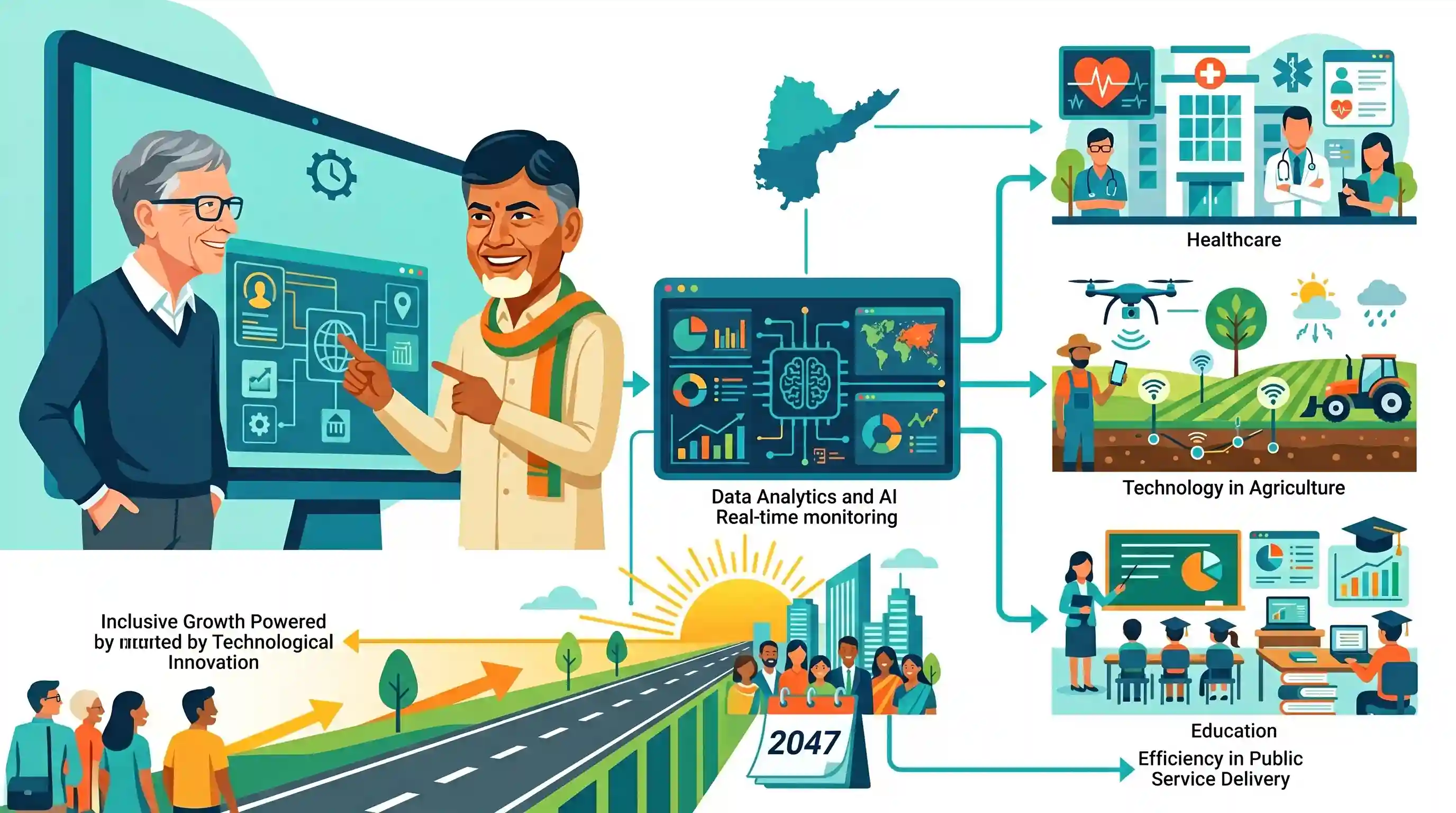
Bill Gates commended the Andhra Pradesh government’s tech-driven approach to public administration, specifically praising its Real Time Governance System (RTGS). Chief Minister N. Chandrababu Naidu showcased how the state utilizes data analytics and artificial intelligence for real-time monitoring and efficient public service delivery across vital sectors like healthcare, agriculture, and education. The meeting also discussed the 'Swarna Andhra Vision 2047' roadmap, emphasizing inclusive growth powered by technological innovation.
Key Points
- Bill Gates praised the Andhra Pradesh government for its tech-driven governance and public service delivery models.
- The state showcased its Real Time Governance System (RTGS), highlighting real-time monitoring, data-driven decision-making, and transparency.
- Discussions focused on leveraging artificial intelligence and modern technology to boost outcomes in healthcare, agriculture, and education.
- The state's long-term developmental roadmap, 'Swarna Andhra Vision 2047', was also presented as a model for technology-based inclusive growth.
Important Terms
Real Time Governance System (RTGS)

An e-governance framework leveraging data analytics, IoT, and real-time monitoring to enhance public service delivery, grievance redressal, and disaster management through a centralized state-level control room.
UPSC context
GS Paper 2: Governance (e-governance models). Tests understanding of technology's role in improving administrative transparency and accountability.
Swarna Andhra Vision 2047
A strategic developmental roadmap aiming to transform Andhra Pradesh into a high-income, inclusive, and sustainable state by 2047, aligning with the national 'Viksit Bharat' vision.
UPSC context
GS Paper 2 & 3: Developmental Policies and Economic Planning. Relevant for questions on long-term state-level planning and inclusive growth strategies.
Bill & Melinda Gates Foundation
A global philanthropic organization partnering with governments to improve healthcare, agriculture, and education through technological innovation, such as AI-driven diagnostics and precision farming.
UPSC context
GS Paper 2: Role of NGOs and International Foundations. Tests the impact of private-public partnerships (PPP) in social sector development.
e-Governance
The application of information and communication technology (ICT) to provide government services, enhance transparency, and empower citizens through digital platforms like RTGS and e-Seva.
UPSC context
GS Paper 2: Governance. A core syllabus topic focusing on the successes, limitations, and potential of digital administrative reforms in India.
Sanjeevini Project
A flagship digital health initiative in Andhra Pradesh supported by international partners to provide preventive screenings, electronic health records, and low-cost diagnostics to the entire population.
UPSC context
GS Paper 2: Social Justice (Health). Illustrates technology-enabled preventive healthcare models and their implementation at the state level.
Prelims Trap
The Real Time Governance System (RTGS) is a centralized digital public infrastructure launched by MeitY.
Aspirants easily confuse this state-level governance model with a central digital initiative or the RBI's Real Time Gross Settlement (RTGS) payment system.
Static Concepts Connected
What distinguishes 'Real-Time Governance' from standard e-Governance?
- Data Integration: Breaks departmental silos by combining satellite, IoT, and administrative data for instantaneous, cross-sectoral insights.
- Proactive Delivery: Shifts from reactive grievance redressal to predictive interventions, such as automated localized disaster alerts.
- Live Feedback Loops: Continuous monitoring via command-and-control centers enables immediate policy tweaking and resource allocation.
How does e-Technology directly support agricultural crop management?
- Crop Monitoring: Geo-tagging and satellite imagery (e.g., AP's e-Panta) track sowing patterns and assess weather damage accurately.
- Targeted Advisories: Platforms like eSagu provide real-time, farm-specific advisories, reducing input wastage and optimizing yields.
- DBT & Insurance: Digital mapping ensures subsidies and crop insurance payouts (PMFBY) are routed swiftly directly to affected farmers.
Cross-Topic Patterns
State visions anchoring Viksit Bharat
AP’s 'Swarna Andhra 2047' highlights a cooperative federalism trend: states drafting customized long-term tech blueprints to dovetail with national Viksit Bharat targets.
AI health analytics vs Data Privacy
Using AI for real-time disease surveillance in public governance triggers GS-2 privacy debates, testing how the DPDP Act handles state epidemiological tracking.

Expect a 2026 Mains GS-2 question evaluating 'Real-Time Governance' vs traditional e-Governance, using AP's RTGS as a core case study.
Linked PYQs · 5
Linked PYQs · 5
- 2023MainsGS2
e-governance, as a critical tool of governance, has ushered in effectiveness, transparency and accountability in governments. What inadequacies hamper the enhancement of these features ?
- 2024MainsGS2
e-governance is not just about the routine application of digital technology in service delivery process. It is as much about multifarious interactions for ensuring transparency and accountability. In this context evaluate the role of the 'Interactive Service Model' of e-governance.
- 2023MainsGS3
Introduce the concept of Artificial Intelligence (AI). How does Al help clinical diagnosis? Do you perceive any threat to privacy of the individual in the use of Al in healthcare?
- 2023MainsGS3
How does e-Technology help farmers in production and marketing of agricultural produce? Explain it.
- 2025MainsGS2
e-governance projects have a built-in bias towards technology and back-end integration than user-centric designs. Examine.
