High level diplomatic visit to enhance bilateral cooperation
Source:Indian Express ↗
Why It Matters
The India-Israel strategic partnership is a major pillar of India's foreign policy, directly impacting domestic priorities like defense modernization, water security, and agricultural productivity. It also illustrates India's independent and pragmatic foreign policy approach in complex geopolitical regions.
Summary
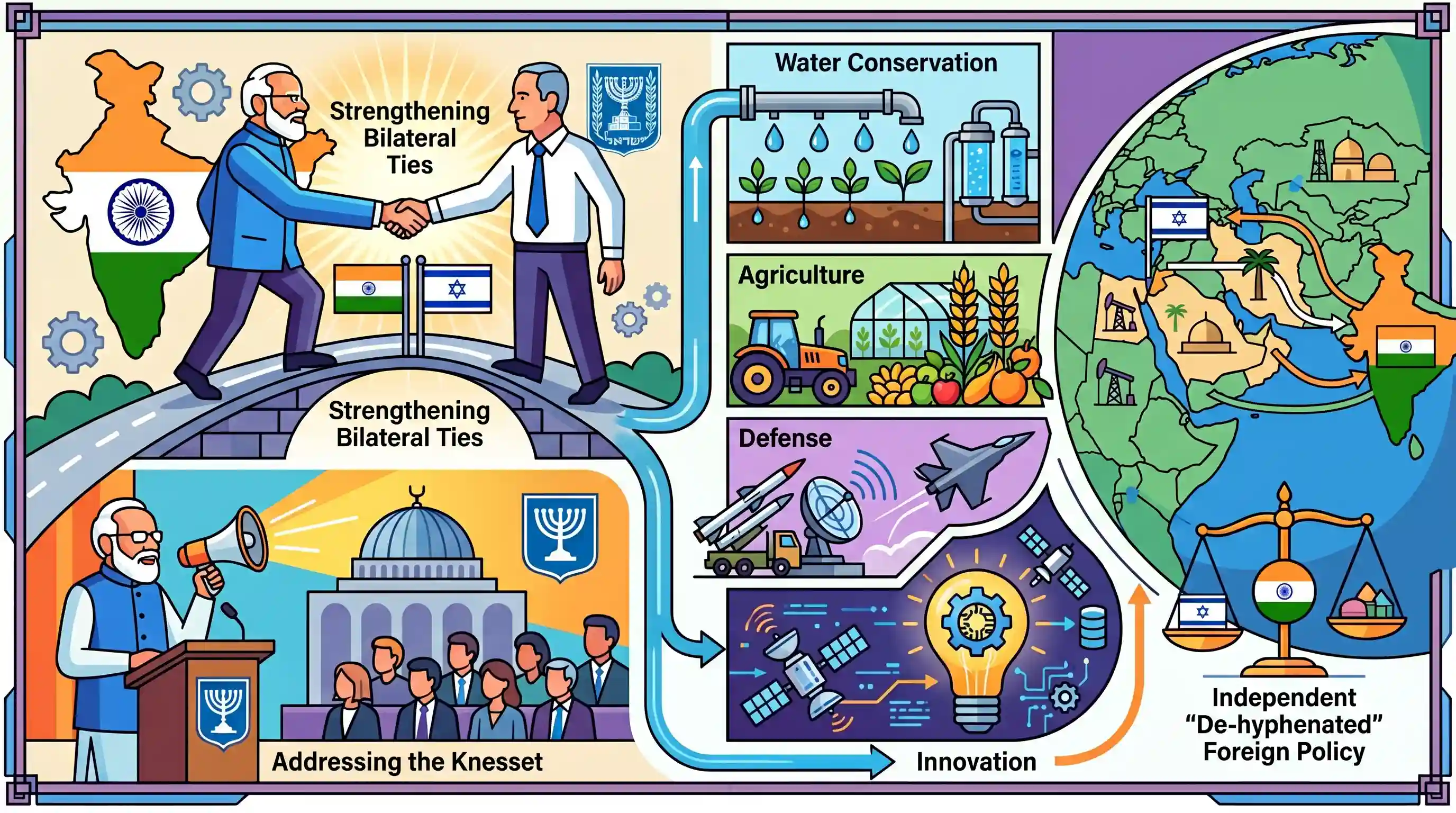
Prime Minister Narendra Modi’s historic visit to Israel, the first by an Indian premier, underscores a significant strengthening of bilateral ties. During the 48-hour mission, which includes addressing the Knesset, discussions will focus on signing pacts across key sectors such as defense, agriculture, water conservation, and innovation. The visit reflects India's robust strategic partnership with Israel and its continued pursuit of a 'de-hyphenated' foreign policy in the Middle East, treating its relationship with Israel on its own independent merits.
Key Points
- Prime Minister Narendra Modi's historic visit makes him the first Indian premier to visit Israel, highlighting a confident shift in bilateral relations.
- The visit features an address to the Knesset (Israel's parliament), underscoring democratic linkages and strong political ties.
- Bilateral talks and pacts are expected to focus heavily on defense cooperation, agriculture, water management, counter-terrorism, and technological innovation.
- The visit further cements India's 'de-hyphenation' policy, allowing it to pursue strategic interests with Israel independent of its traditional stance on Palestine.
Important Terms
De-hyphenated Foreign Policy

A foreign policy approach where India deals with two rival nations (Israel and Palestine) as separate, independent bilateral entities based on merit and national interest rather than linking them.
UPSC context
GS-2: International Relations. Tests understanding of India's pragmatic shift in West Asia and the balancing of ideological vs. strategic interests.
Knesset
The unicameral national parliament of Israel, consisting of 120 members. It is the supreme legislative body responsible for enacting laws and electing the President and Prime Minister.
UPSC context
GS-2: International Relations/World Legislatures. Significant as the venue for historic diplomatic addresses by visiting heads of state to signal bilateral trust.
West Asia
A diverse region encompassing the Middle East that is critical to India for energy security, trade, and the welfare of its approximately 8-9 million strong diaspora.
UPSC context
GS-2: International Relations. Core area for 'Look West' policy and analyzing India’s ability to navigate regional rivalries (Iran-Saudi-Israel).
I2U2 Grouping
A strategic grouping of India, Israel, the UAE, and the US (often called the 'West Asian Quad') focused on joint investments in water, energy, transportation, and food security.
UPSC context
GS-2: Bilateral and Regional Groupings. Important for analyzing new plurilateral architectures and India’s growing influence in the Middle East.
Strategic Partnership
A high-level formal relationship between nations involving deep cooperation in sensitive sectors like defense, intelligence sharing, counter-terrorism, and high-end technology.
UPSC context
GS-2: International Relations. Tests the distinction between transactional ties and long-term, multi-sectoral security and developmental cooperation.
Prelims Trap
India officially recognized the State of Israel in 1992 when diplomatic ties were established.
India officially recognized Israel in 1950, but full diplomatic relations (embassies) were only established in 1992. Aspirants frequently conflate these two distinct historical milestones.
Static Concepts Connected
What defines India's 'de-hyphenation' policy in West Asia?
- Independent Merits: Treating relations with Israel and Palestine independently, rather than viewing one through the lens of the other.
- Strategic Autonomy: Allows India to maintain robust defense and tech ties with Israel while continuing to support a negotiated two-state solution for Palestine.
Which key defence and agricultural technologies are co-developed with Israel?
- Barak-8 MRSAM: A Medium-Range Surface-to-Air Missile system co-developed by India's DRDO and Israel Aerospace Industries (IAI).
- Phalcon AWACS: Israeli advanced airborne warning and control radar systems mounted on Russian IL-76 aircraft, acting as critical force multipliers for India.
- Centers of Excellence: Agricultural hubs established under the Indo-Israel Agricultural Project (IIAP) to transfer micro-irrigation and protected cultivation tech to Indian farmers.
Cross-Topic Patterns
I2U2 Grouping and West Asia Geopolitics
Deepening India-Israel bilateral ties form the foundation for mini-lateral frameworks like I2U2 (India, Israel, UAE, US), blending strategic partnerships with economic and tech cooperation.
GS3 Agriculture meets GS2 Diplomacy
Israel’s expertise in desalinization and micro-irrigation directly addresses India's water stress and agricultural productivity goals, a recurring theme in Mains GS3.

Expect a 2026 prelims question mixing India-Israel defence tech (Barak-8) and agricultural CoEs with I2U2's regional framework.
Linked PYQs · 1
Linked PYQs · 1
- 2018MainsGS2
“India’s relations with Israel have, of late, acquired a depth and diversity, which cannot be rolled back.” Discuss.
