Bilaspur train crash and signal passed at danger violations
Source:Indian Express ↗
Why It Matters
Frequent train accidents attributed to human error critically test the infrastructure resilience and disaster preparedness of Indian Railways. It highlights the intersection of technological solutions (like Kavach) and human resource management (pilot fatigue) for GS3 and GS2 Mains answers, as well as Prelims questions on indigenous technology.
Summary
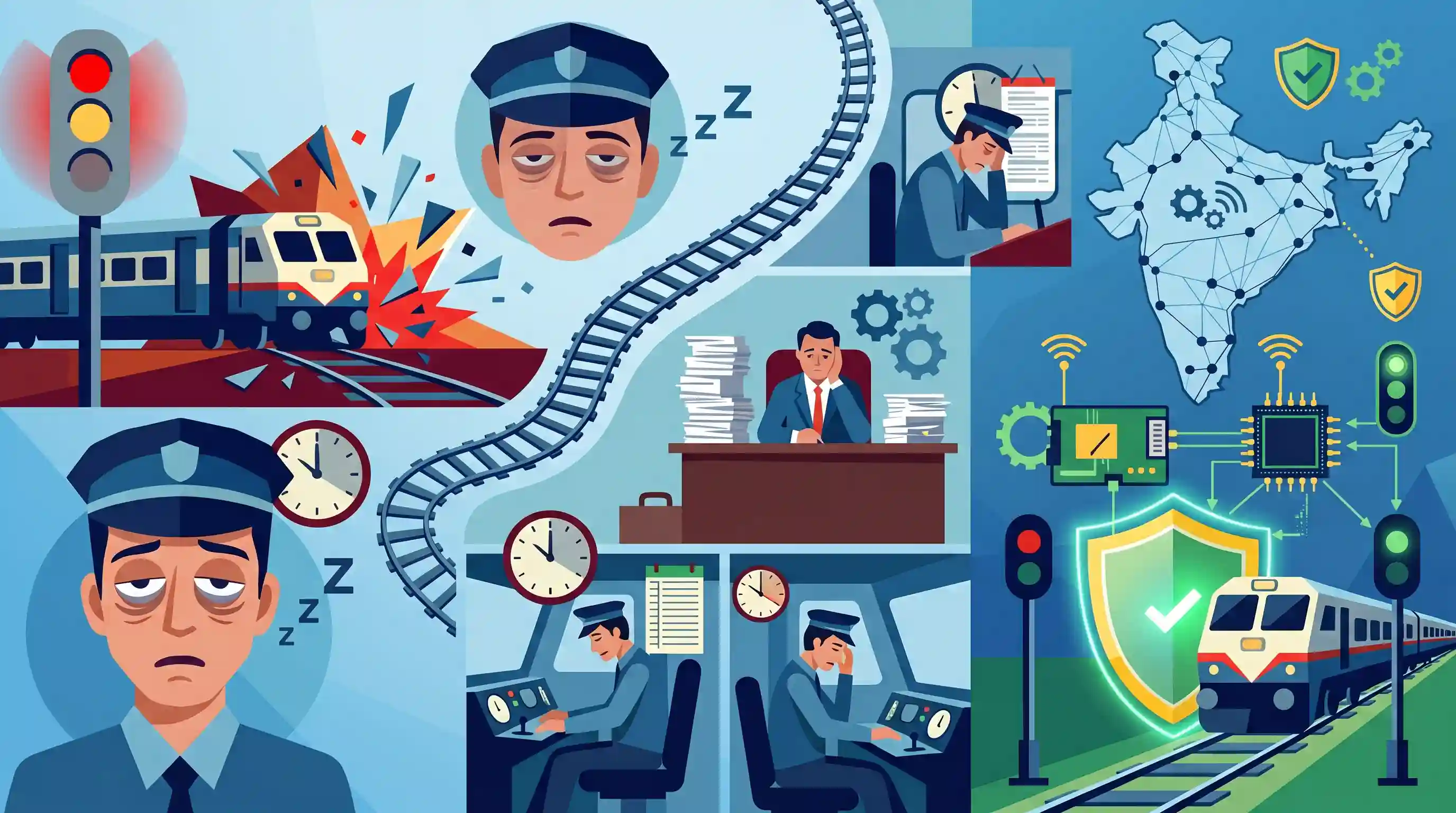
An initial investigation into a fatal train collision in Bilaspur that killed 11 people has attributed the cause to the crew failing to stop at a danger signal. This human error, known in railway parlance as Signal Passed at Danger (SPAD), raises serious concerns about railway safety and the systemic vulnerabilities of manual train operation. The incident strongly highlights the need for the accelerated nationwide rollout of the indigenous Kavach Automatic Train Protection system, which intervenes to prevent collisions when human control fails. Furthermore, it brings to light deeper governance issues regarding the working conditions, chronic fatigue, and rigorous safety training of locomotive pilots in Indian Railways.
Key Points
- An initial report into the Bilaspur train crash, which claimed 11 lives, revealed that the crew failed to control the train at a danger signal, leading to a Signal Passed at Danger (SPAD) incident.
- The tragedy highlights the vulnerability of train operations to human error and underscores the critical need for fail-safe mechanisms like the Kavach Automatic Train Protection (ATP) system.
- Repeated SPAD incidents draw attention to the severe working conditions, fatigue, and stress experienced by locomotive pilots, pointing to necessary administrative reforms in duty rostering.
- The incident exposes infrastructural gaps and re-emphasizes the urgency of rapidly deploying modern automated safety technologies across the entire Indian Railways network to prevent mass-casualty disasters.
Important Terms
Kavach (Automatic Train Protection System)

An indigenous Automatic Train Protection (ATP) system developed by RDSO. It prevents collisions and Signal Passed at Danger (SPAD) by automatically applying brakes if the pilot fails to act.
UPSC context
GS Paper 3: Infrastructure and Technology; tests knowledge of indigenous safety innovations and disaster prevention.
Signal Passed at Danger (SPAD)
A safety violation where a train proceeds beyond a signal showing a red (stop) aspect without authorization, often cited as a primary cause of rail accidents.
UPSC context
GS Paper 3: Infrastructure; critical for understanding human-error factors and technical safety benchmarks in transportation.
Commission of Railway Safety (CRS)
A statutory body under the Ministry of Civil Aviation that investigates serious train accidents to ensure independence from the Ministry of Railways' administrative influence.
UPSC context
GS Paper 2: Statutory bodies and Governance; tests understanding of institutional independence and safety oversight.
Locomotive Pilot
Railway personnel responsible for train operation. Issues regarding their working conditions—such as chronic fatigue, long shifts, and cabin heat—are central to railway safety and labor reforms.
UPSC context
GS Paper 3: Disaster Management and GS Paper 2: Governance; relates to human factors in infrastructure safety and labor welfare.
Automatic Train Protection (ATP)
A safety system that monitors train speed and signal compliance, automatically intervening to apply brakes if the crew fails to respond to a danger signal.
UPSC context
GS Paper 3: Infrastructure/Science & Technology; fundamental concept for technological interventions in modernizing public transport.
Prelims Trap
"Kavach is an Automatic Train Operation (ATO) system enabling driverless trains."
Kavach is an Automatic Train Protection (ATP) system, not an ATO. It does not drive the train, but intervenes with braking only when the pilot fails.
Static Concepts Connected
How does the Kavach Automatic Train Protection system function?
- SIL-4 Certification: It holds a Safety Integrity Level 4 (SIL-4) certification, denoting the highest level of safety and reliability for electronic railway systems.
- RFID Technology: It relies on Radio Frequency Identification (RFID) tags installed along tracks and station yards to determine train position and direction.
- UHF Radio Comm: Continuous communication between locomotives and stations is maintained via Ultra High Frequency (UHF) radio to trigger automatic braking in emergencies.
What are the key institutional mechanisms governing Indian Railway safety?
- Rashtriya Rail Sanraksha Kosh: A dedicated, non-lapsable fund (created in 2017 with ₹1 lakh crore for 5 years) specifically designated for financing critical safety infrastructure renewals.
- Kakodkar Committee: A 2012 High-Level Safety Review Committee that heavily emphasized minimizing human dependence by shifting to advanced signaling and creating an independent Safety Authority.
- HOER Rules 2005: The Railway Servants (Hours of Work and Period of Rest) Rules cap loco pilot duty hours to prevent fatigue-induced errors like SPAD.
Cross-Topic Patterns
Tech fixes vs. Labor rights
The intersection of technological fixes (Kavach) and human resource limits (HOER rules/fatigue) reflects a classic GS2/GS3 governance challenge: technology alone cannot solve chronic manpower and administrative deficits.
RRSK and Non-lapsable Funds
Like the Central Road Fund (CRF) or Nirbhaya Fund, RRSK’s utilization rates and non-lapsable nature are prime targets for GS3 infrastructure funding and CAG audit questions.

Expect a multi-statement Prelims question combining Kavach's RFID tech, SIL-4 certification, and SPAD definitions in 2026.
Linked PYQs · 3
Linked PYQs · 3
- 2023MainsGS3
Dam failures are always catastrophic, especially on the downstream side, resulting in a colossal loss of life and property. Analyze the various causes of dam failures. Give two examples of large dam failures.
- 2025PrelimsGS1
Consider the following statements : I. Indian Railways have prepared a National Rail Plan (NRP) to create a 'future ready' railway system by 2028. II. 'Kavach' is an Automatic Train Protection system developed in collaboration with Germany. III. 'Kavach' system consists of RFID tags fitted on track in station section. Which of the statements given above are not correct?
- 2025MainsGS2
"In contemporary development models, decision-making and problem-solving responsibilities are not located close to the source of information and execution defeating the objectives of development." Critically evaluate.
