Bikaner Hospital Maternal Death Sparks Inquiry into C Section Safety
Source:hindustantimes ↗
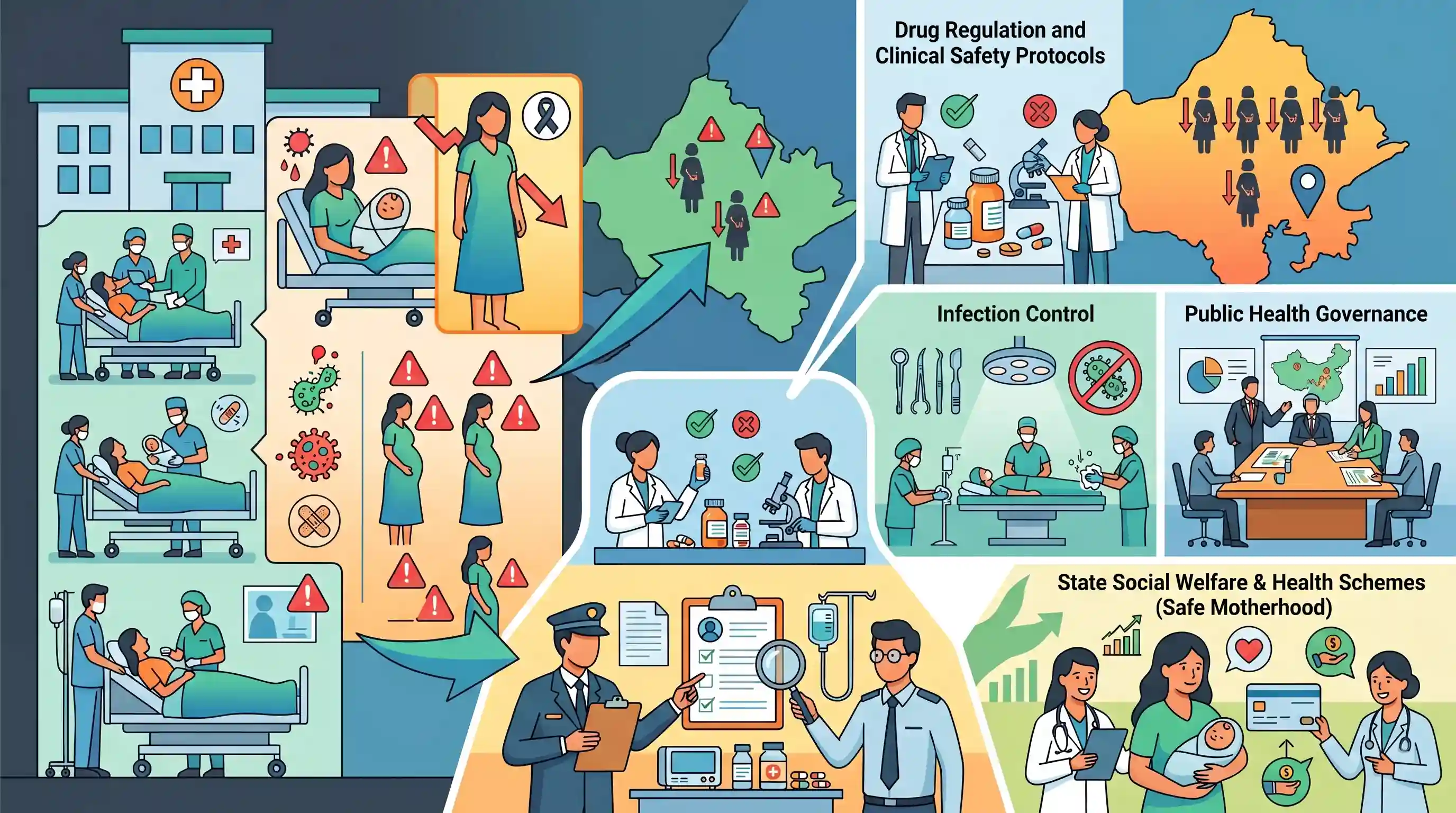
Why It Matters
This incident highlights critical challenges in maternal healthcare safety, infection control, and drug quality standards in public health institutions. In examinations like RPSC RAS, questions are frequently asked on state health indicators (e.g., Maternal Mortality Ratio), safety regulations, and public health schemes (e.g., JSSK, JSY, and medical insurance models).
Summary
A 20-year-old woman died at PBM Hospital in Bikaner, Rajasthan, due to multiple organ failure following a C-section delivery. She was one of six women who suffered post-operative complications like infections and excessive bleeding. This incident, coming soon after five maternal deaths in Kota, has led to multi-level government inquiries to investigate medical safety, infection control, and drug quality issues.
Key Points
- A 20-year-old woman named Preeti died of multiple organ failure at PBM Hospital, Bikaner, after remaining on ventilator support for 20 days due to post-C-section complications.
- Preeti was one of six young women (aged 20 to 27) who suffered from post-operative complications including excessive bleeding, infections, low platelet count, and multi-organ dysfunction.
- Multi-level inquiry committees have been constituted by the hospital administration, Sardar Patel Medical College, and the Rajasthan state government to identify any systemic lapses or contaminated drug issues.
- This tragedy follows a similar incident a month prior where five women died after C-section deliveries at a government hospital in Kota, raising critical concerns about sterile environments and surgical safety protocols in public health institutions.
- The case spotlights the broader policy challenges surrounding institutional delivery safety, drug standard testing, maternal health care quality, and the implementation of mother-child welfare schemes.
Important Terms
Maternal Mortality Ratio (MMR)

The number of maternal deaths per 100,000 live births during a given period, due to causes related to or aggravated by pregnancy or its management (excluding accidental causes).
UPSC context
GS Paper II (Social Justice/Health). Tests demographic concepts, public health achievements, and progress toward Sustainable Development Goal (SDG) 3.1.
Janani Suraksha Yojana (JSY)
A 100% centrally sponsored conditional cash transfer scheme under the National Health Mission (NHM) aimed at reducing maternal and neonatal mortality by promoting institutional deliveries among poor pregnant women.
UPSC context
GS Paper II (Government Schemes/Health). Tests interventions for vulnerable groups and strategies to improve maternal health outcomes.
Janani Shishu Suraksha Karyakram (JSSK)
A national scheme launched in 2011 providing completely free and cashless delivery (including C-section), transport, drugs, and diagnostics for pregnant women and sick infants accessing public health institutions.
UPSC context
GS Paper II (Social Justice/Health). Evaluates safety nets to eliminate out-of-pocket healthcare expenses for maternal and child welfare.
Mukhyamantri Nishulk Dawa Yojana
A landmark state-level health scheme in Rajasthan launched in 2011, providing essential generic medicines, surgical items, and sutures completely free of cost to all patients visiting government hospitals.
UPSC context
GS Paper II (State Schemes/Health Governance). Tests understanding of decentralised welfare models and mechanisms to reduce out-of-pocket health expenditure.
Mukhyamantri Ayushman Arogya Yojana
Rajasthan's universal health insurance scheme (formerly Chiranjeevi Swasthya Bima Yojana) providing cashless medical coverage of up to ₹25 lakh per family annually for secondary and tertiary care.
UPSC context
GS Paper II (Health & Governance). Tests evolution of state health insurance models and public-private partnerships in healthcare.
Prelims Trap
Maternal Mortality Ratio (MMR) is defined as the number of maternal deaths per 100,000 total pregnancies or total births.
MMR is calculated specifically per 100,000 live births. Total births (which includes stillbirths) or total pregnancies are incorrect denominators.
Static Concepts Connected
What is the LaQshya Initiative and its core quality parameters?
- Primary Target: Aims to improve quality of care in Labour Rooms and Maternity Operation Theatres in public health facilities.
- Surgical Infection Limit: Mandates reducing the Surgical Site Infection (SSI) rate in maternity operation theatres to 5% or less.
- Certification Standards: Utilizes National Quality Assurance Standards (NQAS) for certification, awarding bronze, silver, gold, or platinum badges.
How is drug quality regulation divided under the Drugs and Cosmetics Act, 1940?
- Central Jurisdiction: CDSCO controls drug imports, approves new drugs, conducts clinical trials, and sets national safety standards.
- State Jurisdiction: State Licensing Authorities license manufacture, sale, and distribution, and monitor 'Not of Standard Quality' (NSQ) local batches.
Cross-Topic Patterns
Federalism in drug safety regulation
Dual jurisdiction between CDSCO and State Licensing Authorities can lead to regulatory gaps, directly impacting drug safety in state-run maternal healthcare units.
Health infrastructure and SDG 3.1
Sub-national variations in maternal safety show that financial outlays like JSSK must be matched with strict structural audits under LaQshya to achieve SDG targets.

Expect a multi-statement question linking maternal health programs (LaQshya, JSSK) with federal drug regulatory challenges in 2026.
Linked PYQs · 1
Linked PYQs · 1
- 2021RPSC_PRELIMSGS1
Under the Ayushman Bharat Mahatma Gandhi Rajasthan Health Insurance Scheme, the amount provided per family per year in the event of a critical illness health insurance is
