Voter Roll Errors and Institutional Credibility of Election Body
Source:Indian Express ↗
Why It Matters
The integrity of electoral rolls is the bedrock of any functioning democracy. Issues of voter exclusion directly relate to the GS2 syllabus covering the Representation of the People Act and the constitutional mandate of the Election Commission of India. Questions on electoral reforms, ECI's autonomy, and democratic deficits frequently appear in both Prelims and Mains.
Summary
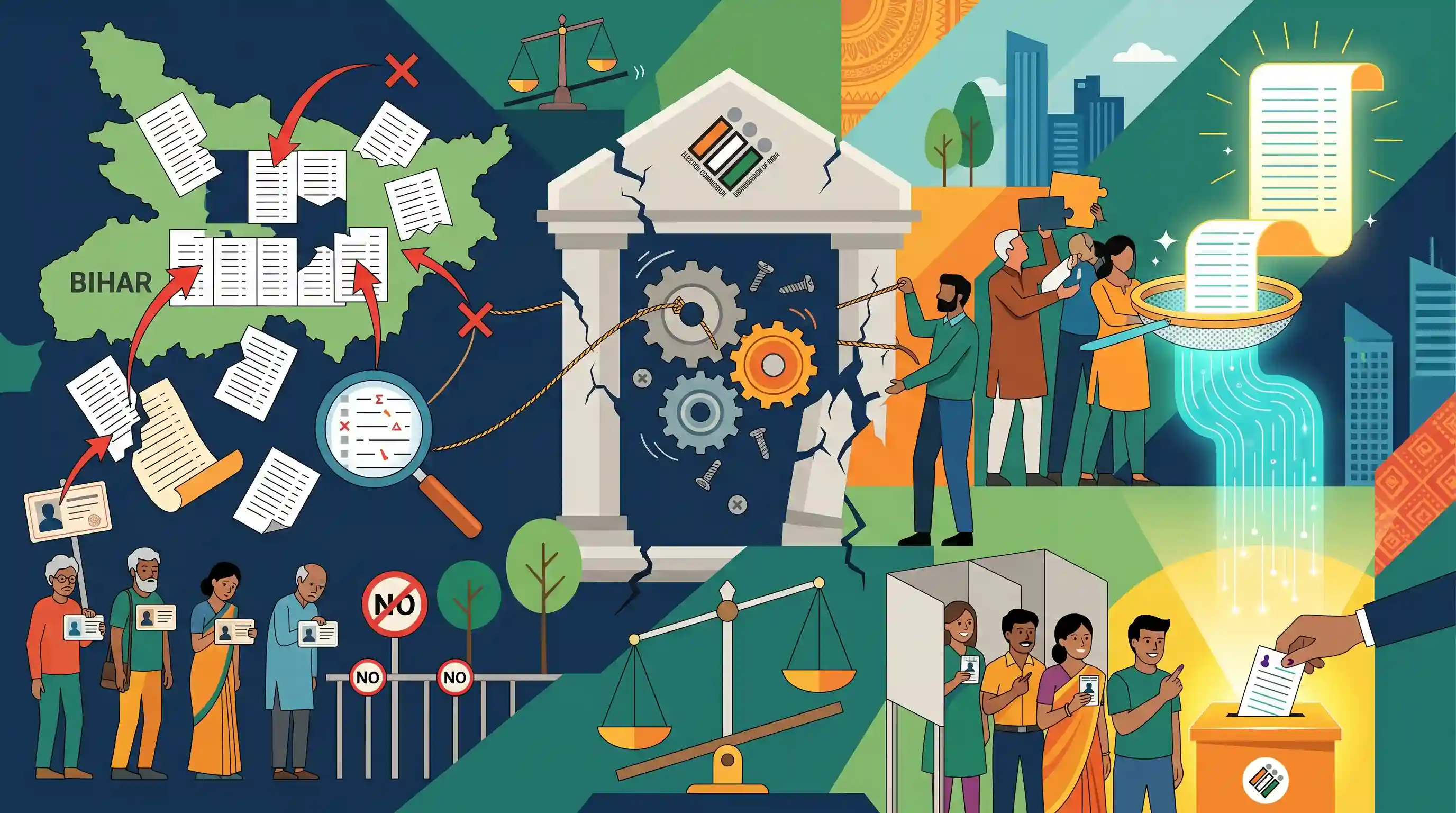
The article discusses the significant exclusions and ambiguities present in Bihar's recently published final voter rolls, highlighting the disenfranchisement of eligible voters. These procedural lapses and inaccuracies in the electoral lists are symptomatic of a broader institutional crisis within the Election Commission of India (ECI). The inability to maintain a flawless voter registry not only deprives citizens of their constitutional right to vote but also casts doubt on the ECI's administrative efficiency and autonomy. The piece emphasizes that ensuring an inclusive and error-free electoral roll is paramount for conducting free and fair elections, thereby calling for necessary electoral reforms to protect democratic integrity.
Key Points
- Significant exclusions and ambiguities have been identified in Bihar's final voter rolls, raising concerns about the disenfranchisement of eligible voters.
- Such discrepancies in the electoral roll undermine the foundational democratic principle of universal adult suffrage and the right to vote.
- The administrative lapses point to a broader institutional crisis within the Election Commission of India (ECI), questioning its efficiency and autonomy.
- Maintaining accurate, transparent, and inclusive voter lists is essential for ensuring free and fair elections, highlighting an urgent need for procedural electoral reforms.
Important Terms
Representation of the People Act, 1950

A landmark law providing for the allocation of seats, delimitation of constituencies, voter qualifications, and the preparation of electoral rolls for Parliamentary and State Legislative elections.
UPSC context
GS Paper II: Statutory bodies and electoral laws. Focuses on the preparatory framework of Indian democracy.
Representation of the People Act, 1951
The primary legislation governing the actual conduct of elections, candidate qualifications/disqualifications, registration of political parties, corrupt practices, and the resolution of electoral disputes.
UPSC context
GS Paper II: Governance and Electoral Reforms. Key for questions on candidate disqualification (Section 8) and election integrity.
Election Commission of India (ECI)
An autonomous constitutional authority (Article 324) responsible for administering Union and State election processes, including the supervision of electoral rolls to ensure free and fair voting.
UPSC context
GS Paper II: Constitutional bodies. Tests understanding of institutional autonomy, administrative efficiency, and challenges in electoral management.
Prelims Trap
The Election Commission of India prepares and maintains the electoral rolls for all elections in India, including Panchayats and Municipalities.
State Election Commissions (SECs) prepare electoral rolls for local bodies under Articles 243K and 243ZA. The ECI only prepares rolls for Parliament and State Legislatures.
Static Concepts Connected
What distinguishes the Representation of the People Acts of 1950 and 1951?
- RPA 1950: Governs the preparation of electoral rolls, delimitation of constituencies, and allocation of seats in Parliament and State Legislatures.
- RPA 1951: Governs the actual conduct of elections, outlines corrupt practices, handles election disputes, and details candidate disqualifications.
Which Constitutional Articles directly govern electoral rolls and the right to vote?
- Article 324: Vests the superintendence, direction, and control of the preparation of electoral rolls entirely in the Election Commission of India.
- Article 325: Mandates one general electoral roll per territorial constituency, prohibiting exclusion based solely on religion, race, caste, or sex.
- Article 326: Establishes universal adult suffrage as the basis for voting rights, legally recognizing the right to vote as a constitutional right.
Cross-Topic Patterns
Voter rolls + Aadhaar integration
The 2021 Election Laws Amendment permitted linking Aadhaar to electoral rolls to prevent duplication, sparking interlinked debates on the Puttaswamy right to privacy and the risk of algorithmic disenfranchisement.
ECI Autonomy + 2023 Appointment Act
Administrative lapses in voter rolls are frequently tied in Mains answers to the structural autonomy of the ECI, a theme amplified by the controversial 2023 CEC and EC Appointment Act.

Expect a multi-statement prelims question contrasting ECI's roll-preparation powers under RPA 1950 with State Election Commission mandates.
Linked PYQs · 5
Linked PYQs · 5
- 2017MainsGS2
To enhance the quality of democracy in India the Election Commission of India has proposed electoral reforms in 2016. What are the suggested reforms and how far are they significant to make democracy successful?
- 2024MainsGS2
Examine the need for electoral reforms as suggested by various committees with particular reference to "one nation one election" principle.
- 2022MainsGS2
Discuss the role of the Election Commission of India in the light of the evolution of the Model Code of Conduct.
- 2017PrelimsGS1
For election to the Lok Sabha, a nomination paper can be filed by
- 2017PrelimsGS1
Right to vote and to be elected in India is a
