Bihar Pradhan Mantri Awas Yojana Rural Housing Allocation
Source:organiser ↗
Why It Matters
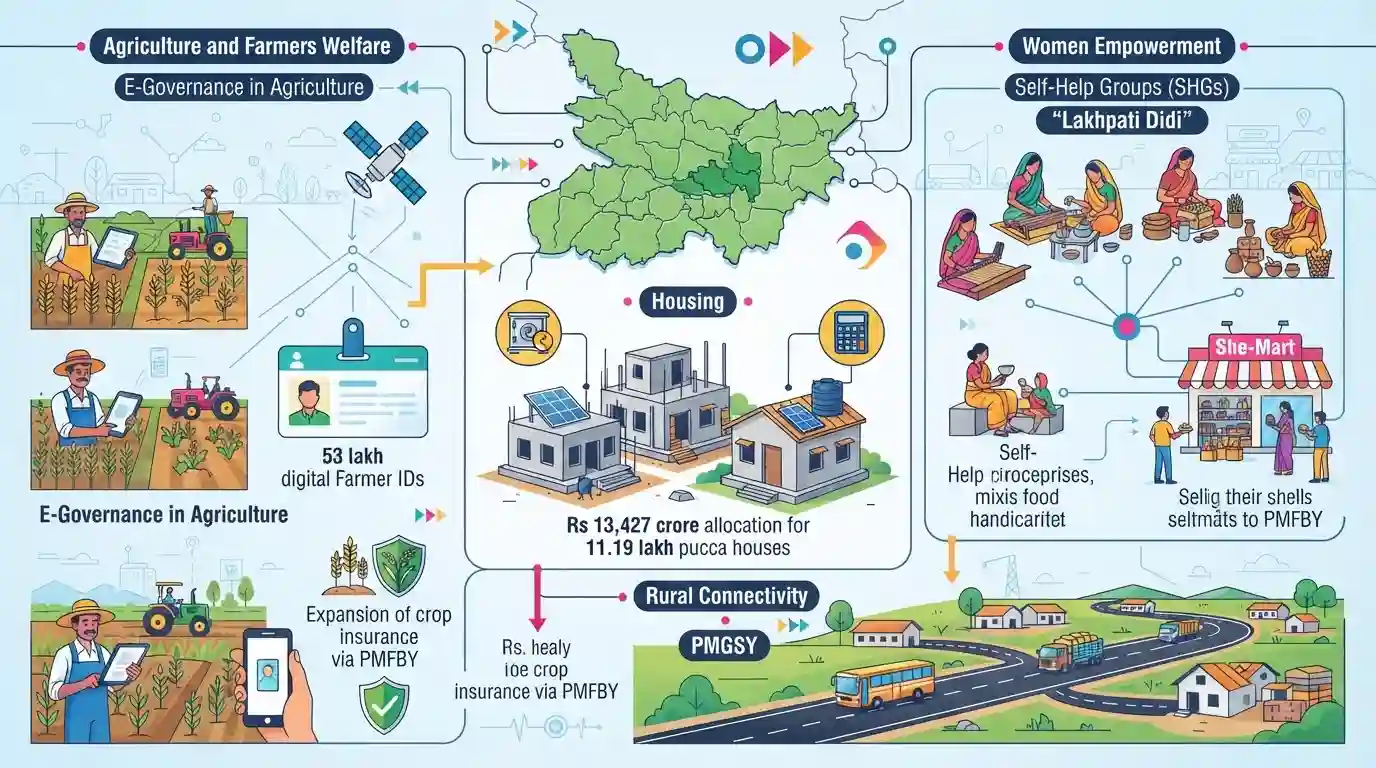
The article highlights a multi-dimensional approach to rural development in Bihar, integrating housing, female entrepreneurship (SHGs/She-Marts), agricultural risk mitigation, and digital governance. It is highly relevant for BPSC Prelims topics on Bihar's socio-economic policies, flagship welfare schemes, and inclusive growth.
Summary
The Union Government has announced a major rural development push in Bihar, allocating Rs 13,427 crore to build 11.19 lakh pucca houses under the Pradhan Mantri Awas Yojana (PMAY). The comprehensive strategy focuses on three pillars: housing, agriculture, and roads. Key initiatives include expanding crop insurance via PMFBY, issuing over 53 lakh digital Farmer IDs to streamline benefit delivery, improving rural connectivity through PMGSY, and empowering women in Self-Help Groups (SHGs). Under the Lakhpati Didi framework, 'She-Marts' are planned in every district to provide dedicated market access for products made by rural women.
Key Points
- 11.19 lakh pucca houses approved for poor families in Bihar under PMAY with a Rs 13,427 crore allocation.
- Focus on rural road connectivity via PMGSY, recognizing housing, roads, and agriculture as rural development pillars.
- Emphasis on PMFBY to provide financial protection against crop losses, alongside the generation of over 53 lakh digital Farmer IDs for transparent scheme delivery.
- Promotion of women's economic empowerment through SHGs and the Lakhpati Didi initiative, including the planned establishment of 'She-Marts' in all districts.
Important Terms
Pradhan Mantri Awas Yojana (PMAY)

A flagship Union government housing scheme aiming to provide pucca houses with basic amenities to eligible rural and urban poor households.
UPSC context
Important for GS Paper 2 (Welfare Schemes). Tests knowledge of rural development, poverty alleviation, and Centre-State fund sharing in Bihar.
Pradhan Mantri Fasal Bima Yojana (PMFBY)
A central crop insurance scheme protecting farmers against financial losses arising from natural calamities, adverse weather conditions, pests, and diseases.
UPSC context
Vital for GS Paper 2 (Agriculture). Crucial for Bihar due to its high vulnerability to recurrent floods and droughts.
She-Marts
Community-owned retail outlets managed by Self-Help Group federations to provide rural women entrepreneurs with dedicated market access for their products.
UPSC context
Highly relevant for GS Paper 2 (Women Empowerment). Tests awareness of micro-enterprise development and livelihood initiatives in Bihar.
Lakhpati Didi
A rural development initiative aiming to enable women in Self-Help Groups to earn a sustainable annual household income of at least ₹1 lakh.
UPSC context
Key for GS Paper 2 (Social Justice). Tests understanding of women-led economic development and financial inclusion strategies in rural areas.
Women's Self-Help Groups (SHGs)
Small, informal associations of women who pool their savings and access credit collectively to start micro-enterprises and achieve financial independence.
UPSC context
Core topic in GS Paper 2 (Governance/NGOs). Essential for evaluating grassroots economic empowerment like Bihar's Jeevika program.
Prelims Trap
PMAY-Gramin is a 100% centrally funded sector scheme for rural housing.
PMAY-Gramin is a Centrally Sponsored Scheme with a 60:40 cost-sharing ratio between the Centre and states like Bihar. It is not fully Centre-funded.
Static Concepts Connected
What are the core features of the Lakhpati Didi Initiative?
- Objective: Aims to train women in Self-Help Groups (SHGs) to help them earn a sustainable household income of at least Rs 1 lakh per annum.
- Skill Development: Provides practical training in modern, marketable skills like agricultural drone operation (Namo Drone Didi), plumbing, LED bulb making, and tailoring.
- Bihar Linkage: In Bihar, the scheme heavily leverages the existing network of JEEVIKA (Bihar Rural Livelihoods Project) to identify and empower rural beneficiaries.
What are the farmer premium structures under Pradhan Mantri Fasal Bima Yojana (PMFBY)?
- Kharif Crops: Farmers pay a maximum premium of 2% of the sum insured for all Kharif food and oilseed crops.
- Rabi Crops: The farmer premium is capped at a maximum of 1.5% for all Rabi food and oilseed crops.
- Commercial & Horticulture: Annual commercial and horticultural crops carry a maximum farmer premium of 5%.
Cross-Topic Patterns
Jeevika synergy with Lakhpati Didi
Bihar's state-led JEEVIKA network provides the foundational SHG base required to execute central initiatives like Lakhpati Didi and establish district-level 'She-Marts' for women entrepreneurs.
AgriStack and Digital Farmer IDs
Generating 53 lakh Farmer IDs integrates Bihar's agriculture with the national AgriStack DPI, linking land records to Aadhaar for leak-proof DBT and PMFBY settlements.

BPSC may test PMAY's 60:40 funding ratio alongside Bihar-specific targets like 'She-Marts' and Lakhpati Didi in a multi-statement question.
Linked PYQs · 4
Linked PYQs · 4
- 2025BPSC_PRELIMSGS1
According to PLFS 2023-24, which of the following statements best describe the nature of employment among women in Bihar?
- 2023BPSC_PRELIMSGS1
What is the policy measure adopted by the Government of India to improve the system of agricultural marketing?
- 2019BPSC_PRELIMSGS1
Which one of the following programmes was initiated during the Sixth Five-Year Plan?
- 2018BPSC_PRELIMSGS1
Which scheme was recognized as world's largest insurance scheme launched in India in September 2018?
