Bihar Cyber Crime Hotspots and Operation Cyber Prahar Implementation
Source:theprint ↗
Why It Matters
Bihar's emergence as a major hub for cybercrime highlights the shift of digital fraud operations to tier-2 and tier-3 locations. For BPSC Preliminary Exams, the state's strategic response—such as Operation Cyber Prahar and the integration of e-governance tools (Sahyog, Samnavya, and MRM)—is a high-yield area under Bihar-specific current events, law enforcement modernization, and e-governance initiatives.
Summary
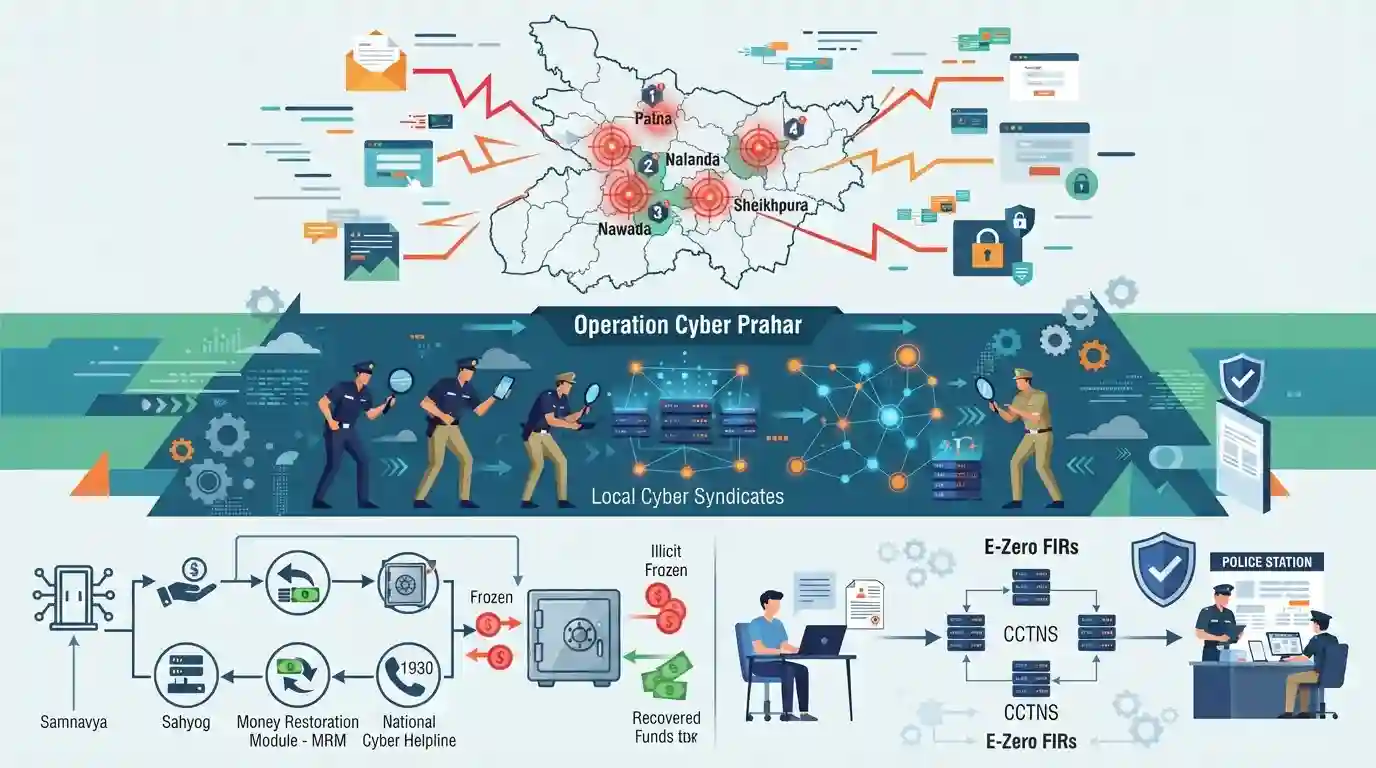
Four districts in Bihar—Nawada, Nalanda, Patna, and Sheikhpura—have been identified among the top 15 cyber-crime hotspots in India by the Union Home Ministry. To combat this growing threat, Bihar Police launched 'Operation Cyber Prahar' aiming at proactive tracking and dismantling of local cyber syndicates. Additionally, a robust digital ecosystem leveraging the Samnavya portal, Sahyog portal, Money Restoration Module (MRM), and the National Cyber Helpline (1930) is being utilized to freeze illicit transactions swiftly and recover lost funds. The state is also adopting e-Zero FIRs via the CCTNS network to make reporting easier.
Key Points
- Nawada, Nalanda, Patna, and Sheikhpura districts in Bihar are among India's top 15 cyber-crime hotspots according to the latest central government data.
- The Bihar Police initiated 'Operation Cyber Prahar' to crack down on cyber criminals and freeze accounts used for illegal transactions.
- Advanced platforms like the Money Restoration Module (MRM), Samnavya portal, and Sahyog portal have been deployed for faster fund freezing and recovery in coordination with financial institutions.
- The state is allowing the registration of e-Zero FIRs for digital frauds via the CCTNS portal to enhance reporting rates and ease of filing.
Important Terms
Operation Cyber Prahar

A proactive campaign by Bihar Police launched to systematically track, identify, and arrest local cybercriminals and dismantle cyber fraud syndicates operating in the state's cybercrime hotspots.
UPSC context
Important for GS Paper 3 (Internal Security), illustrating decentralized law enforcement crackdowns on emerging digital crime networks and hotspots.
Money Restoration Module (MRM)
A digital platform developed by I4C to expedite the refund of frozen fraudulent funds back to cybercrime victims' bank accounts without prolonged legal and judicial delays.
UPSC context
Tests E-governance and Internal Security (GS Paper 3) knowledge, showcasing citizen-centric technology to mitigate cyber financial fraud and bypass judicial delays.
Sahyog portal
A centralized platform by the Ministry of Home Affairs for law enforcement to automate and streamline sending legal takedown notices to online platforms for removing unlawful content.
UPSC context
Relevant to GS Paper 2 & 3 (Governance, Cyber Security), evaluating the IT Act, digital censorship, and intermediary liability.
Samanvaya portal
Also known as the Joint Cybercrime Investigation Facilitation System, it is an I4C platform serving as a unified database for cybercrime mapping, suspect registry, and data sharing among agencies.
UPSC context
Crucial for GS Paper 3 (Internal Security), demonstrating center-state coordination, data-driven policing, and intelligence sharing in investigating interstate cybercrimes.
e-Zero FIR
An electronic mechanism enabling victims to immediately register First Information Reports (FIRs) online for cyber frauds, regardless of jurisdictional boundaries, before transfer to the appropriate police station.
UPSC context
Important for GS Paper 2 (Justice delivery), highlighting police modernization and the removal of jurisdictional barriers in swift cybercrime reporting.
National Cyber Helpline (1930)
A 24x7 toll-free national helpline established by the Ministry of Home Affairs to rapidly report financial cyber frauds and trigger the immediate freezing of illicit bank transactions.
UPSC context
Frequently cited in GS Paper 3 (Cyber Security) as a frontline, citizen-centric emergency response mechanism against digital financial crimes.
Prelims Trap
I4C and the National Cyber Helpline (1930) function under the Ministry of Electronics and Information Technology (MeitY).
I4C and the 1930 helpline are under the Ministry of Home Affairs (MHA), whereas CERT-In falls under MeitY. UPSC frequently swaps these ministries.
Static Concepts Connected
How is India's national cyber architecture divided by mandate?
- I4C (MHA): Nodal center for tackling cybercrimes, managing the 1930 helpline, and coordinating with state law enforcement.
- CERT-In (MeitY): National nodal agency for responding to computer security incidents, vulnerability management, and issuing threat advisories.
- NCIIPC (NTRO): Designated nodal agency operating under NTRO, specifically tasked with protecting India's Critical Information Infrastructure (CII).
What is a 'Zero FIR' in Indian criminal law?
- Jurisdiction-agnostic: Can be registered at any police station regardless of where the crime occurred, initially carrying serial number '0'.
- Immediate action: Mandates the police to take initial action and investigate before transferring the case to the jurisdictional police station.
- Origin: Introduced on the recommendation of the Justice J.S. Verma Committee following the 2012 Nirbhaya case.
Cross-Topic Patterns
CCTNS evolution: from tracking to recovery
CCTNS is shifting from a passive police database to an active financial recovery tool. Integrating it with banking portals (MRM) represents a leap in real-time e-Governance and internal security.
Rural unemployment fueling cyber syndicates
The geographic spread of 'Jamtara-style' phishing hubs to districts like Nalanda highlights a socio-economic pattern: high digital penetration coupled with rural youth unemployment breeds organized cyber syndicates.

Expect a 2026 prelims question contrasting the nodal ministries and mandates of I4C (MHA), CERT-In (MeitY), and NCIIPC (NTRO).
Linked PYQs · 2
Linked PYQs · 2
- 2022BPSC_PRELIMSGS1
The 'Digital India Award, 2020' was given to the Bihar Government for
- 2025BPSC_PRELIMSGS1
Which organization jointly developed the National Urban Innovation Stack (NUIS) Digital Blueprint with the Ministry of Housing and Urban Affairs (MoHUA)?
