Bihar Green Budget Expands Amid Poor Environmental Progress
Source:mongabay ↗
Why It Matters
Understanding state-level green budgeting mechanisms and their effectiveness is crucial for assessing how fiscal tools can combat climate change and environmental degradation in ecologically vulnerable states like Bihar.
Summary
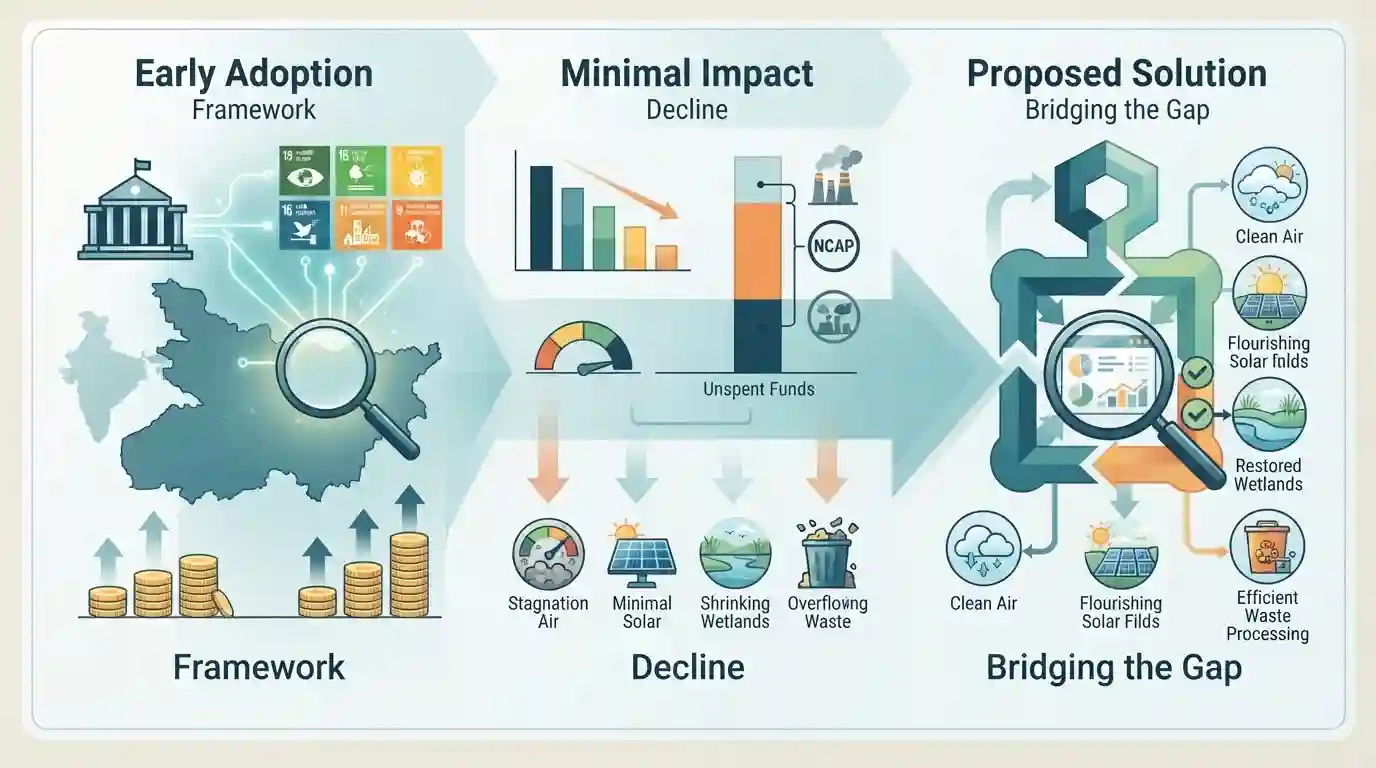
Bihar was one of the early adopters of green budgeting to address climate vulnerabilities, using the Rio Marker methodology to map budget allocations against Sustainable Development Goals (SDGs). However, despite this framework, the state's environmental indicators—such as air quality, renewable energy adoption, wetland preservation, and waste management—show minimal improvement. Financial allocations for the green budget are declining, and a significant portion remains unspent, notably funds under the National Clean Air Programme (NCAP). Experts suggest implementing an Output-Outcome Monitoring Framework (OOMF) to bridge the gap between budgetary allocations and tangible ecological benefits.
Key Points
- Bihar's green budget, introduced to combat ecological vulnerability, maps departments' schemes against specific environmental SDGs using the Rio Marker methodology.
- Odisha pioneered state-level environmental budgeting with its Climate Budget in 2019-20, focusing specifically on climate resilience, whereas Bihar's model integrates broader SDGs.
- Despite the green budgeting initiative, allocations have seen a downward trend, and actual expenditures consistently fall short of the approved budget.
- Key environmental metrics remain poor: coal drives 65% of energy emissions, PM2.5/PM10 and sulphur dioxide levels are high, and wetlands are shrinking.
- Funds allocated under the National Clean Air Programme (NCAP) are heavily underutilized, pointing to execution hurdles in the state’s environmental strategy.
Important Terms
Green Budget

A financial planning tool that identifies and allocates public expenditures towards environmental and climate objectives. States like Bihar use frameworks like the Rio Marker methodology to map funds directly to Sustainable Development Goals (SDGs).
UPSC context
Important for GS Paper 3 (Environment & Economy) for topics linking fiscal policy to climate mitigation and sustainable development.
National Clean Air Programme (NCAP)
A long-term, time-bound national strategy launched in 2019 to comprehensively address air pollution, aiming for a 40% reduction in PM2.5 and PM10 concentrations across non-attainment cities by 2026.
UPSC context
Essential for GS Paper 3 (Environment) to evaluate government pollution mitigation strategies, implementation gaps, and fund utilization across states.
Output-Outcome Monitoring Framework (OOMF)
A performance evaluation framework introduced by NITI Aayog that links budget outlays to measurable physical outputs and real-world outcomes, shifting the focus from mere spending to tangible impacts.
UPSC context
Crucial for GS Paper 2 and 3 (Governance and Economy) regarding budgeting reforms, public accountability, and scheme performance monitoring.
Climate Budget Tagging
A budgetary accounting tool used to identify, classify, and track climate-relevant expenditures. It ensures transparency, prevents greenwashing, and helps governments measure exactly how much funding is reaching climate action goals.
UPSC context
Highly relevant for GS Paper 3 (Economy and Environment) when discussing climate finance mechanisms, budgetary transparency, and sustainable public expenditure.
Prelims Trap
Bihar was the first Indian state to introduce a Climate Budget, using an indigenous methodology developed by the MoEFCC.
Odisha pioneered the 'Climate Budget' in FY 2019-20, whereas Bihar pioneered the broader 'Green Budget' in FY 2020-21. Also, the Rio Marker methodology is developed by the OECD, not indigenous to India.
Static Concepts Connected
What is the OECD's Rio Marker methodology used in climate finance tracking?
- Origin: Developed by the OECD Development Assistance Committee (DAC) to monitor aid targeting Rio Conventions (biodiversity, climate change, desertification).
- Scoring System: Employs a three-value score: 2 (principal objective), 1 (significant objective), and 0 (not targeted) to classify budgetary allocations.
- Objective: Helps sub-national and national governments identify, track, and mainstream environmental and climate goals within public spending.
What are the key features and targets of the National Clean Air Programme (NCAP)?
- Mandate: Launched in 2019 by MoEFCC to reduce PM10 and PM2.5 concentrations across non-attainment cities.
- Revised Target: Targets a 40% reduction in particulate matter concentration by 2026 (revised from the initial 20-30% by 2024 target).
- Coverage: Focuses on 131 non-attainment cities that continuously violated National Ambient Air Quality Standards (NAAQS).
Cross-Topic Patterns
Fiscal Federalism & Forest Devolution
Links sub-national green spending directly with the 15th Finance Commission's horizontal devolution formula, which assigns a 10% weight to forest cover and ecology.
Municipal Governance & Air Quality
Highlights how municipal capacity bottlenecks (GS-2 Governance) stymie environmental objectives, as seen in the high underutilization of national schemes like NCAP.

Sub-national environmental budgeting models (Rio Markers vs Climate Budgets) and revised 2026 NCAP targets likely to feature in Prelims 2026.
Linked PYQs · 4
Linked PYQs · 4
- 2024-EBPSC_PRELIMSGS1
When did Bihar State introduce the Green Budget for the first time?
- 2025BPSC_PRELIMSGS1
Match List-I with List-II: List-I (Scheme/Initiative): a. Perform, Achieve and Trade (PAT) scheme b. Mangrove Initiative for Shoreline Habitats and Tangible Incomes (MISHTI) c. The Lifestyle for Environment (LiFE) initiative d. National Clean Air Programme (NCAP) List-II (Description): 1. Introduced in the Union Budget for 2023-24 2. Aims to reduce emissions in energy-intensive industries 3. Launched in 2019 as a national-level strategy 4. Launched at COP26 in Glasgow in November 2021
- 2023BPSC_PRELIMSGS1
Bihar Government has planned to make Bihar State ‘pollution-free’ by reducing carbon emissions by which year?
- 2016BPSC_PRELIMSGS1
What is Particulate matter?
