Socio-Economic Vulnerabilities Drive Child Trafficking Hub in Bihar
Source:The Hindu ↗
Why It Matters
Human trafficking is a severe violation of fundamental rights (Article 23) and highlights significant gaps in governance, social justice, and border security. Understanding its root causes (poverty, illiteracy) and geographical enablers (porous borders) is critical for policy-making and internal security modules in the UPSC syllabus.
Summary
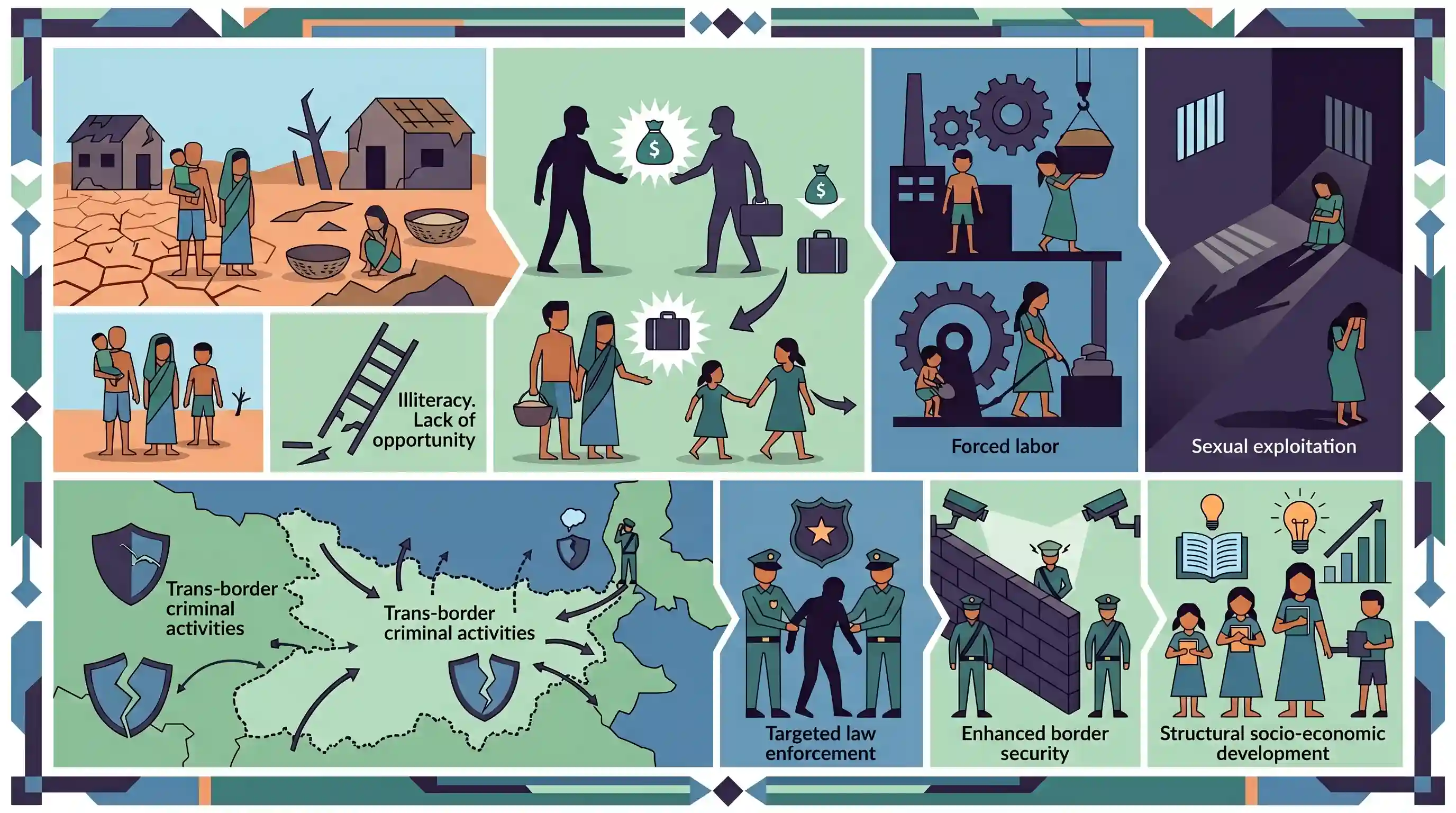
Bihar is increasingly recognized as a major hub for the trafficking of girl children, driven by deep-rooted socio-economic challenges such as poverty, illiteracy, and social marginalization. Traffickers exploit vulnerable families through false promises of employment, leading to forced labor and sexual exploitation. The situation is further complicated by the state's porous borders, which facilitate trans-border criminal activities. Tackling this severe violation of fundamental rights requires urgent, comprehensive action combining targeted law enforcement, enhanced border security, and structural socio-economic development to break the vicious cycle of poverty and exploitation.
Key Points
- Bihar has emerged as a prominent source and transit hub for the trafficking of young girls, exploiting systemic socio-economic vulnerabilities.
- Extreme poverty, widespread illiteracy, and a lack of employment opportunities force marginalized families to fall prey to traffickers' false promises of jobs and better lives.
- Porous international borders (like the Indo-Nepal border) exacerbate the challenge, allowing transnational organized crime networks to operate with relative impunity.
- Addressing this crisis requires a multi-pronged approach, including stricter law enforcement, better border management, and robust socio-economic empowerment programs for vulnerable populations.
Important Terms
Article 23

Fundamental Right prohibiting 'traffic in human beings,' begar (forced labour), and similar forms of exploitation. It protects individuals against both the State and private persons.
UPSC context
GS Paper II (Polity); essential for understanding constitutional safeguards against human trafficking and forced labour.
Article 24
Fundamental Right that strictly prohibits the employment of children below the age of 14 years in factories, mines, or any hazardous work.
UPSC context
GS Paper II (Polity); key to child rights and legislative measures like the Child Labour (Prohibition) Act.
Anti-Human Trafficking Units (AHTUs)
Specialized district-level law enforcement units in India responsible for the prevention, rescue, and investigation of human trafficking cases.
UPSC context
GS Paper III (Internal Security); relevant for discussing organized crime and administrative police reforms.
Ujjawala Scheme
A Ministry of Women and Child Development scheme providing for the prevention, rescue, and long-term rehabilitation of victims of commercial sexual exploitation.
UPSC context
GS Paper II (Social Justice); critical for analyzing welfare schemes for vulnerable and trafficked women.
Porous Borders
Unsecured or open geographic boundaries (like the India-Nepal border) that facilitate the illegal movement of people and contraband due to lack of strict surveillance.
UPSC context
GS Paper III (Border Management); vital for understanding trans-border crime and its impact on internal security.
POCSO Act (2012)
A stringent legal framework designed to protect children from sexual assault, harassment, and pornography, ensuring child-friendly trial procedures.
UPSC context
GS Paper II (Social Justice/Governance); tests knowledge of child protection laws and institutional justice mechanisms.
Prelims Trap
Article 24 of the Constitution specifically prohibits human trafficking and forced labor (begar).
Article 23 prohibits human trafficking and begar. Article 24 strictly deals with prohibiting the employment of children below 14 in hazardous industries like mines and factories.
Static Concepts Connected
What are the Constitutional safeguards against trafficking and child exploitation?
- Article 23: Prohibits trafficking in human beings, begar, and other forms of forced labor. Any contravention is a punishable offense.
- Article 24: Prohibits the employment of children below the age of 14 years in factories, mines, or any other hazardous employment.
- Article 39(e) & (f): A Directive Principle directing the State to ensure children are protected against moral and material abandonment and exploitation.
Which CAPF guards the Indo-Nepal border and handles trans-border crimes?
- Sashastra Seema Bal: The Sashastra Seema Bal (SSB) is the designated nodal border guarding force for the open Indo-Nepal and Indo-Bhutan borders.
- Open Border Challenge: Because the border is visa-free (1950 Treaty), SSB's primary mandate includes preventing smuggling, unauthorized entry, and human trafficking.
- AHTUs: Specialized district-level police task forces (AHTUs) operate alongside the SSB and NGOs to intercept and rescue trafficking victims at transit points.
Cross-Topic Patterns
Open Borders & Transnational Crime
The 1950 Indo-Nepal Treaty of Peace and Friendship allows free movement, creating an open border paradox that is routinely exploited by transnational syndicates for human trafficking and fake currency smuggling.
ILO Conventions & Domestic Law
India's ratification of ILO Core Conventions 138 (Minimum Age) and 182 (Worst Forms of Child Labour) catalyzed the 2016 amendments to the Child Labour Act, tightening anti-exploitation legal frameworks.

Expect a multi-statement Prelims question linking SSB's Indo-Nepal border mandate with Article 23 and ILO child labour conventions.
Linked PYQs · 5
Linked PYQs · 5
- 2024MainsGS2
Poverty and malnutrition create a vicious cycle, adversely affecting human capital formation. What steps can be taken to break the cycle ?
- 2020MainsGS3
Analyze internal security threats and transborder crimes along Myanmar, Bangladesh and Pakistan borders including Line of Control (LoC). Also discuss the role played by various security forces in this regard.
- 2020PrelimsGS1
Which one of the following categories of Fundamental Rights incorporates protection against untouchability as a form of discrimination?
- 2025PrelimsGS1
Consider the following pairs : Provision in the Constitution of India Stated under I. Separation of Judiciary from the Executive in the public services of the State : The Directive Principles of the State Policy II. Valuing and preserving of the rich heritage of our composite culture : The Fundamental Duties III. Prohibition of employment of children below the age of 14 years in factories : The Fundamental Rights How many of the above pairs are correctly matched?
- 2018MainsGS1
Women's movement in India has not addressed the issues of women of lower social strata.' Substantiate your view.
