Bihar Lymphatic Filariasis Transmission Assessment Survey Milestone
Source:drishtiias ↗
Why It Matters
This is a historic achievement for Bihar in eradicating a major endemic vector-borne disease. It validates the effectiveness of the Directly Observed Treatment (DOT) strategy and highlights the state's progress toward achieving India's 2027 national elimination goal.
Summary
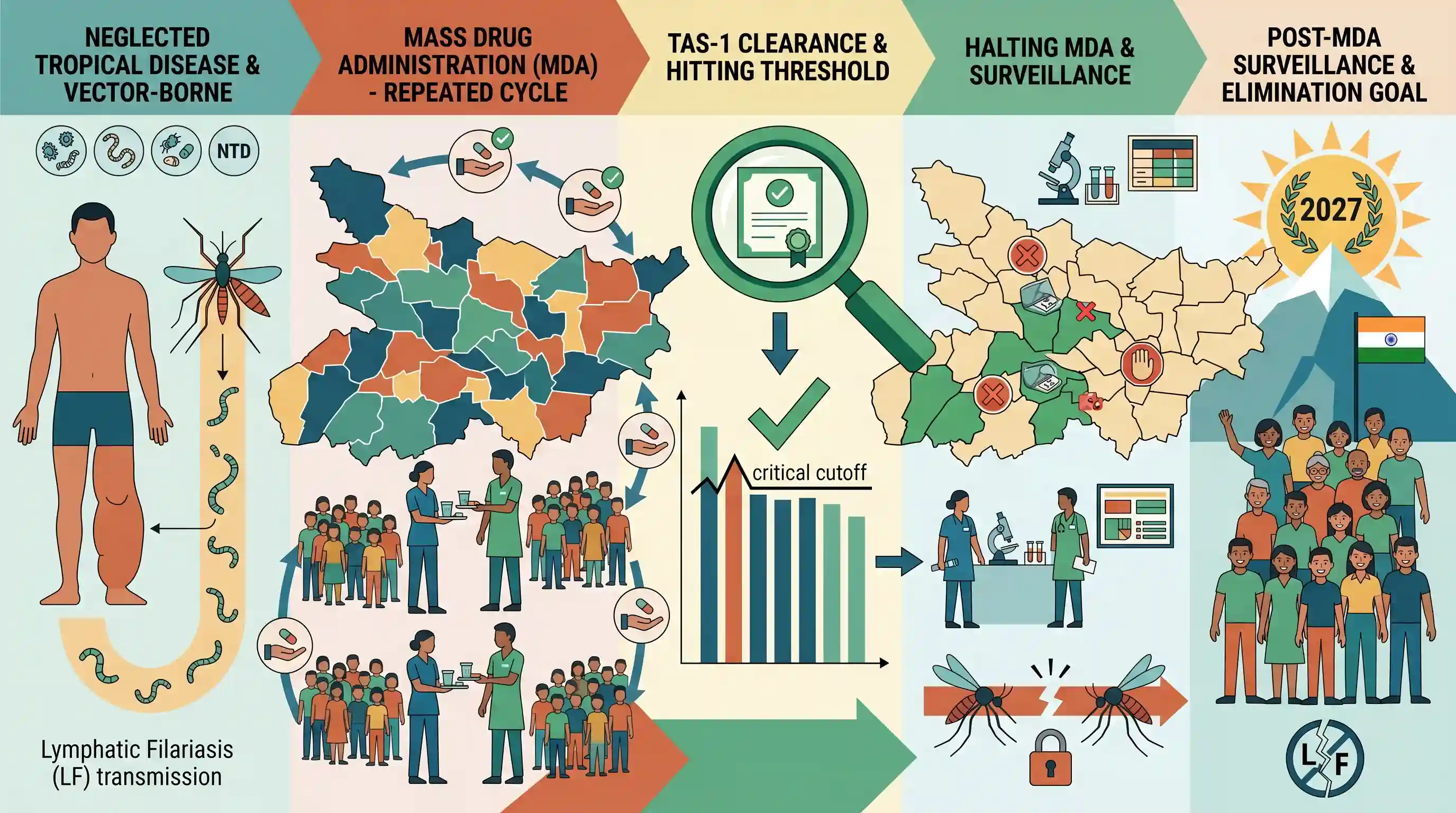
Bihar has achieved a major milestone in public health by clearing its first Transmission Assessment Survey (TAS-1) for Lymphatic Filariasis (LF) control, allowing multiple districts to halt Mass Drug Administration (MDA) and move to post-MDA surveillance. This is a critical step towards India's goal of eliminating LF by 2027.
Key Points
- Bihar has cleared its first Transmission Assessment Survey (TAS-1) for Lymphatic Filariasis (LF) elimination since the Mass Drug Administration (MDA) programme started in 2004.
- Clearing TAS-1 enables successful implementation units to halt MDA and shift focus to post-MDA surveillance.
- Lymphatic Filariasis is a Neglected Tropical Disease (NTD) caused by parasitic worms and transmitted via mosquito vectors (such as Anopheles and Culex).
- India’s national target is to eliminate Lymphatic Filariasis as a public health problem by 2027, ahead of the global WHO target of 2030.
- All 38 districts of Bihar are endemic for LF, involving 592 implementation units.
- In Bihar's first TAS-1, 55 out of 57 implementation units across four districts (Araria, Madhepura, Supaul, and Kishanganj) successfully cleared the survey, allowing Araria, Madhepura, and Supaul to completely stop MDA.
- Bihar improved coverage and compliance using Directly Observed Treatment (DOT), where health workers personally ensure that patients consume the medicine.
Important Terms
Lymphatic Filariasis (LF)

A debilitating neglected tropical disease caused by parasitic worms and transmitted via mosquito bites, leading to severe swelling (elephantiasis), permanent disability, and social stigma.
UPSC context
GS Paper II (Social Justice/Health) & GS III (S&T); tests knowledge of infectious disease elimination targets and public healthcare challenges.
Transmission Assessment Survey (TAS-1)
A standardized epidemiological survey conducted on children to assess whether active lymphatic filariasis transmission has dropped below a critical threshold, indicating it is safe to halt annual MDA campaigns.
UPSC context
GS Paper II (Health/Governance) & GS III (S&T); evaluates comprehension of monitoring and evaluation frameworks in disease elimination protocols.
Mass Drug Administration (MDA)
A preventative chemotherapy strategy involving supervised, door-to-door distribution and consumption of anti-filarial medications (such as DEC, Albendazole, and Ivermectin) to all eligible individuals in endemic zones.
UPSC context
GS Paper II (Health/Governance); tests understanding of massive-scale healthcare campaigns, drug compliance mechanisms, and grassroots healthcare delivery systems.
National Centre for Vector Borne Diseases Control (NCVBDC)
India's central nodal agency under the Ministry of Health & Family Welfare responsible for formulating policies, guidelines, and managing programs to prevent and control six major vector-borne diseases.
UPSC context
GS Paper II (Government Policies/Institutions); tests knowledge of central agencies steering national health missions and institutional disease frameworks.
Neglected Tropical Diseases (NTDs)
A diverse group of communicable diseases prevalent in tropical and subtropical regions, primarily affecting impoverished communities with inadequate sanitation and limited access to healthcare.
UPSC context
GS Paper II (Social Justice/Health) & GS III (S&T); tests awareness of global health burdens, drug development, and healthcare equity.
Prelims Trap
Clearing TAS-1 certifies an implementation unit or district as completely free/eliminated of Lymphatic Filariasis.
Clearing TAS-1 does not mean the region is certified as having eradicated or eliminated LF. It only signifies that active transmission is low enough to safely halt Mass Drug Administration (MDA) and transition to post-MDA surveillance.
Static Concepts Connected
What are Neglected Tropical Diseases (NTDs) and why are they classified as such?
- Definition: A diverse group of 20 vector-borne, parasitic, viral, bacterial, and fungal diseases prevailing in tropical and subtropical regions.
- Target Population: They primarily affect impoverished populations lacking adequate sanitation, clean water, and healthcare access in developing nations.
- Funding Neglect: Historically overlooked on the global health agenda, receiving disproportionately less R&D funding compared to diseases like HIV/AIDS, Malaria, and TB.
What is the Triple-Drug Regimen (IDA) for Lymphatic Filariasis?
- Composition: A highly effective combination of three antifilarial drugs: Ivermectin, Diethylcarbamazine Citrate (DEC), and Albendazole.
- Efficacy: Introduced to fast-track elimination by killing the microfilariae (immature worms) more rapidly and preventing transmission more effectively than the older two-drug (DA) regimen.
- Administration: Administered annually to entire eligible populations in endemic areas through Mass Drug Administration (MDA) campaigns.
Cross-Topic Patterns
NTDs + One Health approach
Linking vector-borne NTD elimination to sanitation and climate-driven vector migration emphasizes the convergence of environmental management and clinical public health under 'One Health'.
Public Health + Cooperative Federalism
Health is a State Subject (List II), but achieving national targets like the 2027 LF elimination relies on central policy funding paired with customized grassroots execution.

India's 2027 LF target, IDA triple-drug therapy (Ivermectin, DEC, Albendazole), and TAS-1 criteria are highly probable 2026 Prelims targets.
Linked PYQs · 1
Linked PYQs · 1
- 2024-IBPSC_PRELIMSGS1
Besides spreading Malaria, Anopheles mosquito’s are also vectors of
