Bihar Women Empowerment Schemes and Police Didi Initiative for Safety
Source:impressive-times ↗
Why It Matters
This article details pivotal governance initiatives in Bihar regarding women's safety (Police Didi) and economic empowerment (JEEViKA, Lakhpati Didi), which are highly relevant for BPSC Prelims and Mains questions on state-specific policies, social justice, and governance.
Summary
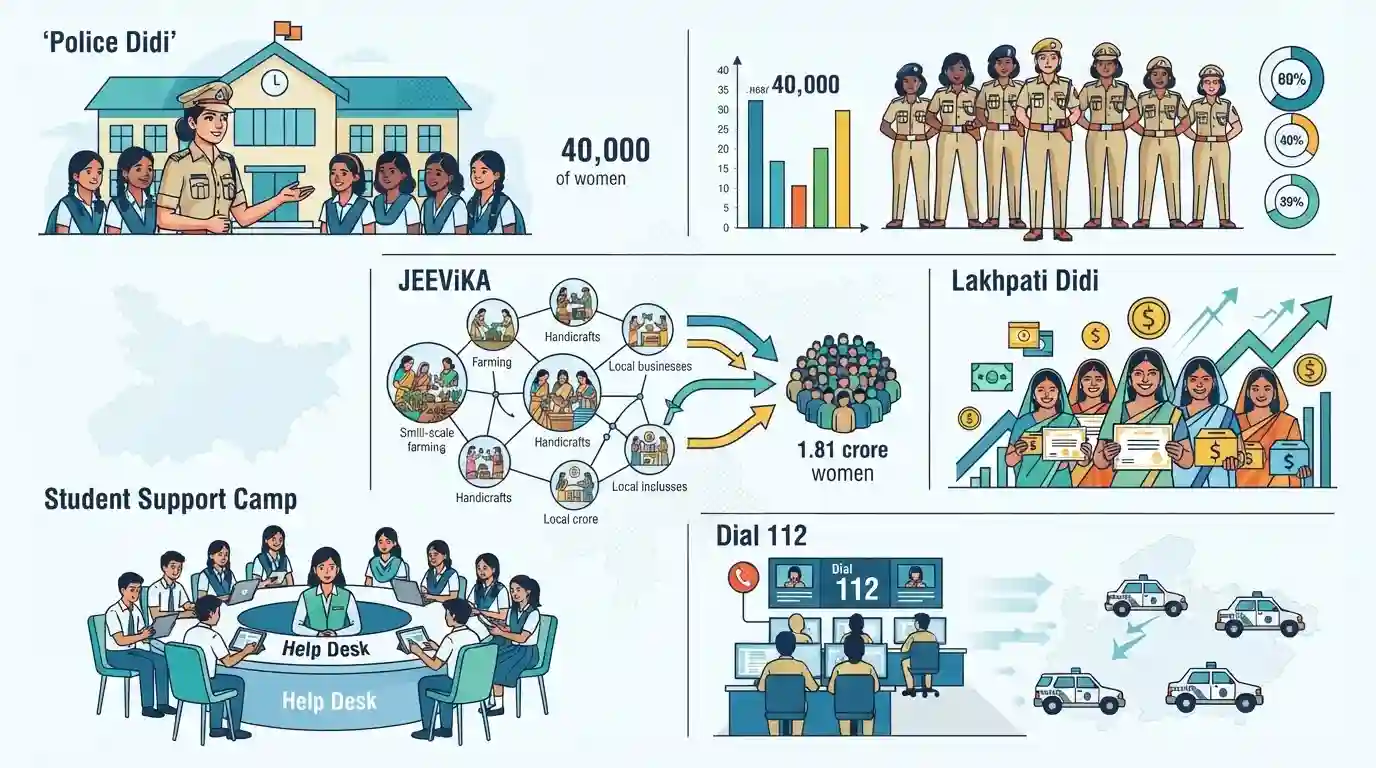
Bihar Deputy Chief Minister Samrat Choudhary has announced several new women-centric initiatives, prominently featuring the 'Police Didi' campaign designed to deploy women police personnel in educational institutions for enhanced safety. Choudhary highlighted the state's significant strides in women's empowerment, noting that women comprise nearly 40,000 of the state's police force. Furthermore, he emphasized the economic progress facilitated by the JEEViKA programme, which connects 1.81 crore women, and the success of the 'Lakhpati Didi' scheme. A new 'Student Support Camp' was also launched to address student issues, and improvements in the 'Dial 112' emergency response times were noted.
Key Points
- Bihar Deputy CM Samrat Choudhary unveiled the 'Police Didi' campaign, deploying women police officers at schools and colleges to enhance girls' safety.
- To support the initiative, the state provided 2,700 scooties and 2,000 motorcycles to equip women police personnel.
- Bihar currently has a robust female representation in its police force, with nearly 40,000 women officers.
- The emergency response time for 'Dial 112' has been reduced to under 10 minutes, with the goal of bringing it down further to 5-7 minutes.
- Economic empowerment through the JEEViKA programme has successfully linked 1.81 crore women, fostering over 70 lakh active members.
- Around 43 lakh women in Bihar have achieved 'Lakhpati Didi' status, and the government targets adding 1 lakh more in the next two years.
- The state government also launched a 'Student Support Camp', scheduled for the fourth Tuesday of every month, to address student grievances.
Important Terms
Police Didi Initiative

A Bihar government campaign deploying female police personnel on specialized two-wheelers around schools and colleges to curb harassment and ensure the safety of young women.
UPSC context
Highly relevant for BPSC GS Paper 2 (Governance), highlighting state-specific community policing and women's security measures.
JEEViKA (Bihar Rural Livelihoods Project)
A World Bank-assisted initiative by the Bihar government designed to empower the rural poor socially and economically by creating self-managed community institutions and enhancing incomes.
UPSC context
Crucial for BPSC GS Paper 2 (Economy and Geography of Bihar), illustrating rural poverty alleviation and women's empowerment.
Lakhpati Didi Scheme
A government initiative that economically empowers women in Self-Help Groups by helping them engage in diversified livelihood activities to earn a sustainable annual income exceeding ₹1 lakh.
UPSC context
Important for BPSC Current Affairs and GS Paper 2 (Economics), focusing on financial inclusion and rural livelihood generation.
Emergency Response Support System (ERSS - Dial 112)
An integrated, pan-India single-number helpline (112) for police, fire, and medical emergencies. Bihar has significantly upgraded this system to bring response times under 10 minutes.
UPSC context
Relevant for BPSC GS Paper 2 (Governance and Internal Security), demonstrating tech-driven public service delivery and law enforcement.
Self-Help Groups (SHGs)
Small, community-based collectives of individuals, typically rural women, who pool financial resources and support each other in micro-enterprise, serving as the foundational units for schemes like JEEViKA.
UPSC context
Essential for BPSC GS Paper 2 (Polity and Economy), illustrating grassroots mobilization and decentralized socio-economic empowerment.
Prelims Trap
"The Bihar government's Lakhpati Didi scheme aims to create a total of 1 lakh Lakhpati Didis."
Aspirants often confuse incremental targets with cumulative ones. The state has already achieved 43 lakh Lakhpati Didis; the 1 lakh figure is merely the additional target for the next two years.
Static Concepts Connected
What are the foundational pillars of the JEEViKA programme?
- Origin: Launched in 2007 by the Government of Bihar with financial assistance from the World Bank.
- Objective: Aims at poverty alleviation through the social and economic empowerment of the rural poor by forming Self-Help Groups (SHGs).
- Convergence: It serves as the state nodal agency for implementing the National Rural Livelihoods Mission (NRLM) in Bihar.
What is the framework for women's reservation in Bihar's administration?
- Public Employment: Bihar provides a 35% horizontal reservation for women across all state government jobs and services, introduced in 2016.
- Local Governance: Bihar was the first Indian state to provide 50% reservation for women in Panchayati Raj Institutions (PRIs) in 2006.
- Police Force: The state boasts one of the highest numbers of women in its police force (nearly 40,000) due to these affirmative action policies.
Cross-Topic Patterns
Women Empowerment + Internal Security
Deploying 'Police Didi' bridges gender representation with localized internal security, addressing grassroots safety in educational institutions to ultimately reduce female dropout rates in Bihar.
SHGs + Microfinance + Livelihood Schemes
The JEEViKA model demonstrates how SHG-led microcredit creates a compounding economic effect, acting as the primary delivery mechanism for national livelihood initiatives like Lakhpati Didi.

Questions will likely test exact targets of Lakhpati Didi (43 lakh achieved) alongside Bihar's 35% women reservation in government jobs.
Linked PYQs · 4
Linked PYQs · 4
- 2016BPSC_PRELIMSGS1
'JEEVIKA' is an initiative of Bihar Govt for:
- 2020BPSC_PRELIMSGS1
Bihar Government launched a new scheme 'Satat Jivikoparjan Yojana' in August 2018. The objective of this scheme is
- 2022BPSC_PRELIMSGS1
In which year was 50% reservation to women in Panchayat bodies provided in Bihar?
- 2025BPSC_PRELIMSGS1
According to PLFS 2023-24, which of the following statements best describe the nature of employment among women in Bihar?
