Bihar Paddy Cultivation and Kharif Crop Targets for Monsoon Season
Source:indiatimes ↗
Why It Matters
Agriculture is a vital component of Bihar's economy, contributing about 19% to its GSDP. Monitoring monsoon progress, crop transplantation (paddy/maize), and flood-coping mechanisms is highly relevant for understanding Bihar's agricultural geography and economy, which are major focus areas in the BPSC Prelims.
Summary
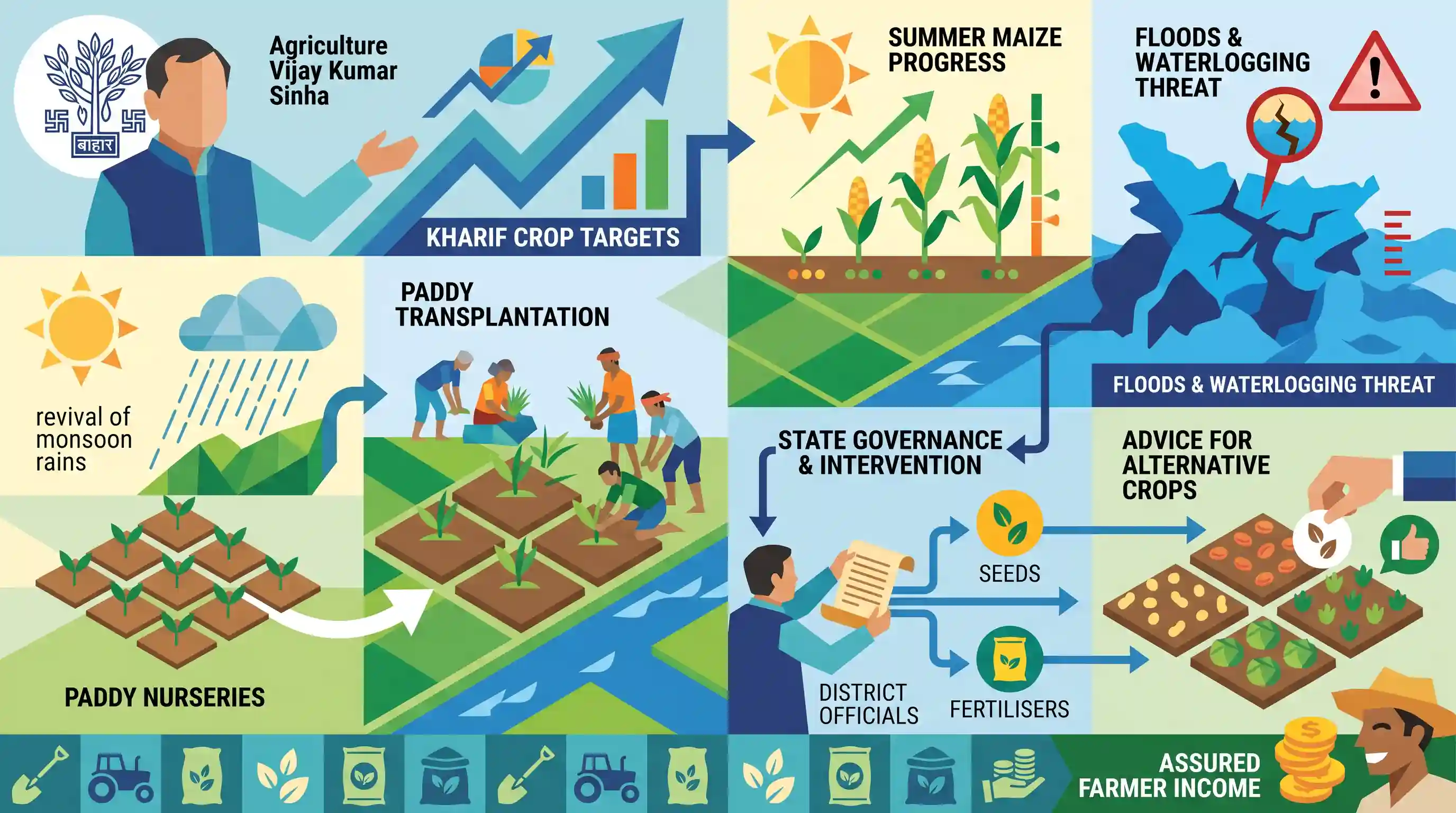
Bihar's Agriculture Minister Vijay Kumar Sinha declared that Bihar is on track to meet its targets for paddy and kharif crop cultivation following a revival of monsoon rains. Paddy nurseries are ready, transplantation is in progress, and summer maize has shown satisfactory progress. To counter the threat of floods and waterlogging, district officials are tasked with ensuring the supply of seeds and fertilisers and advising alternative crops where necessary.
Key Points
- Bihar Agriculture Minister Vijay Kumar Sinha expressed confidence that the state will achieve its targets for paddy cultivation and other kharif crops after the revival of monsoon rains.
- Paddy nursery raising has been successfully completed, and transplantation is progressing at a brisk pace across Bihar.
- Summer maize sowing in the state has also recorded satisfactory progress.
- Agriculture officials have been instructed to guarantee a steady, timely supply of quality seeds, fertilisers, and other inputs.
- In response to potential flood and waterlogging risks, officials have been directed to advise and guide farmers toward alternative cropping systems to ensure assured income.
Important Terms
Bihar Department of Agriculture

The state government department responsible for agricultural development, implementing agrarian policies, distributing inputs like seeds and fertilizers, and enhancing farmer livelihoods in Bihar.
UPSC context
GS Paper 2 and 3 (Governance/Agriculture); tests governance, state welfare schemes, and regional crop patterns.
Kharif Crops
Monsoon-dependent crops sown at the beginning of the southwest monsoon (June-July) and harvested in autumn (September-October), requiring warm, humid climates and high rainfall, such as paddy and maize.
UPSC context
GS Paper 1 (Geography) and GS Paper 3 (Agriculture); tests major cropping patterns and climatic requirements.
Contingency Crop Planning
Pre-designed alternative cropping strategies implemented immediately when the normal agricultural season fails or is severely disrupted by delayed monsoon, floods, or dry spells.
UPSC context
GS Paper 3 (Disaster Management/Agriculture); tests climate-resilient cropping, drought mitigation, and agricultural security.
Summer Maize
Maize cultivated as an intermediate crop during summer (Zaid season), acting in Bihar as a high-yield, profitable alternative to traditional crops like paddy.
UPSC context
GS Paper 3 (Cropping Patterns); tests crop diversification, water-use efficiency, and agricultural value chains.
Prelims Trap
According to Köppen's classification, the entire geographical area of Bihar falls strictly under the Cwg climate zone.
While Cwg (monsoon with dry winter) dominates, Bihar's extreme southeastern districts transition into the Aw (tropical savanna) climate zone.
Static Concepts Connected
What features define the Cwg and Aw climate zones in India under Köppen's scheme?
- Cwg Climate: Characterized by a humid subtropical climate with hot summers and dry winters, dominant across the Indo-Gangetic plains.
- Aw Climate: Represents a tropical savanna climate with distinct wet and dry seasons, typically bordering the tropical regions.
What is 'Diara land' farming and how does it support disaster resilience?
- Riverine areas: Flood-prone island or riverbed soils formed by Ganga-Koshi systems, highly prone to annual submergence.
- Sand-farming: Cultivators use these lands post-floods for fast-growing cucurbits (watermelon, cucumber) which thrive in sandy, moist riverbeds.
- Contingency crops: Relies on short-duration paddy varieties (like Prabhat) that mature before the peak inundation period.
Cross-Topic Patterns
Maize production + Ethanol blending targets
Bihar’s high maize surplus directly feeds into India's 20% ethanol blending target, shifting maize's role from a food/feed crop to a commercial biofuel driver.
Diara ecology + Land degradation neutrality
Sand-casting from Koshi floods degrades arable land, requiring biological interventions like agroforestry to prevent permanent desertification of fertile plains.

Expected 2026 pairing of Köppen's climate zones with localized riverine adaptation strategies like Diara land farming.
Linked PYQs · 4
Linked PYQs · 4
- 2025BPSC_PRELIMSGS1
Which of the following is a Kharif crop?
- 2024-IBPSC_PRELIMSGS1
In which district of Bihar, Maize production is maximum?
- 2025BPSC_PRELIMSGS1
Most of the Bihar comes under which of the following climate type?
- 2024-EBPSC_PRELIMSGS1
What is the contribution of agriculture in the Gross Domestic Product (GDP) of Bihar?
