Bihar Har Ghar Nal Ka Jal Rural Water Supply Scheme
Source:Indian Express ↗
Why It Matters
Crucial for BPSC aspirants tracking flagship state welfare programs, rural infrastructure development, and components of the 'Saat Nishchay' policy framework.
Summary
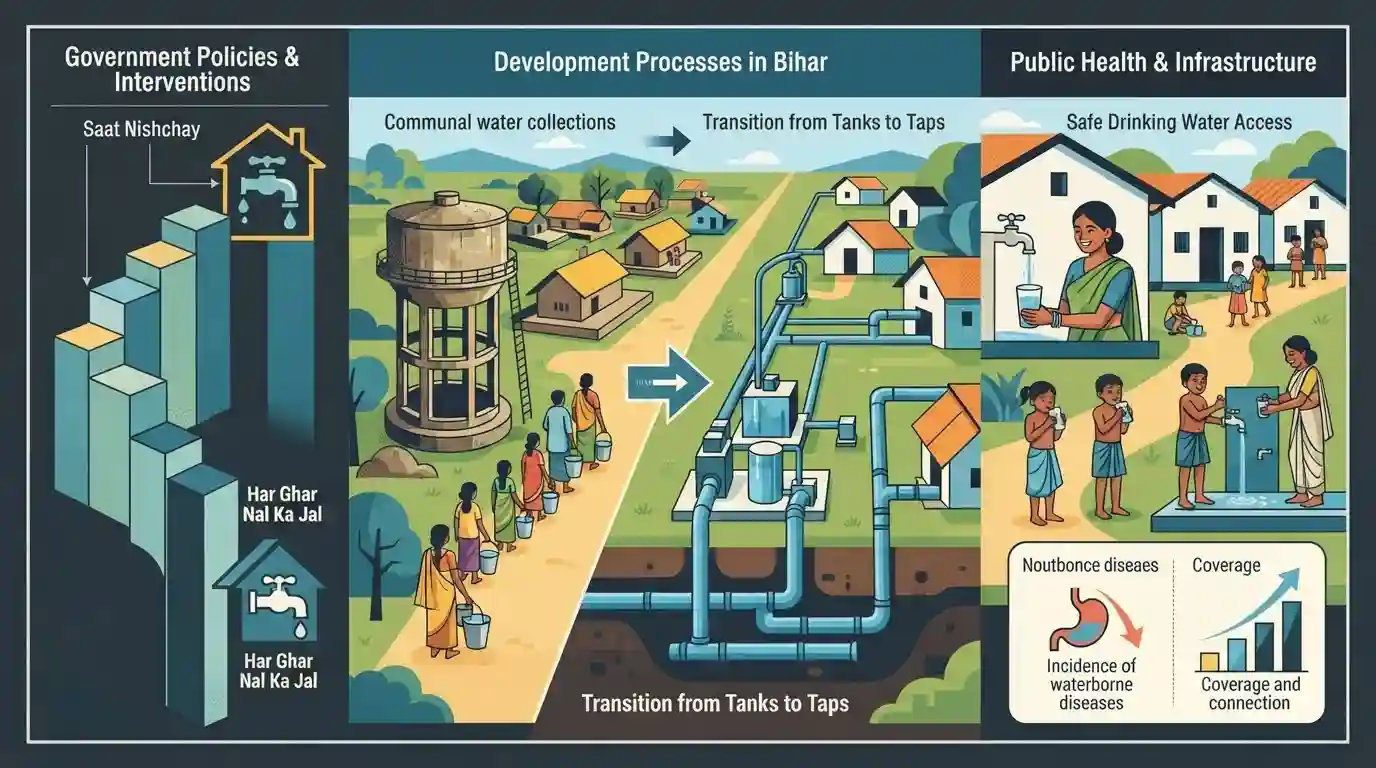
The article discusses the implementation, scope, and significance of Bihar's flagship rural water scheme ('Har Ghar Nal Ka Jal') under the 'Saat Nishchay' framework, detailing its transition from tanks to taps to ensure safe drinking water access across rural households in the state.
Key Points
- The Bihar government's rural drinking water scheme, 'Har Ghar Nal Ka Jal', is a key component of the flagship 'Saat Nishchay' (Seven Resolves) initiative aimed at providing piped drinking water to every rural household.
- The scheme integrates various technical and structural provisions to ensure sustainable tap water supply across rural habitations, addressing issues like groundwater contamination (such as arsenic and fluoride).
- It serves as an important case study for rural infrastructure development, welfare governance, and public health management in Bihar.
Important Terms
Har Ghar Nal Ka Jal

A flagship rural drinking water initiative under Bihar's Saat Nishchay framework, ensuring safe tap water connections to every household to improve public health and rural infrastructure.
UPSC context
BPSC Paper II (Governance & Schemes): Evaluates welfare delivery, rural infrastructure, and public health interventions in Bihar.
Saat Nishchay Yojana
An omnibus policy framework of the Bihar government comprising seven core development resolves aimed at improving socio-economic conditions, rural infrastructure, youth empowerment, and women's self-reliance.
UPSC context
BPSC Paper II (State Development Policies): Tests knowledge of Bihar's flagship governance blueprint and its multi-sectoral welfare impacts.
Mukhyamantri Gramin Solar Street Light Yojana
A Bihar government initiative under Saat Nishchay-2 to install solar street lights across rural wards, promoting clean energy and night-time safety.
UPSC context
BPSC Paper II (Infrastructure & Energy): Tests rural electrification strategies, renewable energy adoption, and administrative implementation bottlenecks in Bihar.
Prelims Trap
Har Ghar Nal Ka Jal is exclusively a centrally sponsored scheme launched under the Union Jal Jeevan Mission.
Aspirants often confuse Har Ghar Nal Ka Jal as a purely central scheme, overlooking that it originated independently under Bihar's state-level Saat Nishchay initiative before aligning with Jal Jeevan Mission.
Static Concepts Connected
What are the key thematic components of Bihar's Saat Nishchay (Seven Resolves) framework?
- Initial Phase: First phase (2015-2020) focused on basic infrastructure like piped drinking water, pucca roads, and electricity.
- Second Phase: Second phase (2020-2025) expanded to youth skill development, higher education access, and rural enterprise support.
- Saat Nishchay-3: Third phase (2025-2030) shifts focus toward inclusive economic growth, industrial expansion, and employment-led development.
Cross-Topic Patterns
Rural Water Access & Public Health Governance
Bihar's PHED tackling arsenic/fluoride in rural water supply bridges public health governance with decentralized panchayati raj implementation frameworks.
Saat Nishchay Evolution & State Planning
The transition from Saat Nishchay-1 infrastructure delivery to Saat Nishchay-3 employment and industrial expansion reflects Bihar's state-level development policy evolution.

Expect a multi-statement BPSC question combining Saat Nishchay pillars, PHED roles, and Jal Jeevan Mission convergence.
Linked PYQs · 2
Linked PYQs · 2
- 2020BPSC_PRELIMSGS1
Which of the following is not included in Seven Resolves (Saat Nishchay) of Bihar Government?
- 2024-EBPSC_PRELIMSGS1
In which of the following years the Bihar state Hydroelectric power corporation was established?
