Bihar Vegetable Supply Chain Infrastructure and Cooperative Funding
Source:patnapress ↗
Why It Matters
Enhancing cold chain and collection infrastructure is a recurrent theme in agricultural economics. This specific Bihar state initiative highlights the role of cooperatives (PVCS) in rural development, a critical area for BPSC Prelims and Mains (GS Paper 2 - Bihar Economy & Agriculture).
Summary
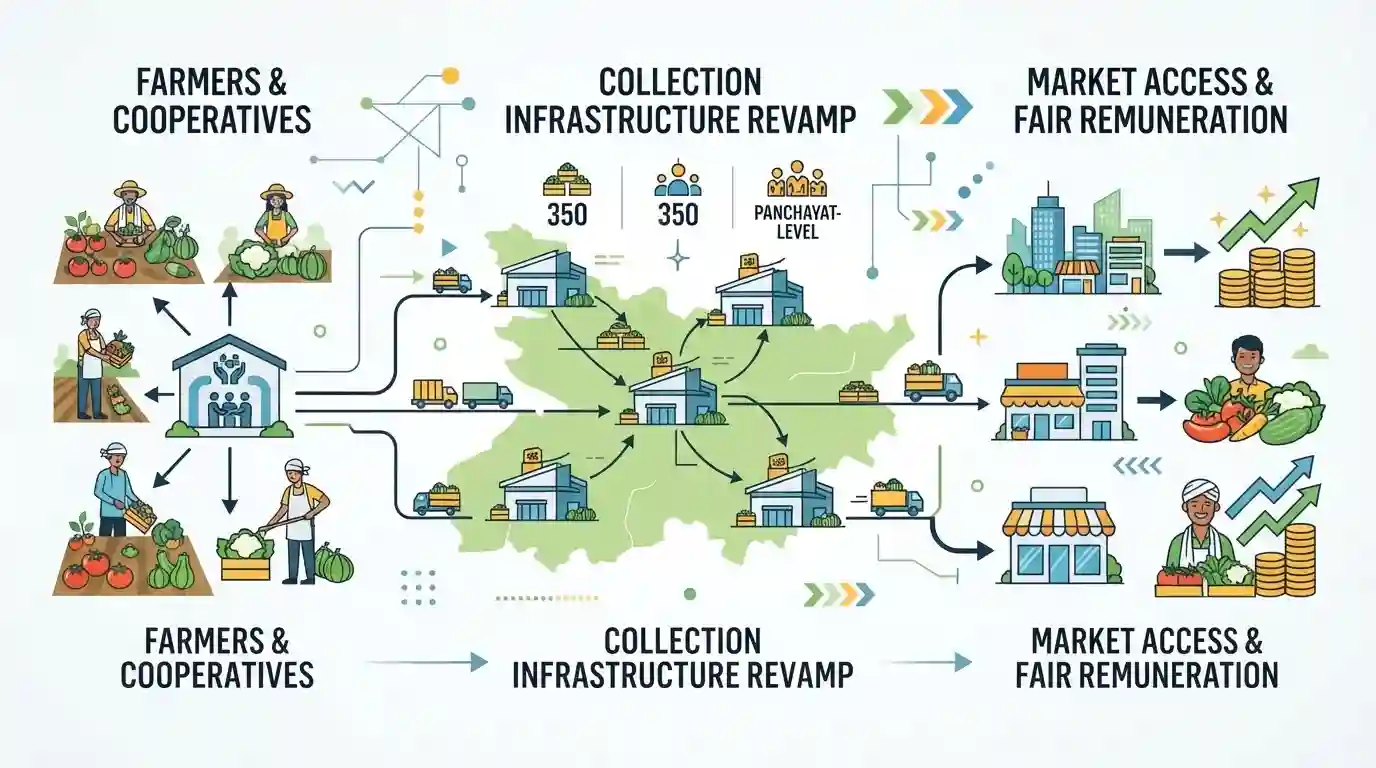
The Bihar government has announced a Rs 106.39 crore initiative to revamp the vegetable supply chain by creating collection infrastructure across the state. By establishing 350 panchayat-level collection centres and funding cooperative societies, the state aims to ensure fair remuneration for farmers and improve market access.
Key Points
- The Bihar Cooperation Department approved a project worth Rs 106.39 crore to strengthen the state's vegetable supply chain.
- The initiative will establish 350 panchayat-level vegetable collection centres and 50 block-level centres to aggregate fresh produce.
- A total of 534 Primary Vegetable Producer Cooperative Societies (PVCS) will receive Rs 2 lakh each in working capital to act as primary aggregators.
- Nine regional vegetable unions (including Harit, Tirhut, Mithila, and Kosi) will receive Rs 10 lakh each to bolster their operations.
- The primary objective is to empower farmers, reduce post-harvest losses, and stabilize market prices by eliminating intermediaries.
Important Terms
Bihar Cooperation Department

The Bihar government body responsible for implementing policies, funding, and overseeing cooperative networks (such as dairy and vegetables) to strengthen agricultural marketing, eliminate intermediaries, and empower rural farmers.
UPSC context
GS Paper II (Governance) and GS Paper III (Agriculture). Tests state-level cooperative models and policy interventions for doubling farmers' income.
Vegfed (Vegetable Federation)
An apex state-level cooperative body in Bihar, modeled after milk cooperative COMFED, responsible for the macro-level planning, processing, branding (under 'Tarkari'), and marketing of vegetables to boost farmers' incomes.
UPSC context
GS Paper III (Agriculture marketing, supply chains). Tests understanding of cooperative federation models to improve farm incomes and export capacities.
Primary Vegetable Producer Cooperative Societies (PVCS)
Local-level cooperative societies formed at the panchayat/block level under Bihar's 3-tier cooperative structure, serving as primary collection centers where vegetable farmers aggregate and directly sell their produce.
UPSC context
GS Paper III (Agricultural marketing). Tests understanding of decentralized cooperative models and grassroot-level aggregation networks in strengthening rural economies.
Prelims Trap
Cooperative societies operating within a single state are regulated under the Multi-State Co-operative Societies Act, 2002.
Single-state cooperatives are governed entirely by state-specific laws under Entry 32 of the State List; only multi-state cooperatives fall under the Central Act.
Static Concepts Connected
What is the constitutional status and division of power regarding Cooperative Societies in India?
- State Subject: 'Cooperative societies' is a State Subject under Entry 32 of the State List in the Seventh Schedule.
- 97th Amendment: Passed in 2011, it inserted Article 19(1)(c) (Fundamental Right) and Article 43B (DPSP) to promote cooperative autonomy.
- Part IXB: Added to the Constitution to govern the democratic functioning and audit of cooperative societies across India.
Why is supply chain infrastructure critical for Indian horticulture?
- Perishability Loss: Horticultural crops suffer 30-40% post-harvest losses due to inadequate cold storage and lack of first-mile aggregation.
- Price Realization: Direct village-level aggregation bypasses long chains of intermediaries, ensuring better farm-gate prices for smallholders.
- Market Integration: It links localized surplus zones to urban deficit markets, dampening extreme seasonal price volatility.
Cross-Topic Patterns
Cooperatives + Agrarian Distress
Decentralized state-led cooperative aggregation acts as a safety valve against price crashes, supplementing MSP-based procurement which largely ignores perishable horticulture.
First-mile logistics + Climate Resilience
Panchayat-level aggregation centres reduce transit times, directly mitigating climate-induced heatwave losses in perishable vegetable supply chains.

Mains 2026 may compare state-led cooperative federations with corporatized FPOs in solving the 'first-mile' aggregation bottleneck.
Linked PYQs · 3
Linked PYQs · 3
- 2022BPSC_PRELIMSGS1
Which type of banks is proposed to be established for agriculture and rural development in Bihar?
- 2024-EBPSC_PRELIMSGS1
What is the contribution of agriculture in the Gross Domestic Product (GDP) of Bihar?
- 2023BPSC_PRELIMSGS1
What is the policy measure adopted by the Government of India to improve the system of agricultural marketing?
