Bihar Anganwadi Centres Upgrade to Nand Ghars via CSR
Source:indianmasterminds ↗
Why It Matters
Highlights a key public-private partnership model (CSR) in Bihar aimed at overhauling Anganwadi infrastructure to improve education, nutrition, and women's livelihood. It is highly relevant for GS Paper 2 topics on governance, social justice, and welfare schemes for vulnerable sections.
Summary
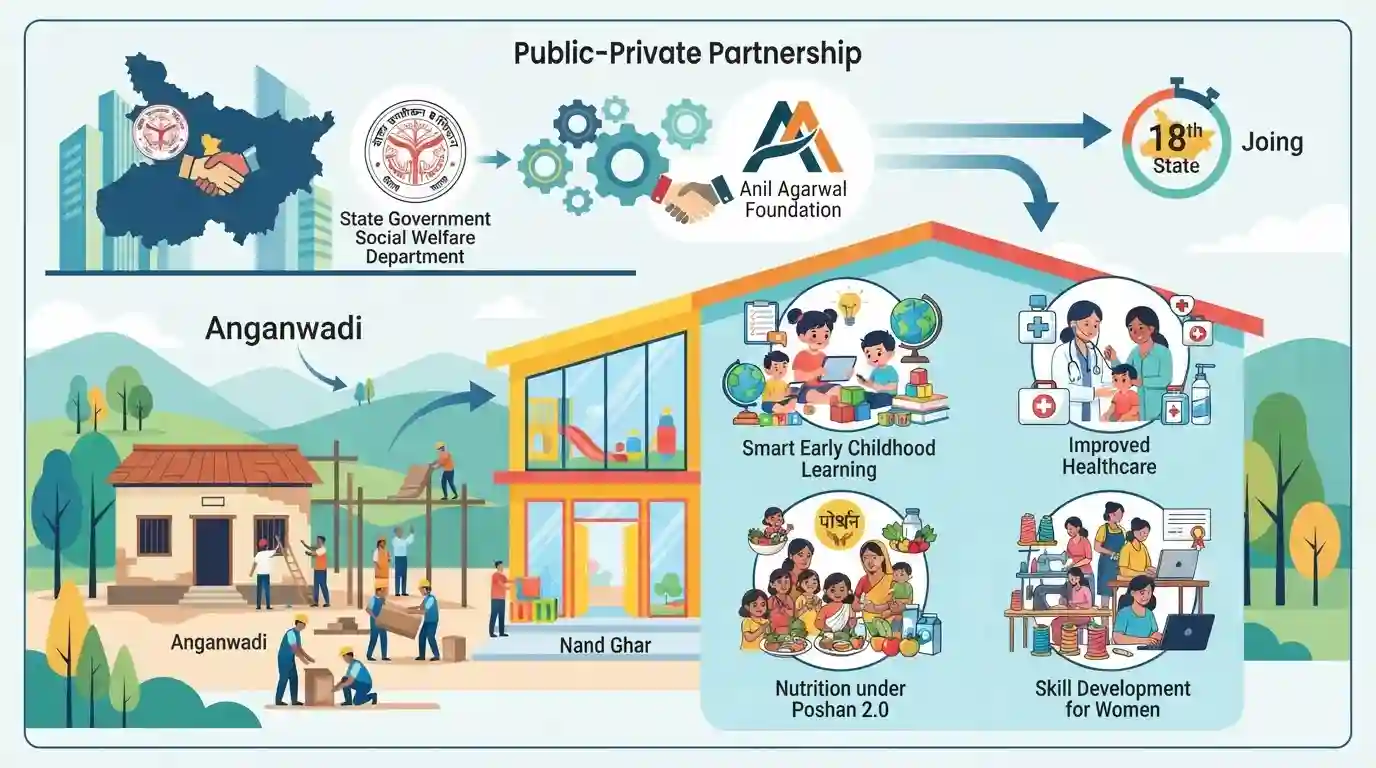
Bihar is upgrading 1,000 Anganwadi centres into modern 'Nand Ghars' through a collaboration between its Social Welfare Department and the Anil Agarwal Foundation. This initiative, rolling out in six districts, focuses on smart early childhood learning, improved healthcare, nutrition under Poshan 2.0, and skill development for women. The public-private partnership marks Bihar as the 18th state to adopt this CSR-led model for grassroot empowerment.
Key Points
- The Bihar Social Welfare Department and Anil Agarwal Foundation (Vedanta Group) have partnered to transform 1,000 Anganwadi centres into modern 'Nand Ghars'.
- The first phase will cover 1,000 centres across six districts: Patna, Gaya, Purnia, Sitamarhi, Jamui, and Sheikhpura.
- The modernised centres will feature smart learning tools (TVs, audio-visuals), solar panels, and water purifiers to improve early childhood care and education.
- The initiative aligns with national schemes like Poshan 2.0 and Poshan Bhi Padhai Bhi, addressing child malnourishment and providing skill development training for women's empowerment.
- Bihar is the 18th state in India to adopt the Nand Ghar movement under corporate social responsibility (CSR) efforts.
Important Terms
Nand Ghar

A public-private partnership initiative by the Anil Agarwal Foundation and the government to upgrade traditional Anganwadis into modern, technology-enabled centers providing early childhood education, nutrition, healthcare, and women's skilling.
UPSC context
Relevant for GS Paper 2 (Social Justice). Exemplifies Corporate Social Responsibility (CSR) in strengthening grassroots welfare infrastructure.
Poshan 2.0
An integrated nutrition support program by the Ministry of Women and Child Development merging previous schemes to combat malnutrition in children, adolescent girls, pregnant women, and lactating mothers.
UPSC context
Important for GS Paper 2 (Welfare Schemes). Tests knowledge on India's integrated strategy to address child stunting, wasting, and maternal anemia.
Poshan Bhi Padhai Bhi
A flagship Early Childhood Care and Education (ECCE) program to provide universal, high-quality preschool instruction at Anganwadis, focusing on holistic child development as envisioned in NEP 2020.
UPSC context
GS Paper 2 (Education/Welfare). Bridges the gap between early childhood health and primary education, linking Anganwadis to the National Education Policy.
Saksham Anganwadi
A sub-component of Poshan 2.0 focusing on upgrading traditional Anganwadi centers into integrated hubs with modern infrastructure, smart learning tools, and digital governance features like the Poshan Tracker.
UPSC context
GS Paper 2. Highlights the shift from a pure nutrition focus to holistic child development and community-level digital monitoring.
Prelims Trap
"Nand Ghar is a Centrally Sponsored Scheme entirely funded by the Union Ministry of Women and Child Development."
Nand Ghar is actually a Public-Private Partnership (PPP) model driven by corporate social responsibility (CSR) efforts (Vedanta Group) in collaboration with state governments, not a CSS.
Static Concepts Connected
What are the core pillars of Mission Saksham Anganwadi and Poshan 2.0?
- Nutrition Support: Focus on maternal, infant, and young child nutrition through supplementary nutrition, emphasizing millets and fortified rice.
- ECCE Focus: Integration of early childhood care and education (ECCE) for children aged 3-6 years under the 'Poshan Bhi Padhai Bhi' campaign.
- Infrastructure Upgrade: Upgrading traditional centers to 'Saksham Anganwadis' equipped with better infrastructure, smart learning tools, rainwater harvesting, and solar power.
What are the mandatory CSR applicability rules under the Companies Act, 2013?
- Applicability Threshold: Applies to companies with a net worth of ₹500+ cr, turnover of ₹1000+ cr, or net profit of ₹5+ cr in the preceding financial year.
- Mandated Spend: Eligible companies must spend at least 2% of their average net profits made during the three immediately preceding financial years on Schedule VII activities.
Cross-Topic Patterns
CSR shaping grassroots social infrastructure
The integration of Vedanta's CSR funds into Anganwadis exemplifies how Schedule VII mandates are transitioning from isolated charity to structural PPPs supporting existing Centrally Sponsored Schemes.
Decentralized tech aiding rural care
Adding solar panels and water purifiers to Anganwadis mirrors the broader governance trend of using decentralized clean technology to ensure uninterrupted basic public service delivery in rural hubs.

Expect a multi-statement Prelims question testing the sub-components of Poshan 2.0 alongside the statutory rules for CSR fund deployment.
Linked PYQs · 3
Linked PYQs · 3
- 2025BPSC_PRELIMSGS1
What is the primary objective of Bihar’s Mission Daksh?
- 2022BPSC_PRELIMSGS1
The new ministry proposed in the Bihar Budget for the year 2021-22 focuses on
- 2020BPSC_PRELIMSGS1
Which of the following is not included in Seven Resolves (Saat Nishchay) of Bihar Government?
