Fast Track Courts and Criminal Law Implementation in Bihar
Source:uni-india ↗
Why It Matters
The establishment of dedicated fast-track courts and monthly escalation camps illustrates how state governments are scaling up administrative and judicial infrastructures to implement the new criminal code and handle high caseloads under the 'development with justice' framework.
Summary
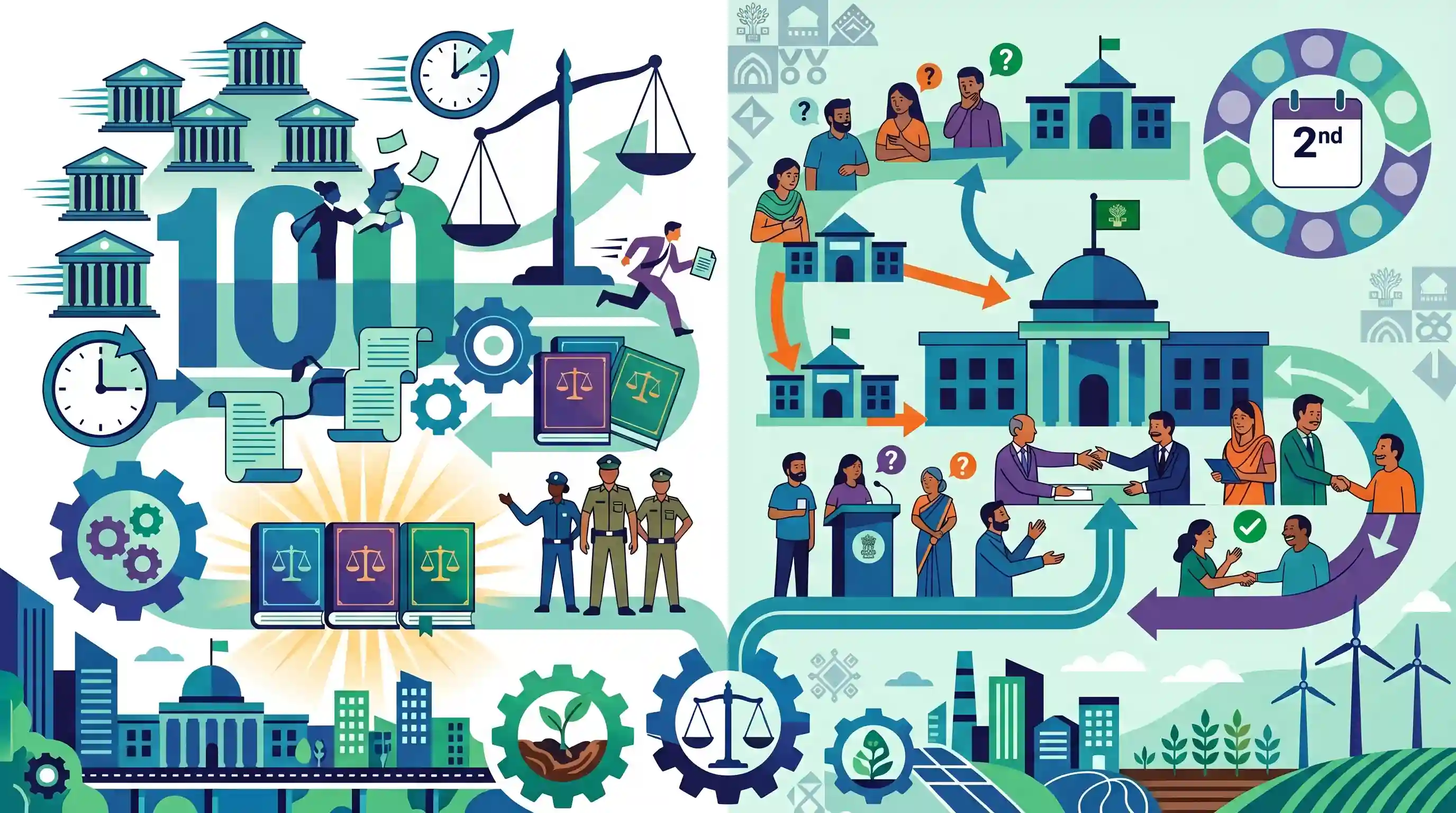
The Government of Bihar has announced the setting up of 100 fast-track courts to ensure the speedy disposal of criminal cases and strengthen law enforcement. This decision aligns with the state's transition to the new criminal law regime (BNS, BNSS, and BSA) under the governing principle of 'development with justice'. Additionally, a state-level Sahyog camp will be convened in Patna on the second Tuesday of every month to serve as an escalation and redressal mechanism for public grievances that were not resolved satisfactorily at the block level.
Key Points
- Bihar Chief Minister Samrat Choudhary announced the establishment of 100 fast-track courts across the state for the speedy disposal of criminal cases.
- The decision was announced at a state-level conference in Patna focusing on the integrated implementation of three new criminal laws: Bharatiya Nyaya Sanhita (BNS), Bharatiya Nagarik Suraksha Sanhita (BNSS), and Bharatiya Sakshya Adhiniyam (BSA).
- To streamline public grievance redressal, Bihar will organize state-level 'Sahyog camps' in Patna on the second Tuesday of every month to hear unsatisfied applicants whose issues were addressed at the block level but remained unresolved.
- The state's administrative and judicial actions remain guided by the governing policy of 'development with justice' (विकास के साथ न्याय).
- The initiative stresses coordination among the three vital pillars of governance—Judiciary, Police, and Executive—and highlights the scaling up of capacities to serve Bihar's population of 14+ crore.
- The governance plan also includes integrating Artificial Intelligence (AI) and advanced technologies to control crime and facilitate swift judicial processes.
Important Terms
Bharatiya Nyaya Sanhita (BNS)

The substantive criminal code of India that came into effect on July 1, 2024, replacing the colonial-era Indian Penal Code (IPC) of 1860 to modernize offense definitions.
UPSC context
GS Paper II: Criminal Justice Reforms. Tests understanding of substantive legal shifts, statutory definitions, and modernization of criminal jurisprudence.
Bharatiya Nagarik Suraksha Sanhita (BNSS)
The procedural law governing criminal administration in India that replaced the Code of Criminal Procedure (CrPC) of 1973, introducing timelines for trials, technology integration, and procedural safeguards.
UPSC context
GS Paper II: Judicial Administration. Tests knowledge of trial procedures, timelines for justice delivery, and procedural accountability in policing.
Bharatiya Sakshya Adhiniyam (BSA)
The modern rules of evidence in India that replaced the Indian Evidence Act of 1872, detailing the admissibility of electronic and digital records as primary evidence.
UPSC context
GS Paper II: Judicial Reforms. Tests awareness of electronic evidence standards, digital forensics, and technology integration in legal proceedings.
Fast-Track Courts (FTCs)
Specialized judicial courts established to expedite the trial and disposal of long-pending cases, particularly those involving heinous crimes, women, and children, to reduce judicial pendency.
UPSC context
GS Paper II: Structure & Functioning of Judiciary. Tests knowledge of institutional reforms addressing judicial backlog, speedy trials, and crime deterrence.
Sahyog camp initiative
A decentralized public grievance redressal program launched by the Bihar government to ensure direct interaction, time-bound resolution of public complaints, and monitoring of grassroot development schemes.
UPSC context
GS Paper II: Governance & Public Policy. Tests analysis of citizen-centric administrative mechanisms, decentralization, and state-level grievance redressal frameworks.
Prelims Trap
All Fast-Track Courts (FTCs) in India are funded through the Centrally Sponsored Scheme of the Nirbhaya Fund.
Only Fast-Track Special Courts (FTSCs) for Rape/POCSO cases are funded via the Nirbhaya Fund. Regular FTCs are state-funded, originating from 11th Finance Commission recommendations.
Static Concepts Connected
What is the difference between Fast-Track Courts (FTCs) and Fast-Track Special Courts (FTSCs)?
- Origin: FTCs recommended by 11th Finance Commission (2000) for general backlogs; FTSCs launched as a Centrally Sponsored Scheme (2019) under Law Ministry.
- Mandate: FTCs handle broad sessions cases; FTSCs focus strictly on Rape and POCSO Act cases.
- Funding: FTSCs are funded via the Nirbhaya Fund (60:40 share); regular FTCs are funded by state governments.
How does the BNSS, 2023 institutionalize speedy trials compared to the CrPC, 1973?
- Framing Charges: Mandates courts to frame charges within 60 days from the first hearing of charge.
- Judgment Delivery: Requires delivery of judgment within 30 days of completing arguments (extendable to 60 days only with written reasons).
- Victim Updates: Directs police to inform victims of progress in investigation within 90 days.
Cross-Topic Patterns
BNSS timelines + Judicial independence
Statutory timelines for judgments under BNSS intersect with the basic structure of judicial independence, balancing administrative efficiency against the right to a fair, unhurried trial.
Nirbhaya Fund + Gender-just governance
FTSCs funded through Nirbhaya pool represent a shift where fiscal federal allocation is directly tied to target-specific, fast-tracked criminal justice for women and children.

BNSS statutory timelines for trials and judgments will likely be tested against constitutional principles of natural justice and fair trial.
Linked PYQs · 1
Linked PYQs · 1
- 2022BPSC_PRELIMSGS1
Judicial process in India is based on
