Electric Vehicle Policy and Sustainable Public Transport in Bihar
Source:world-auto-forum ↗
Why It Matters
This is a critical development for Bihar-specific current affairs as it directly touches upon clean mobility, climate commitments (reducing emissions by 2030), state budget allocations, women-centric welfare policies, and infrastructure upgrades in tier-2 cities.
Summary
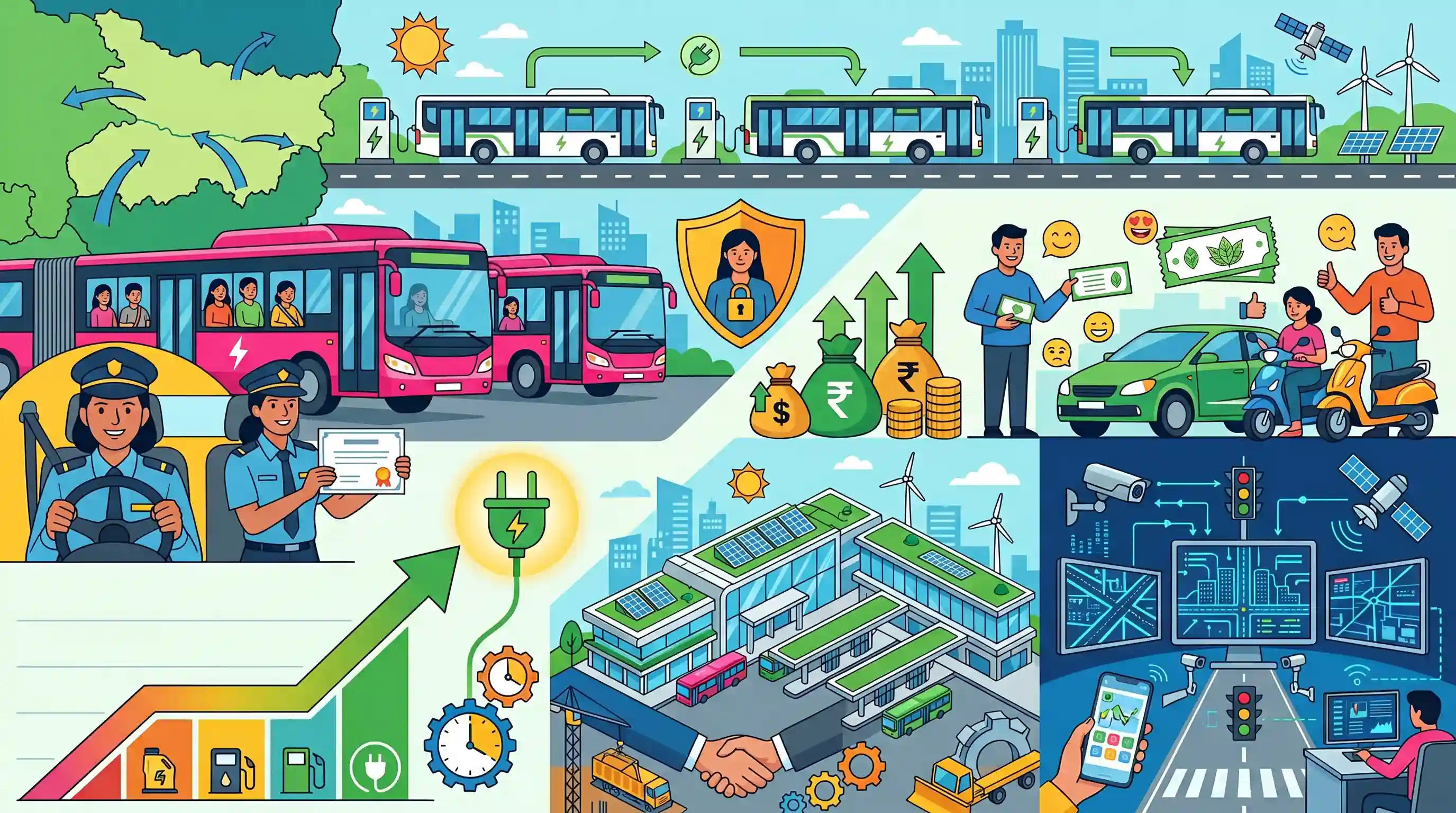
The Bihar government is significantly expanding its green transport footprint and promoting women's safety with the rollout of 200 electric buses under the PM e-Bus Sewa Phase-II scheme. Operating across six major cities, the initiative is backed by a ₹517.16 crore state allocation. In parallel, the state is introducing 100 'Pink Buses' for female commuters, training women drivers, and implementing infrastructure upgrades like modern PPP bus terminals and an Intelligent Traffic Management System. Furthermore, the newly approved Bihar Electric Vehicle (Revised) Policy 2026 provides substantial purchasing subsidies and sets an ambitious target for EVs to comprise 30% of new registrations by 2030.
Key Points
- Bihar to deploy 200 air-conditioned electric buses in June 2026 under Phase 1 of the PM e-Bus Sewa Phase-II scheme, out of a total of 400 approved buses.
- The state cabinet approved ₹517.16 crore on May 6, 2026, to fund the procurement of these 400 electric buses across six key cities: Patna, Muzaffarpur, Gaya, Bhagalpur, Darbhanga, and Purnea.
- An initiative of 100 security-equipped 'Pink Buses' (with CCTV, GPS, and panic buttons) is being rolled out for female commuters, backed by a program to train 100 female drivers (with 22 already trained).
- The newly approved Bihar Electric Vehicle (Revised) Policy 2026 (passed on May 13, 2026) offers subsidies up to ₹1 lakh for women purchasing electric four-wheelers and up to ₹12,000 for electric two-wheelers.
- The revised EV policy targets a 30 per cent share of electric vehicles in all new vehicle registrations in Bihar by 2030, aligning with the state's broader climate goals.
- Additional transit infrastructure plans include developing 31 modern bus terminals under the Public-Private Partnership (PPP) model, deploying an Intelligent Traffic Management System (ITMS) at 200 locations, and enabling e-challan payments via BBPS.
Important Terms
PM e-Bus Sewa Scheme

A centrally-sponsored scheme to deploy 10,000 electric buses under the Public-Private Partnership model across select Indian cities, strengthening green urban mobility and augmenting charging infrastructure.
UPSC context
GS Paper 3: Infrastructure and Sustainable Urban Development; tests knowledge of green transport and climate mitigation policies.
Bihar Electric Vehicle (Revised) Policy 2026
A state policy approved to ensure electric vehicles comprise 30% of new registrations by 2030, offering direct purchase subsidies, motor vehicle tax exemptions, and scrapping incentives.
UPSC context
GS Paper 3: State Government Policies and Climate Change Mitigation; tests knowledge of regional EV adoption strategies.
Bharat Bill Payment System (BBPS)
An RBI-conceptualized, interoperable bill payment ecosystem operated by the National Payments Corporation of India (NPCI) providing secure, standardized, and anytime-anywhere recurring bill payment services.
UPSC context
GS Paper 3: Indian Economy and Digital Financial Infrastructure; tests understanding of payment systems, financial inclusion, and NPCI.
Public-Private Partnership (PPP)
A long-term contractual arrangement between a government agency and a private sector entity to collaboratively design, finance, construct, and operate public infrastructure or services with shared risks.
UPSC context
GS Paper 3: Investment Models and Infrastructure; tests knowledge of infrastructure financing and private sector project delivery.
Intelligent Traffic Management System (ITMS)
An advanced, technology-driven traffic control system utilizing artificial intelligence, real-time cameras, and automatic sensors to optimize traffic flow, improve road safety, and automate traffic violation enforcement.
UPSC context
GS Paper 3: Science and Technology and Urban Infrastructure; tests knowledge of smart city technologies and digital policing.
Prelims Trap
Under PM-eBus Sewa, the central government directly procures and owns the electric buses before leasing them to state municipal bodies.
The scheme runs on a PPP model. Private operators procure, run, and maintain buses; the government provides viability/operational subsidies on a per-kilometer basis.
Static Concepts Connected
What is the Gross Cost Contract (GCC) model in public transport PPPs?
- Definition: Under GCC, private operators procure, operate, and maintain the buses, while the public authority retains fare revenue and bears demand risk.
- Payment Mechanism: The public authority pays the private operator a fixed fee per kilometer of operation, lowering commercial risk for operators.
- Relevance: This is the primary procurement model used under the PM-eBus Sewa and FAME schemes to accelerate public EV adoption.
What distinguishes Centrally Sponsored from Central Sector Schemes?
- Funding Source: Central Sector Schemes are 100% funded by the Centre, while Centrally Sponsored Schemes share costs (e.g., 60:40) between Centre and States.
- Implementation Agency: Central Sector Schemes are executed by Union ministries, whereas Centrally Sponsored Schemes are implemented by State government administrations.
- Subject Matter: Centrally Sponsored Schemes typically cover subjects listed under the State or Concurrent Lists of the Seventh Schedule.
Cross-Topic Patterns
Gender-Responsive Infrastructure & Urban Safety
Integrating pink transport networks directly addresses safe mobility, a key structural barrier to boosting India's low Female Labor Force Participation (FLFP) rate.
Fiscal Federalism & State EV Policies
State EV policies demonstrate how sub-national governments use targeted fiscal incentives to operationalize India's national climate pledges on decarbonizing transport.

Mains 2026 may require evaluating how gender-blind urban transit restricts female economic agency and how PPP frameworks can resolve this.
Linked PYQs · 1
Linked PYQs · 1
- 2023BPSC_PRELIMSGS1
Bihar Government has planned to make Bihar State ‘pollution-free’ by reducing carbon emissions by which year?
