Bihar government plans revival of three closed cooperative sugar mills
Source:chinimandi ↗
Why It Matters
The sugar industry is a cornerstone of Bihar's agro-based economy. Reviving closed mills addresses industrial sickness, creates rural employment, and provides market access to sugarcane farmers, which directly relates to BPSC's recurring focus on the state's economic development and agricultural potential.
Summary
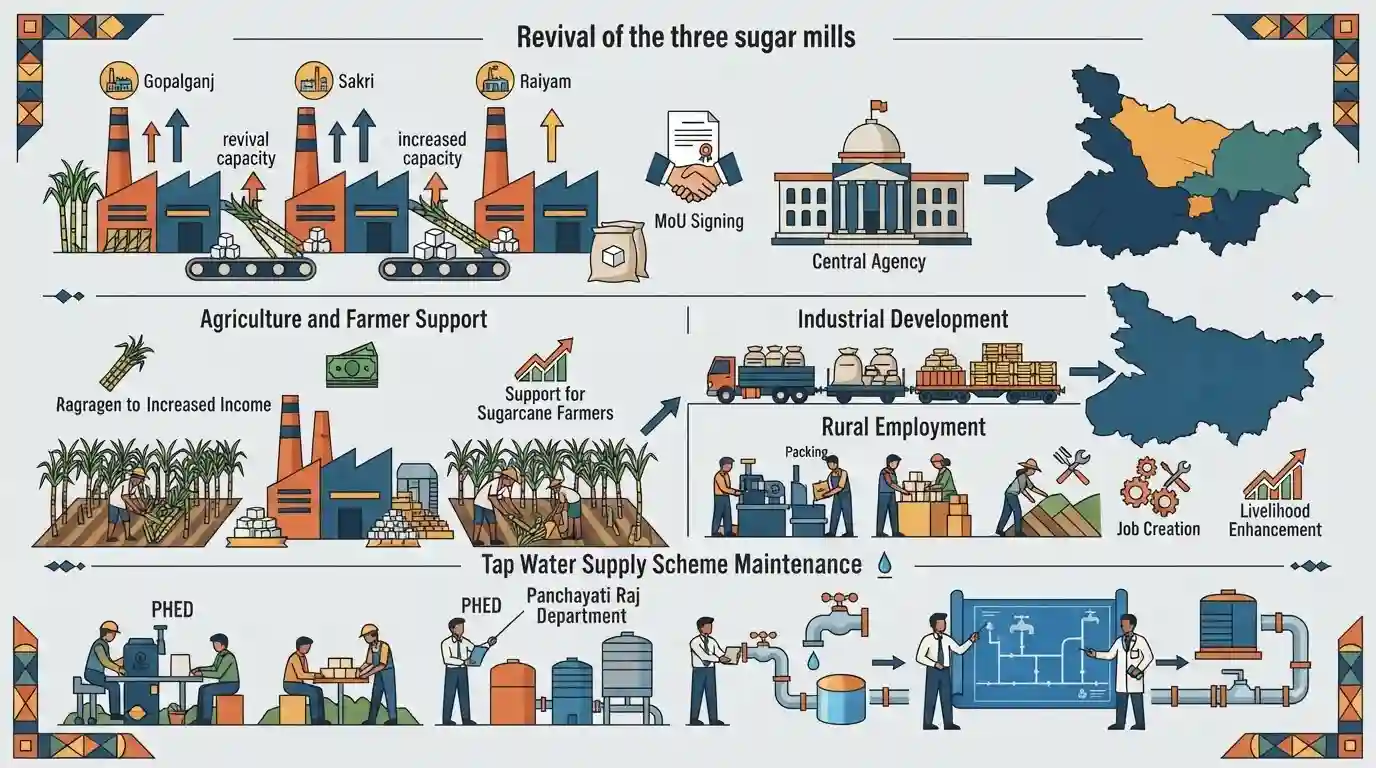
Bihar Chief Minister Samrat Choudhary announced the revival of three closed sugar mills in Gopalganj, Sakri, and Raiyam through an MoU with a central agency. This strategic move aims to boost crushing capacity, support sugarcane farmers, and generate rural employment, thereby strengthening Bihar's agro-based industrial sector. Additionally, the government will consult with the PHED and Panchayati Raj Department regarding the maintenance of the state's tap water supply scheme.
Key Points
- The Bihar government plans to revive three closed sugar mills located in Gopalganj, Sakri, and Raiyam.
- An MoU will be signed with a central government agency to facilitate the reopening of these mills.
- The initiative aims to increase sugarcane crushing capacity, improve market access for farmers, and generate rural employment.
- CM Samrat Choudhary also announced that discussions will be held with the PHED and Panchayati Raj Department regarding the maintenance of the state's tap water supply scheme.
Important Terms
Legislative Council

The upper house of a bicameral state legislature in India, such as the Bihar Vidhan Parishad. It consists of indirectly elected and nominated members who serve staggered six-year terms.
UPSC context
GS Paper 2 (Polity); tests the constitutional basis of state legislatures, bicameralism, and Articles 169 and 171.
Tap water supply scheme
Government initiatives, such as Bihar's 'Har Ghar Nal Ka Jal' and the central Jal Jeevan Mission, aimed at providing safe and functional household piped drinking water to rural areas.
UPSC context
GS Paper 2 (Government Policies); relevant for topics on public health, water security, and rural infrastructure delivery.
Public Health Engineering Department (PHED)
A state administrative body responsible for planning, executing, and maintaining rural water supply infrastructure, sanitation facilities, and ensuring drinking water quality.
UPSC context
GS Paper 2 (Governance); highlights state administrative capacity in delivering essential services and managing local public infrastructure.
Panchayati Raj Department
The state administrative department that oversees the empowerment, functioning, and funding of rural local self-governing bodies in accordance with the 73rd Constitutional Amendment.
UPSC context
GS Paper 2 (Local Self-Government); tests knowledge of democratic decentralisation, rural governance, and the devolution of administrative powers.
Prelims Trap
The State Governments are solely responsible for fixing the Fair and Remunerative Price (FRP) of sugarcane to protect local farmers.
FRP is determined nationally by the Cabinet Committee on Economic Affairs (CCEA) based on CACP recommendations, while States can only declare a State Advised Price (SAP).
Static Concepts Connected
What is the regulatory framework for sugarcane pricing in India?
- FRP Determination: The Central Government (CCEA) fixes the Fair and Remunerative Price based on CACP recommendations under the Sugarcane (Control) Order, 1966.
- State Advised Price: State Governments of key growing states declare their own SAP, which is typically higher than the federally mandated FRP.
What factors favor the South Indian sugar industry over North India?
- Tropical Climate: The maritime, frost-free climate in the South ensures a longer crushing season compared to the shorter subtropical window in the North.
- Higher Recovery Rate: Southern sugarcane varieties yield a higher sucrose content, resulting in superior sugar recovery rates per tonne of crushed cane.
Cross-Topic Patterns
Sugar industry + Biofuel economics
Integrating closed mills with ethanol production supports India's National Policy on Biofuels, creating a dual-revenue stream that mitigates cyclical sugar price shocks for rural farmers.
Decentralized water + Rural governance
Using Panchayati Raj institutions for tap water scheme maintenance tests local administrative capacity, reflecting the devolution principles of the 73rd Constitutional Amendment.

Mains questions will likely evaluate how linking agro-industries with biofuel targets (like ethanol) acts as a hedge against rural distress.
Linked PYQs · 2
Linked PYQs · 2
- 2018BPSC_PRELIMSGS1
Which type of industries has potentials and prospects in Bihar?
- 2023BPSC_PRELIMSGS1
Which food industry dominates among the agro-based industries in Bihar?
