Bihar Marksheets to Replace Fail with Skill Development
Source:drishti-ias ↗
Why It Matters
This policy shift is a unique state-level educational reform in Bihar that addresses the societal stigma of academic failure and integrates vocational training directly with secondary education. It aligns with broader national policies (like NEP 2020) and demonstrates the government's approach to human resource development and welfare in Bihar.
Summary
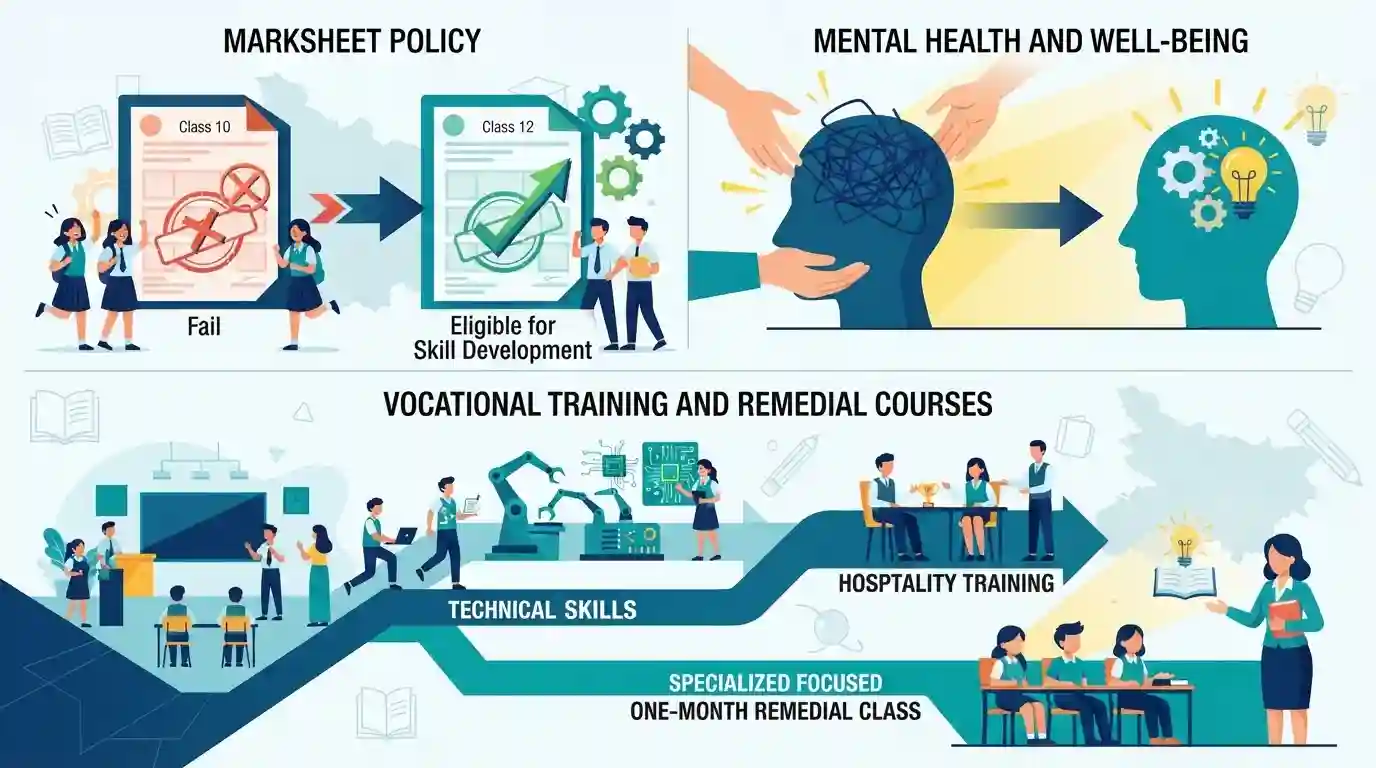
The Bihar Government has decided to replace the word 'Fail' with 'Eligible for Skill Development' on the marksheets of Class 10 and Class 12 students who do not pass their board exams, starting from the current academic session. This initiative, executed through the Education Department and BSEB, aims to alleviate the mental pressure of academic failure by guiding students toward alternative vocational and skill-based programs via the Bihar Board of Open Schooling and Examination (BBOSE). Additionally, Class 10 supplementary candidates will receive a special one-month remedial course to support their learning.
Key Points
- The Bihar Government will replace the word 'Fail' with 'Eligible for Skill Development' on Class 10 and Class 12 board marksheets starting from the current academic session.
- The Bihar Education Department will amend existing rules and direct the Bihar School Examination Board (BSEB) to execute this change.
- Students who do not clear the board examinations can pursue vocational and skill-development pathways through the Bihar Board of Open Schooling and Examination (BBOSE).
- Class 10 students appearing for supplementary exams will receive a special one-month remedial preparation support session to improve their passing chances.
- The policy aims to reduce the psychological pressure and social stigma linked to academic failure, emphasizing alternative educational and skill-based careers.
Important Terms
Bihar School Examination Board (BSEB)

A statutory body under the Bihar School Examination Act, 1952, responsible for prescribing courses and conducting secondary (Class 10) and senior secondary (Class 12) examinations across Bihar.
UPSC context
BPSC GS Paper II (Social Sector - Education); tests state education infrastructure, boards' functioning, and administrative reforms.
Bihar Board of Open Schooling and Examination (BBOSE)
An autonomous organization of the Bihar Education Department established in 2011 on the lines of NIOS to provide open and distance learning, academic, and vocational courses.
UPSC context
BPSC GS Paper II (Social Welfare/Demographic Dividend); tests alternative models for universalizing education and skill development.
Kaushal Ke Liye Patra (Eligible for Skill Development)
A new terminology introduced on Class 10 and 12 marksheets in Bihar, replacing the word "Fail" to reduce student psychological pressure and promote vocational pathways.
UPSC context
BPSC GS Paper II (Mental Health & Education Policy); tests student well-being policies, vocational integration, and progressive evaluation systems.
Bihar Skill Development Mission (BSDM)
A government-constituted society under the Department of Labour Resources responsible for formulating, monitoring, and executing standard-aligned skilling and vocational programs to enhance youth employability in Bihar.
UPSC context
BPSC GS Paper II (Human Resource Development); tests state-level employment generation, skill gaps, and Kushal Yuva Program.
Department of Education, Bihar
The primary administrative department of Bihar responsible for policy formulation, infrastructure development, and overall management of primary, secondary, higher, and mass education across the state.
UPSC context
BPSC GS Paper II (State Administration & Governance); tests administrative machinery, implementation of policies, and educational state interventions.
Prelims Trap
The term 'Eligible for Skill Development' will only be printed on marksheets issued by the Bihar Board of Open Schooling (BBOSE).
BSEB (regular board) will replace the term 'Fail' on its regular Class 10/12 marksheets, but will route those students to BBOSE and BSDM for vocational courses. The change is not limited to BBOSE marksheets.
Static Concepts Connected
What are the core components of Bihar's Kushal Yuva Program (KYP)?
- Nodal agency: Run by the Bihar Skill Development Mission (BSDM) under the Department of Labour Resources.
- Target group: Targets youth aged 15-28 (with category-wise age relaxations) who have cleared at least Class 10.
- Curriculum structure: Offers 240 hours of training covering Life Skills (40 hrs), Communication Skills (80 hrs), and IT Literacy (120 hrs).
What is the institutional mandate of BBOSE?
- Establishment: Established in February 2011 as an autonomous registered society under the Education Department, Government of Bihar.
- Model: Designed on the lines of the National Institute of Open Schooling (NIOS) to provide flexible distance education.
- Core objective: Acts as an alternative platform offering vocational, general, and life-enrichment courses for dropouts and marginalized groups.
Cross-Topic Patterns
Student mental health and policy reforms
Destigmatizing board exam failures aligns with national mental health strategies, linking state-level education policy with public health and adolescent well-being outcomes.
Demographic dividend + Skill development
Routing failed students directly into vocational pipelines via BSDM optimizes Bihar's youth demographic dividend, converting potential dropouts into employable skilled labor.

BPSC Mains GS-II may test this as a case study on educational reforms addressing both mental health and youth employability.
Linked PYQs · 3
Linked PYQs · 3
- 2025BPSC_PRELIMSGS1
What is the primary objective of Bihar’s Mission Daksh?
- 2024-IBPSC_PRELIMSGS1
In April, 2020 the Bihar Education Department started the following program through DD Bihar
- 2018BPSC_PRELIMSGS1
Among the States of India, Bihar's rank in terms of lowest literacy rate (2011 Census) is
