Government School Teacher Recruitment Drive Planned in Bihar
Source:etv-bharat ↗
Why It Matters
Large-scale recruitment drives reflect the state's focus on human resource development and employment generation. Filling vacancies in targeted institutions like the Dr Bhimrao Ambedkar Residential Schools is vital for ensuring inclusive growth and educational access for marginalized communities (SC/ST), which are key themes in governance and social justice.
Summary
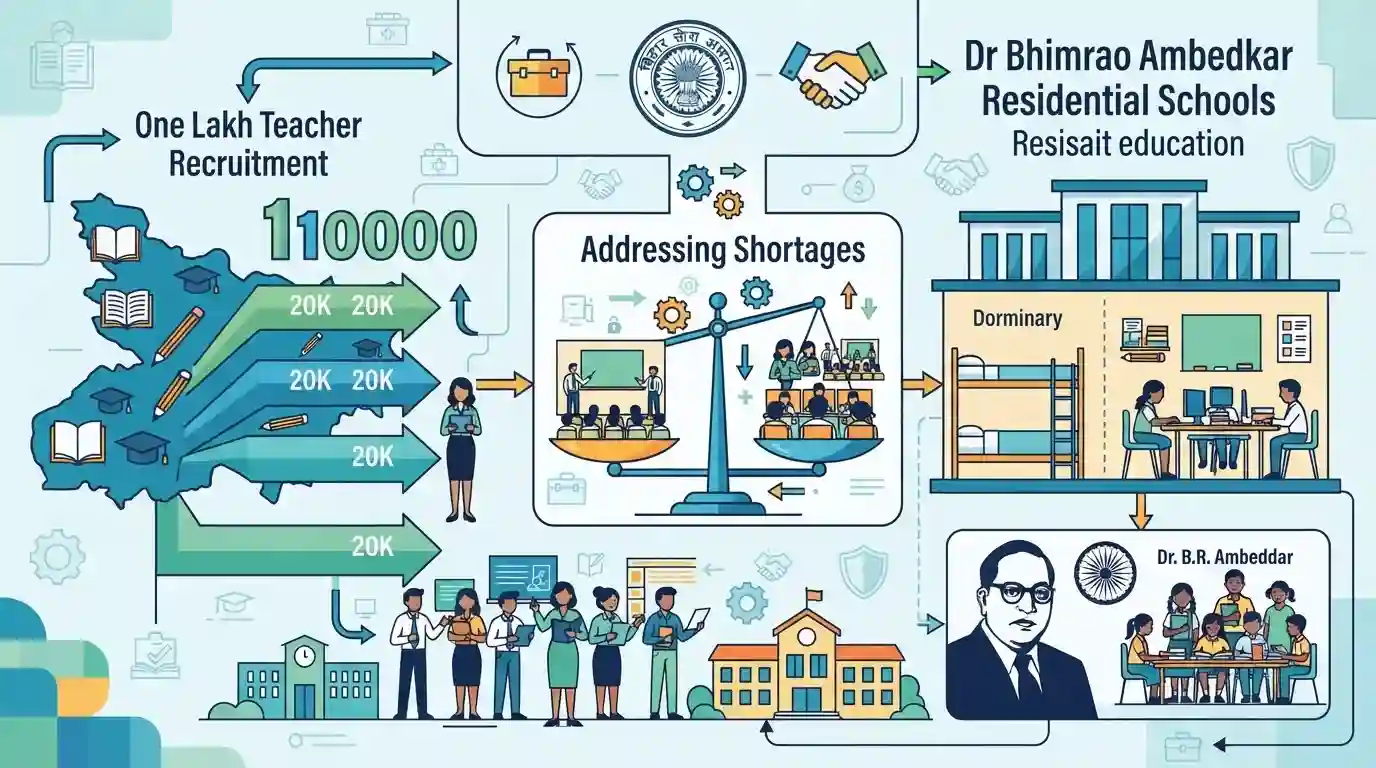
The Bihar government has announced a major employment initiative to recruit one lakh government schoolteachers over the next five years, aiming for an annual intake of 20,000. Education Minister Mithilesh Tiwari confirmed the strategy, which addresses shortages across various state-run institutions. Specifically, SC/ST Welfare Minister Lakhendra Kumar Raushan highlighted that 1,048 vacancies in the Dr Bhimrao Ambedkar Residential Schools will be filled by the BPSC through the TRE-IV examination. These schools play a crucial role in providing education to marginalized communities, currently accommodating around 38,000 students across 101 facilities in the state.
Key Points
- The Bihar government plans to recruit 1 lakh government schoolteachers over the next five years (2026-2030), averaging 20,000 per year.
- The recruitment includes filling vacancies in Dr Bhimrao Ambedkar Residential Schools, which are run for Scheduled Castes and Scheduled Tribes (SC/ST).
- A requisition for recruiting 1,048 teachers for these residential schools has been sent to the BPSC under the TRE-IV drive.
- The SC/ST Welfare Department currently operates 101 such residential schools, providing education and accommodation to approximately 38,000 students.
Prelims Trap
Dr. Bhimrao Ambedkar Residential Schools are a Centrally Sponsored Scheme nationwide.
These Ambedkar residential schools are a state-specific initiative by Bihar's SC/ST Welfare Department, unlike Eklavya Model Residential Schools (EMRS) which are Central.
Static Concepts Connected
What are the Constitutional provisions for SC/ST educational advancement?
- Article 46 (DPSP): Directs the State to promote the educational and economic interests of weaker sections, particularly SCs and STs, and protect them from social injustice.
- Article 15(4) & (5): Empowers the State to make special provisions, including reservations in educational institutions, for the advancement of socially and educationally backward classes, SCs, and STs.
What is the framework for Eklavya Model Residential Schools (EMRS)?
- Central Sector Scheme: EMRS is a Central Sector Scheme run by the Ministry of Tribal Affairs to provide quality upper-primary and secondary education to ST students.
- Article 275(1) Grants: Funds for establishing these schools are routed through grants under Article 275(1) of the Constitution for blocks with over 50% ST population.
Cross-Topic Patterns
EMRS vs State Welfare Schools
State-led SC/ST residential schools parallel the Union's EMRS push. UPSC often tests overlapping central vs. state jurisdictions in welfare delivery and education models.
RTE compliance and State Capacity
Mass teacher recruitment drives by states address persistent shortfalls in the Pupil-Teacher Ratios mandated by the Right to Education (RTE) Act, reflecting state capacity challenges.

Mains 2026 may ask to evaluate specialized residential schools (EMRS, Kasturba Gandhi, state models) in bridging SC/ST educational inequity.
Linked PYQs · 3
Linked PYQs · 3
- 2025BPSC_PRELIMSGS1
What is the primary objective of Bihar’s Mission Daksh?
- 2024-IBPSC_PRELIMSGS1
In April, 2020 the Bihar Education Department started the following program through DD Bihar
- 2024-EBPSC_PRELIMSGS1
Which of the following districts of Bihar has the highest percentage of Scheduled Tribe population in 2011 census?
