Bihar announces compensation and job for Bhojpur encounter victim
Source:The Hindu ↗
Why It Matters
The case brings attention to extrajudicial killings (fake encounters), police accountability, and the mechanisms—such as judicial inquiries and SITs—used by the state to address human rights violations and maintain public trust.
Summary
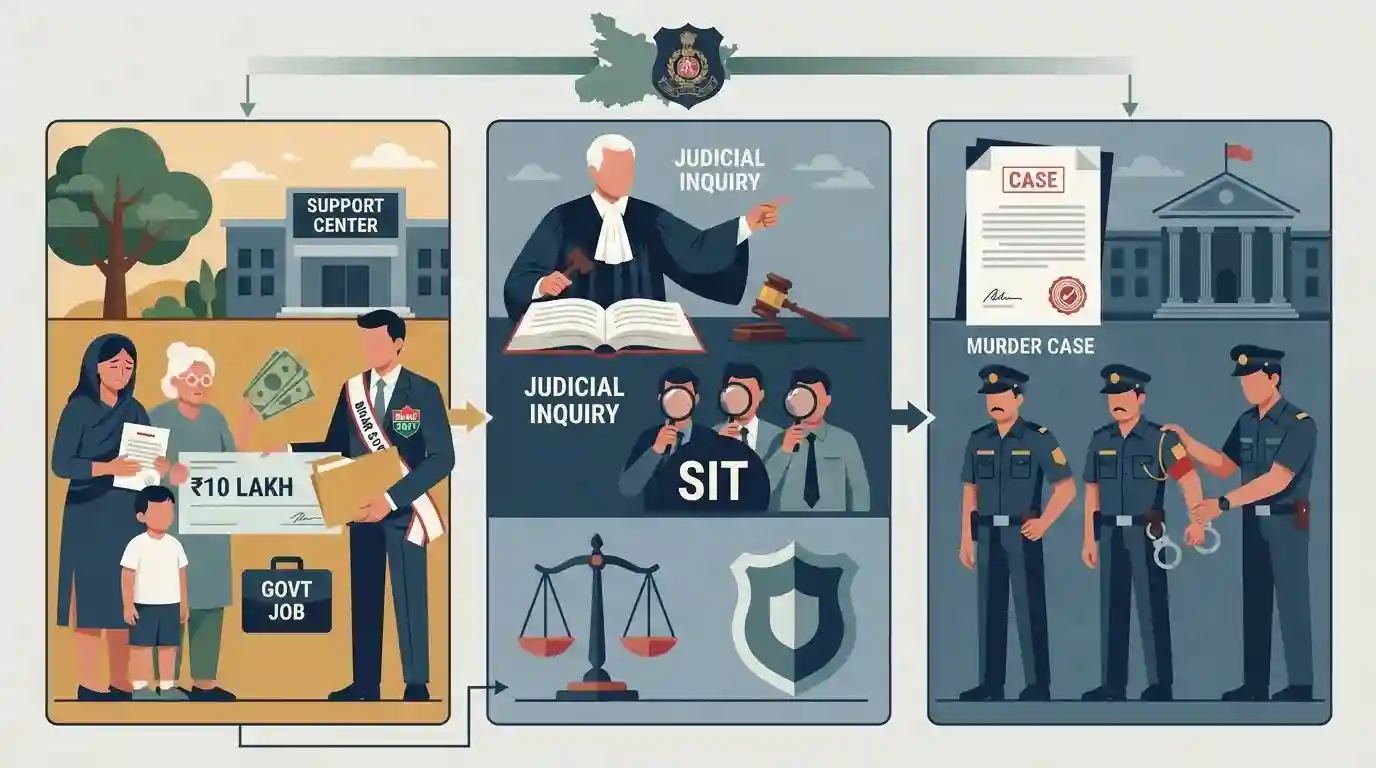
The Bihar government has pledged financial assistance of ₹10 lakh and a government job for the family of Bharat Bhushan Tiwari, a victim of an alleged fake encounter by police in Bhojpur district. Amidst political pressure, the government also ordered a judicial inquiry, the formation of an SIT, and the filing of a murder case against the involved officers, highlighting state accountability in human rights violations.
Key Points
- The Bihar government announced ₹10 lakh in financial assistance and a government job for the family of Bharat Bhushan Tiwari, who was killed in an alleged fake police encounter in Bhojpur district.
- Deputy Chief Minister Vijay Kumar Sinha stated that an FIR under Section 302 (murder) will be lodged against those responsible.
- A Special Investigation Team (SIT) is investigating the case, and a judicial inquiry will be established to ensure accountability.
- The incident underscores critical concerns regarding extrajudicial killings, police reforms, and state mechanisms for upholding human rights.
Important Terms
Fake Encounter

An extrajudicial killing by police or armed forces, usually in custody, staged to appear as an act of self-defense during a confrontation. It lacks specific legal definition but violates fundamental rights under the Constitution.
UPSC context
GS Paper 2 (Human Rights/Polity). Tests understanding of rule of law, Article 21 (Right to Life), and police reforms.
Special Investigation Team (SIT)
A specialized team appointed by courts or governments to probe complex, high-profile, or sensitive cases where standard investigative agencies may lack impartiality or resources.
UPSC context
GS Paper 2 (Governance). Tests knowledge of independent investigation mechanisms, accountability, and the criminal justice system.
Judicial Inquiry
A formal investigation often set up under a specific law to examine serious incidents, allegations of misconduct, or complex issues, frequently headed by serving or retired judges to ensure impartiality.
UPSC context
GS Paper 2 (Polity/Governance). Relevant for understanding institutional accountability, separation of powers, and public trust in administration.
Prelims Trap
Police officers involved in encounter deaths have automatic immunity from murder charges until a magisterial inquiry is concluded.
Under the PUCL (2014) guidelines, an FIR must be immediately registered against participating officers if a complaint alleges a fake encounter; there is no automatic immunity.
Static Concepts Connected
What are the Supreme Court's PUCL guidelines for investigating police encounter deaths?
- Mandatory FIR: Immediate registration of an FIR is required against participating officers and must be forwarded to the competent court.
- Independent Probe: Investigation must be conducted by the CID or a police team from another station, supervised by a senior officer.
- Magisterial Inquiry: A mandatory Magisterial inquiry must be held in all cases of police encounter deaths to determine the facts.
What is the constitutional remedy of compensation for state excesses?
- Article 21 Remedy: The Supreme Court in Nilabati Behera established monetary compensation as a direct public law remedy for deprivation of the Right to Life.
- Sovereign Immunity Bypassed: The State cannot invoke the defense of sovereign immunity to escape strict liability for human rights violations like fake encounters or custodial deaths.
Cross-Topic Patterns
Encounters & Police Complaints Authorities
Frequent extrajudicial killings underscore the poor implementation of the Prakash Singh directives, specifically the mandate to establish independent Police Complaints Authorities to probe serious police misconduct.
Article 21 vs. Sovereign Immunity
State compensation for fake encounters links fundamental rights with tort law, ensuring colonial doctrines like sovereign immunity cannot shield the state from accountability for violating Article 21.

PUCL guidelines on encounters, NHRC reporting norms, and Magisterial inquiry mandates under BNSS are high-probability for 2026 Prelims.
Linked PYQs · 2
Linked PYQs · 2
- 2025BPSC_PRELIMSGS1
Which one of the following subjects fall within the jurisdiction of both High Court and Supreme Court?
- 2025BPSC_PRELIMSGS1
The constitution of India provides for reasonable restrictions on Fundamental Rights but reasonableness must keep in mind that: 1. The restrictions must be necessary for the protection of the rights of others. 2. The restrictions must be proportionate to the end sought. 3. The restrictions must be reasonable in the light of the circumstances. 4. The restrictions must be in the public interest.
