Bihar Government Orders Withdrawal of NEET Protester FIRs
Source:indiatoday ↗
Why It Matters
Highlights the balance between maintaining public order and protecting citizens' fundamental rights to peaceful assembly and protest, as well as the discretionary power of the state executive in prosecuting or withdrawing criminal cases against protesters.
Summary
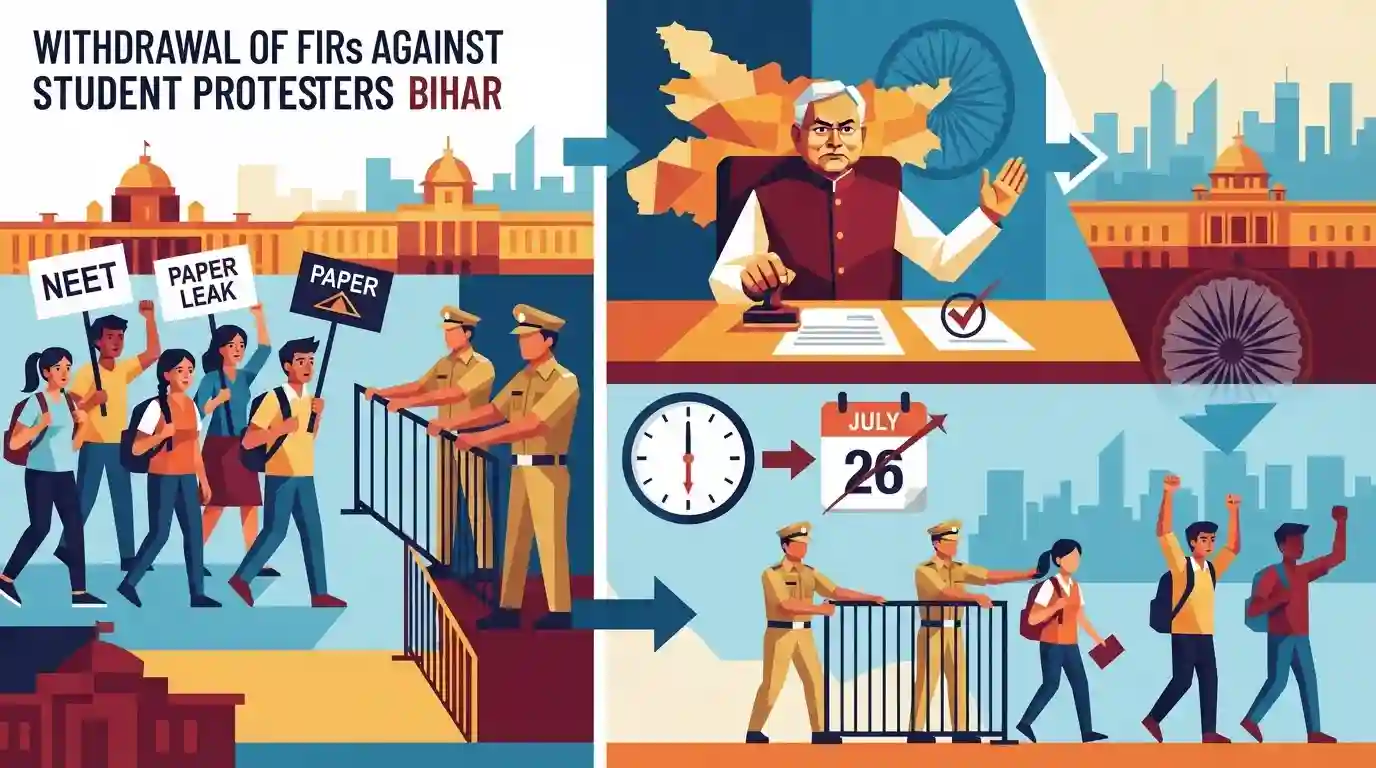
The Bihar government has decided to withdraw FIRs filed against students and youths who protested against the NEET-UG paper leak controversy. Chief Minister Nitish Kumar directed the state DGP to release the detainees and drop the cases registered before 6 PM on July 26.
Key Points
- The Bihar government ordered the withdrawal of FIRs filed against students and youths protesting the NEET-UG paper leak.
- The directive applies to all FIRs lodged up to 6 PM on July 26.
- Chief Minister Nitish Kumar issued instructions to DGP RS Bhatti to release all detained protesters immediately.
Important Terms
Right to Protest

A fundamental democratic right derived from Article 19(1)(a) (freedom of speech) and 19(1)(b) (peaceful assembly) of the Constitution, allowing citizens to publicly express dissent against government policies.
UPSC context
GS Paper 2 (Fundamental Rights). Tests the constitutional balance between democratic dissent and public order.
Withdrawal of Prosecution
A statutory power (Section 321 CrPC / corresponding BNSS provisions) allowing a Public Prosecutor, with court consent, to withdraw criminal charges in the interest of public policy or justice.
UPSC context
GS Paper 2 (Criminal Justice System). Tests executive discretion versus judicial oversight in dropping criminal cases.
Reasonable Restrictions
Constitutional limits placed on fundamental freedoms under Article 19(2) and 19(3) to protect public order, state security, sovereignty, and integrity, ensuring individual rights are not absolute.
UPSC context
GS Paper 2 (Indian Constitution). Tests the lawful limits placed on the right to protest and assemble.
Unlawful Assembly
An assembly of five or more persons whose common object involves criminal force, resisting law execution, or committing an offence, rendering them liable for dispersal or arrest.
UPSC context
GS Paper 2/3 (Law & Order). Tests the legal threshold where a peaceful protest becomes a public order violation.
Prelims Trap
The Chief Minister or State Government can unilaterally withdraw criminal FIRs filed by the state police.
State executives cannot unilaterally drop FIRs. The Public Prosecutor must file an application under Section 360 BNSS, which requires judicial consent and a mandatory hearing of the victim.
Static Concepts Connected
What is the legal procedure for the state to withdraw criminal prosecutions?
- Statutory backing: Governed by Section 360 of the BNSS 2023 (formerly Sec 321 CrPC), allowing the Public Prosecutor or Assistant PP to apply for withdrawal.
- Court consent required: The state cannot unilaterally drop cases; the withdrawal strictly requires the prior consent of the presiding court.
- Victim hearing mandate: BNSS 2023 introduces a new safeguard requiring courts to give victims an opportunity to be heard before permitting case withdrawal.
How is the Right to Protest protected under the Indian Constitution?
- Implicit fundamental right: Not explicitly named, but derived collectively from Article 19(1)(a) (freedom of speech) and 19(1)(b) (peaceful assembly without arms).
- Reasonable restrictions: Subject to reasonable restrictions under Article 19(2) and (3) on grounds of India's sovereignty, integrity, and public order.
Cross-Topic Patterns
Executive leniency vs BNSS victim safeguards
State government directives to drop protest FIRs will now be tested against the newly implemented BNSS 2023, which introduces a mandatory victim-hearing clause before any case withdrawal is permitted.
Fundamental Rights vs Public Order
The recurring constitutional tension between the democratic Right to Protest (Article 19) and state police powers utilizing preventive measures like Section 163 of BNSS (formerly Sec 144 CrPC).

Expect a 2026 Polity question testing the new BNSS 2023 rule: states cannot withdraw criminal cases without the court hearing the victim.
Linked PYQs · 2
Linked PYQs · 2
- 2025BPSC_PRELIMSGS1
The constitution of India provides for reasonable restrictions on Fundamental Rights but reasonableness must keep in mind that: 1. The restrictions must be necessary for the protection of the rights of others. 2. The restrictions must be proportionate to the end sought. 3. The restrictions must be reasonable in the light of the circumstances. 4. The restrictions must be in the public interest.
- 2025BPSC_PRELIMSGS1
Which one of the following subjects fall within the jurisdiction of both High Court and Supreme Court?
