Bihar Nyayshruti Digital Justice System Pilot for Criminal Trials
Source:indianmasterminds ↗
Why It Matters
Highlights Bihar's significant step toward judicial modernization and e-governance through the 'Nyayshruti' initiative, relevant for state-specific current affairs and governance topics in BPSC Prelims.
Summary
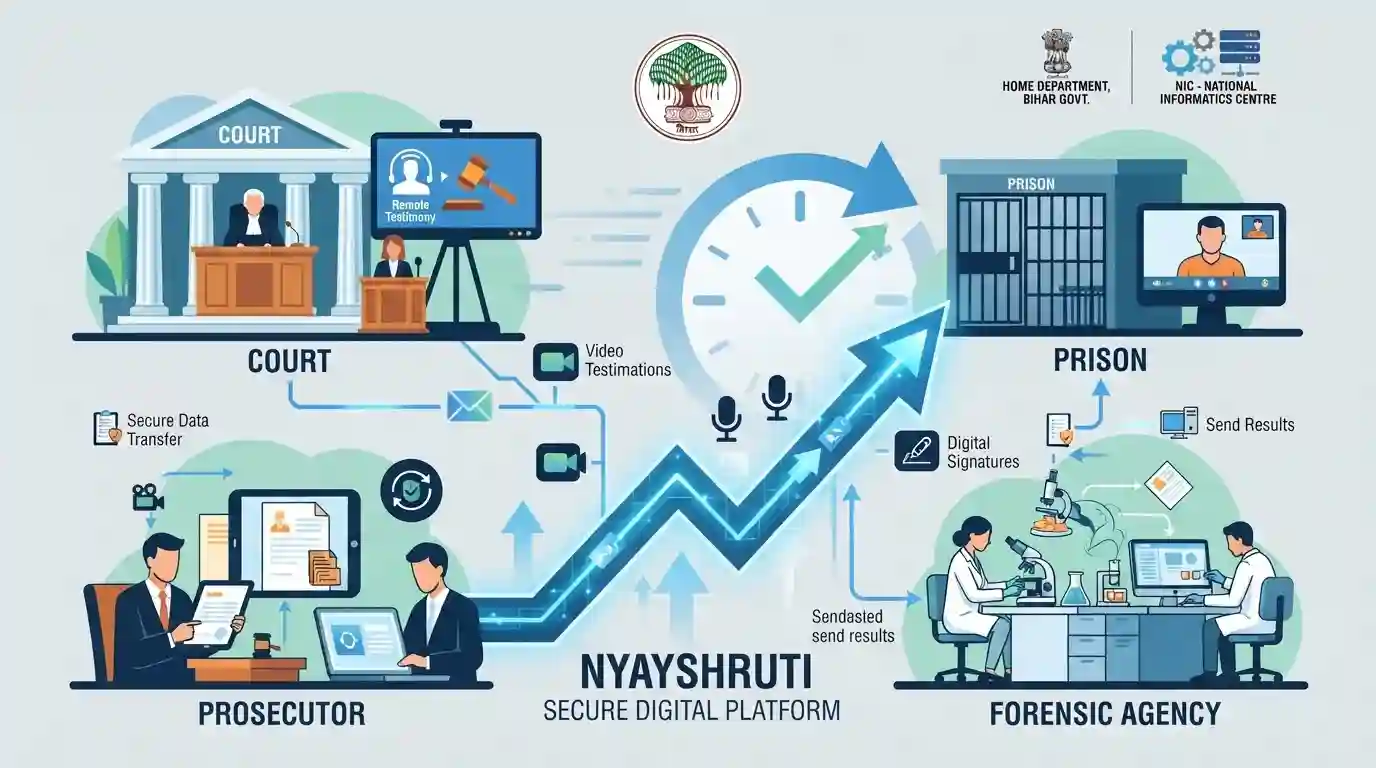
The Bihar government successfully conducted a mock trial of 'Nyayshruti', an advanced digital justice system designed to accelerate criminal trials. Connecting courts, prisons, prosecutors, and forensic agencies, the platform allows for secure digital testimonies and cross-examinations, minimizing delays. Coordinated by the Home Department and supported by the National Informatics Centre (NIC), Nyayshruti aligns with the implementation of India's new criminal laws to modernize the judicial process and improve efficiency.
Key Points
- Bihar successfully completed a pilot test of 'Nyayshruti', a pioneering digital justice delivery system.
- The system seamlessly integrates courts, prosecution, prisons, and forensic science laboratories (FSL) to speed up criminal trials.
- It allows witnesses, including police and medical officers, to record their testimonies and face cross-examinations digitally from their respective locations.
- The initiative aims to facilitate the effective implementation of new criminal laws by ensuring faster justice delivery and reducing trial delays.
- The platform was developed and supported technically by the National Informatics Centre (NIC) under the guidance of the Bihar Home Department.
Important Terms
Nyayshruti

A digital platform launched by the Union Home Ministry that enables courts to hear secure witness testimonies, prisoner hearings, and expert depositions remotely via video conferencing.
UPSC context
GS Paper II (E-Governance/Judiciary). Tests understanding of technological solutions to reduce case pendency and expedite trials.
Bharatiya Nagarik Suraksha Sanhita (BNSS)
India's modernized criminal procedure law, replacing the 1973 CrPC, which legally mandates forensic investigations and authorizes the conduct of trials and recording of evidence in electronic modes.
UPSC context
GS Paper II (Criminal Justice Reforms). Tests knowledge of statutory transitions toward a technology-enabled procedural framework.
Home Department, Bihar
The provincial administrative department responsible for maintaining internal security, managing state police and prisons, and coordinating state-level digital judicial initiatives like Nyayshruti.
UPSC context
GS Paper II (State Governance). Tests knowledge of executive departments implementing law, order, and digital reforms.
National Informatics Centre (NIC)
A key central agency under the MeitY that provides technical infrastructure and IT support to digitize Indian governance, including the development of e-courts and judicial portals.
UPSC context
GS Paper II (E-Governance). Tests awareness of the institutional technology partner driving government digitization initiatives.
State Crime Records Bureau (SCRB)
A state-level division of the police department responsible for managing crime data, tracking criminal records, and implementing ICT platforms like CCTNS.
UPSC context
GS Paper II (Criminal Justice System). Tests understanding of decentralized data management and tracking systems in law enforcement.
Prelims Trap
Nyayshruti is a state-sector digital initiative developed exclusively by and for the state of Bihar.
Nyayshruti is actually a national-level e-governance platform launched under the Inter-operable Criminal Justice System (ICJS), not an exclusive state project. Over 20 High Courts have notified rules for it.
Static Concepts Connected
What is the Inter-operable Criminal Justice System (ICJS)?
- Scheme Type: It is a Central Sector Scheme under the Ministry of Home Affairs (MHA).
- Implementing Agencies: The National Crime Records Bureau (NCRB) is the nodal implementing agency, with NIC as the technology partner.
- Five Pillars: It integrates the five pillars of the criminal justice system: Police (CCTNS), e-Forensics, e-Courts, e-Prosecution, and e-Prisons.
How do the new criminal laws accommodate digital justice?
- Virtual Trials (BNSS): Section 530 of BNSS permits all trials, inquiries, and proceedings to be conducted in electronic mode.
- Electronic Evidence (BSA): Section 63 of BSA requires a dual-signature certification process (device controller and technical expert) to ensure data integrity and prevent tampering.
Cross-Topic Patterns
ICJS and CCTNS integration
Nyayshruti's integration relies heavily on the backbone of the Inter-operable Criminal Justice System (ICJS) and CCTNS, connecting the five pillars of the justice system (Police, Courts, Prisons, Prosecution, Forensics).
Digital transition of new criminal laws
The platform operationalizes the mandate of the new Bharatiya Nagarik Suraksha Sanhita (BNSS) and Bharatiya Sakshya Adhiniyam (BSA) which actively promote electronic evidence and remote testimonies.

The nodal agencies of ICJS (NCRB/NIC) and specific admissibility criteria for electronic evidence under BSA (Section 63) are prime 2026 targets.
Linked PYQs · 2
Linked PYQs · 2
- 2022BPSC_PRELIMSGS1
The 'Digital India Award, 2020' was given to the Bihar Government for
- 2022BPSC_PRELIMSGS1
Judicial process in India is based on
