Bihar and Telangana partner for makhana and oil palm farm innovation
Source:indian-masterminds ↗
Why It Matters
Makhana (fox nut) is a major GI-tagged agricultural product of Bihar, making it highly relevant for BPSC Prelims geography and economy sections. Initiatives promoting agricultural diversification, modern technology, and climate resilience are also central to the state's economic development and frequently appear in both prelims and mains.
Summary
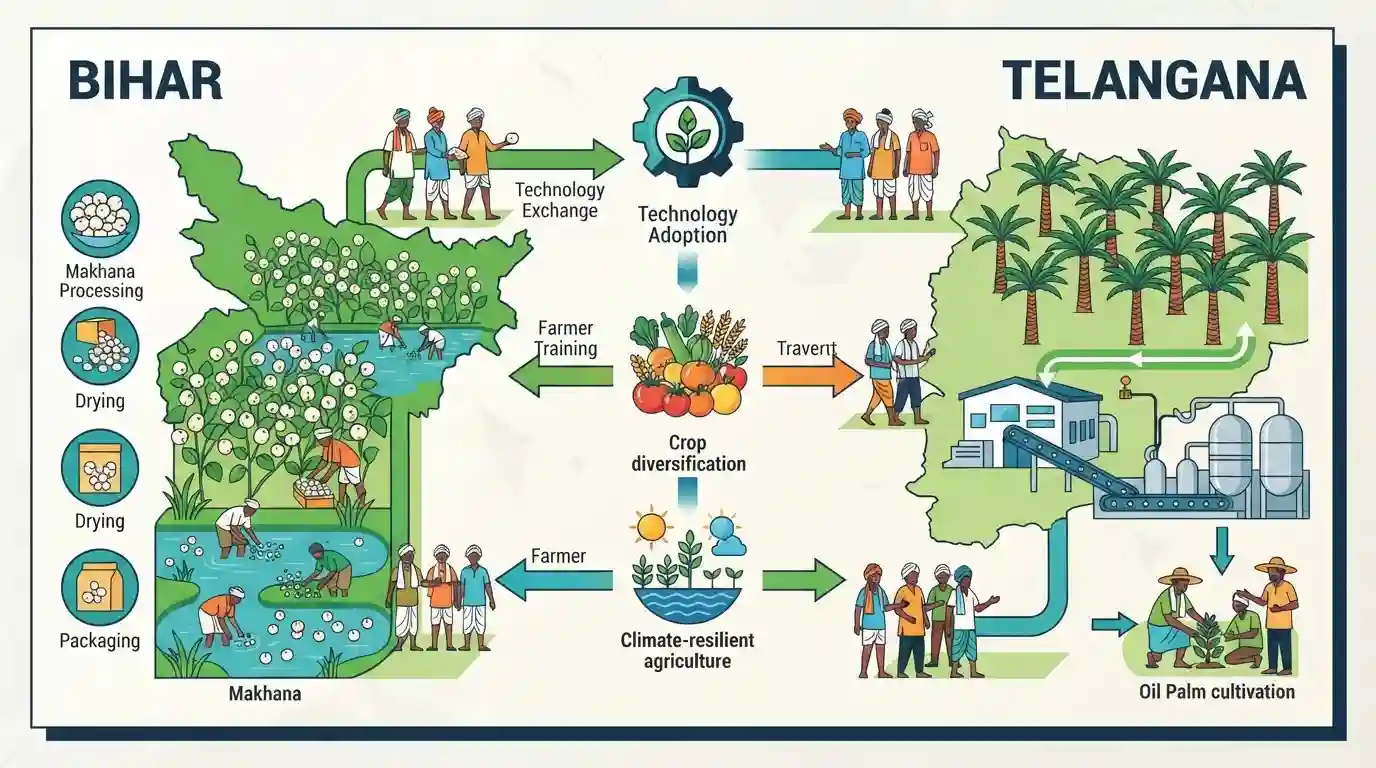
Bihar and Telangana have agreed to strengthen agricultural cooperation through technology exchange, cross-state farmer training, and the sharing of successful farming practices. Under the proposed exchange, farmers from Bihar will visit Telangana to learn about oil palm cultivation and processing, while Telangana farmers will travel to Bihar to gain practical knowledge on makhana (fox nut) cultivation and value addition. The initiative also emphasizes crop diversification, modern technology adoption, and climate-resilient agriculture to help farmers respond to changing environmental conditions and explore new income opportunities.
Key Points
- Bihar and Telangana have agreed on agricultural cooperation focusing on technology exchange, farmer training, and sharing successful practices.
- Bihar farmers will learn oil palm cultivation and processing techniques from Telangana.
- Telangana farmers will visit Bihar to study makhana (fox nut) cultivation, processing, and value addition.
- The collaboration aims to promote agricultural diversification, market access, and climate-resilient farming practices.
Important Terms
Bihar Agriculture Department

The state nodal agency responsible for executing agricultural policies, promoting crop diversification, and developing specialized farming clusters for crops like makhana. It actively facilitates inter-state technology exchange and farmer training.
UPSC context
Relevant for GS 2 (State Governance) and GS 3 (Agriculture). Highlights the state-level institutional role in agrarian development.
Telangana Agriculture Department
The state agency in Telangana driving agricultural innovation, crop diversification, and farmer welfare. It promotes large-scale oil palm cultivation and integrates modern technologies like AI and satellite monitoring into farming.
UPSC context
Relevant for GS 2 and GS 3. Illustrates state-led digital agriculture initiatives and robust crop diversification strategies.
Makhana Cultivation
Cultivation of the aquatic crop Euryale ferox (fox nut) in stagnant freshwater bodies. It is a highly nutritious cash crop, with Bihar accounting for over 85% of India's production and holding a GI tag.
UPSC context
Important for GS 3 (Agriculture). Tests knowledge of regional cropping patterns, GI tags, and nutritional security.
Oil Palm Cultivation
The farming of oil palm trees to produce edible palm oil. Heavily promoted in India to reduce import dependence, requiring tropical conditions, micro-irrigation, and processing infrastructure.
UPSC context
Crucial for GS 3 (Agriculture/Economy). Tests understanding of India's edible oil security, import substitution, and national agricultural missions.
Crop Diversification
Shifting from a single dominant crop to a varied mix of crops, including pulses, oilseeds, and horticulture. It enhances soil health, mitigates climate and price risks, and improves water use efficiency.
UPSC context
Core topic in GS 3 (Agriculture). Evaluated regarding sustainable farming, resource conservation, and doubling farmers' income.
Climate-Resilient Agriculture
An integrated farming approach designed to withstand climate shocks like droughts and erratic rainfall. It combines heat-tolerant crop varieties, micro-irrigation, and sustainable practices to maintain productivity and food security.
UPSC context
High priority for GS 3 (Environment/Agriculture). Tests strategies for climate change adaptation and sustainable agricultural frameworks.
Prelims Trap
"The Northeast region is currently India's largest producer of palm oil due to the NMEO-OP."
While the NMEO-OP heavily targets the Northeast for expansion, southern states (Andhra Pradesh, Telangana, Kerala) actually produce 98% of India's domestic palm oil.
Static Concepts Connected
What are the specific geographic and climatic conditions required for Makhana cultivation?
- Water requirements: Thrives in shallow, stagnant perennial freshwater bodies such as wetlands, ponds, and oxbow lakes.
- Climatic zone: Requires a hot and humid tropical or subtropical climate for optimal growth.
- Soil type: Grows best in heavy, clayey soils rich in organic matter found at the bottom of ponds.
What are the core features of the National Mission on Edible Oils - Oil Palm?
- Mission Objective: A Centrally Sponsored Scheme launched in 2021 to reduce import dependence by expanding domestic palm oil acreage.
- Target regions: Places special emphasis on expanding cultivation in the Northeast and Andaman & Nicobar Islands.
- Price Assurance: Incorporates a Viability Gap Funding (VGF) mechanism to protect farmers from global price volatility.
Cross-Topic Patterns
Horizontal Federalism in Agriculture
Inter-state agricultural exchanges (like Bihar-Telangana) showcase horizontal cooperative federalism, moving beyond traditional Center-State schemes to address crop diversification directly.
Import Substitution via Diversification
Telangana's aggressive oil palm expansion links local crop diversification directly to national macroeconomic goals, specifically reducing India's massive edible oil import bill.

Expect a multi-statement question contrasting the aquatic wetland ecology of Makhana with the high-water footprint of Oil Palm in 2026.
Linked PYQs · 3
Linked PYQs · 3
- 2024-IBPSC_PRELIMSGS1
In which district of Bihar the fox nut is produced highest?
- 2023BPSC_PRELIMSGS1
Which of the following has been awarded the Geographical Indication (GI) Tag in August 2022?
- 2018BPSC_PRELIMSGS1
Which one of the following is the pathway to increase productivity in agriculture?
