School Teacher Transfer Policy and Administrative Reforms
Source:patnapress ↗
Why It Matters
This news highlights Bihar's administrative and decentralized personnel management within primary and secondary education. Understanding the structural hierarchy (panchayats, blocks, districts) and the roles of state-level bodies like SCERT is critical for state governance and administrative reform topics in the BPSC Prelims.
Summary
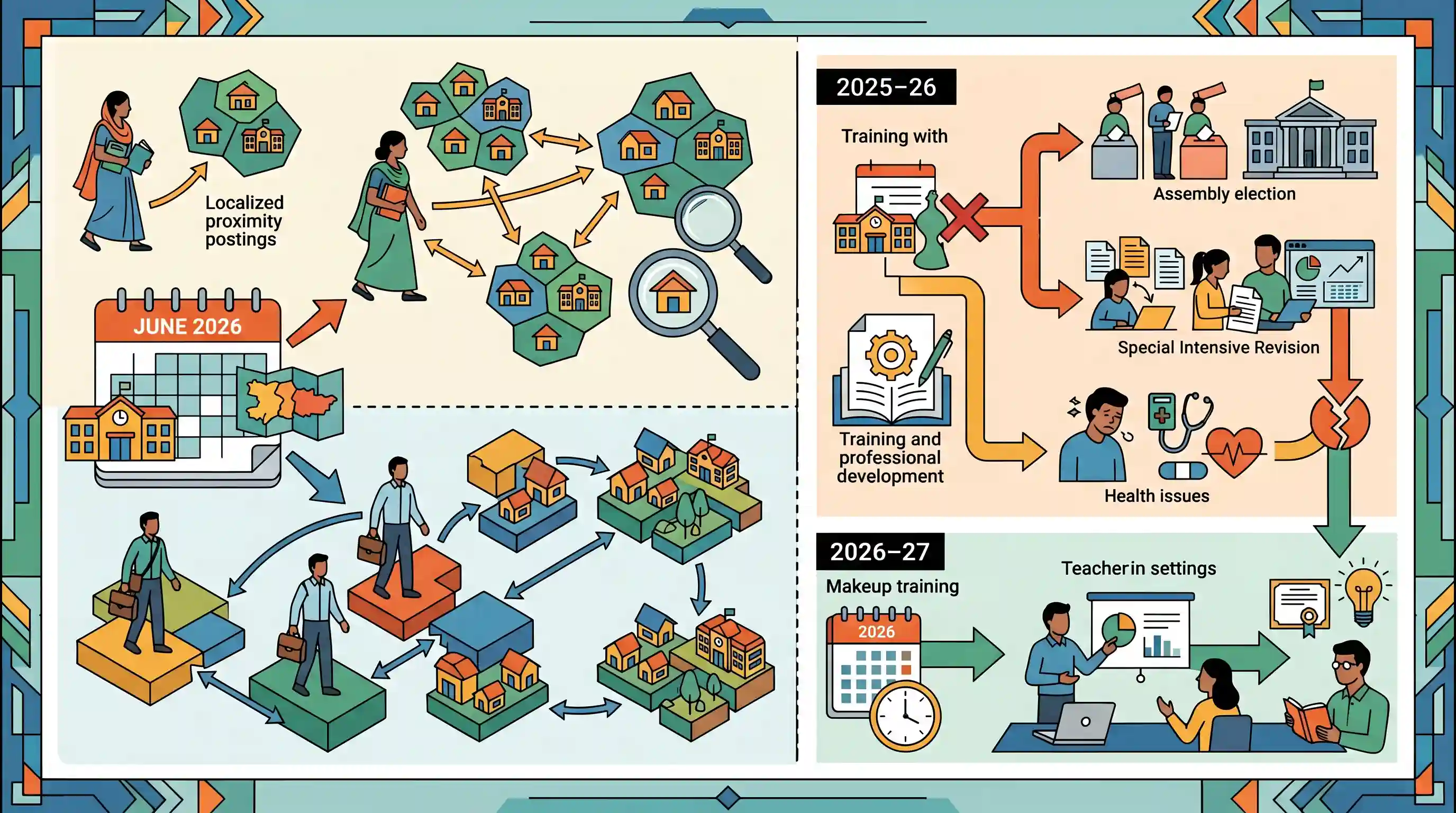
Bihar Chief Minister Samrat Choudhary announced a new teacher transfer policy scheduled for implementation in June 2026, featuring proximity-based postings for female teachers in adjacent panchayats and male teachers in neighbouring blocks. Additionally, the State Council of Educational Research and Training (SCERT) issued training-related reliefs, permitting teachers who missed the 2025–26 training sessions due to official duties (like Assembly elections and Special Intensive Revision) or health issues to make up for them in the 2026–27 session.
Key Points
- Bihar Chief Minister Samrat Choudhary announced at a public programme in Sheikhpura that government school teacher transfers and postings will be completed within June 2026.
- The new policy framework aims to minimize commute distances: women teachers will be prioritized for postings in panchayats adjacent to their home panchayats, while male teachers will be eligible for postings in neighboring blocks.
- State Council of Educational Research and Training (SCERT) issued fresh instructions under Bihar Education Minister Mithilesh Tiwari to allow teachers who missed training during the 2025-26 session to attend in 2026-27.
- Exemptions from training action are granted to teachers who missed sessions due to Special Intensive Revision (SIR) duties, Assembly election duties, or health issues.
- Teachers away from headquarters up to June 20, 2026, under approved summer plans, will face no departmental disciplinary action for missing training.
Important Terms
Bihar State Teacher Transfer Rules, 2026

A policy approved by the Bihar Cabinet in June 2026 to govern systematic, portal-based transfers of over 5.5 lakh school teachers, prioritizing proximity-based postings.
UPSC context
GS Paper II (Governance/Human Resources). Tests understanding of administrative reforms and gender-sensitive deployment in public service.
Special Intensive Revision (SIR)
A comprehensive door-to-door verification and update of electoral rolls undertaken by the Election Commission of India to ensure accurate, error-free voter lists.
UPSC context
GS Paper II (Polity/Elections). Relevant for issues regarding electoral roll integrity, the Representation of the People Act, and democratic processes.
State Council of Educational Research and Training (SCERT)
A state-level academic body modeled after NCERT, responsible for teacher training, educational research, curriculum design, and advising state governments on policy implementation.
UPSC context
GS Paper II (Education/Social Sector). Tests knowledge of institutional frameworks for enhancing teaching standards and primary education quality.
Bihar Education Department
The state administration department in Bihar tasked with formulating educational policy, supervising schools, conducting recruitment, and executing infrastructure and administrative reforms.
UPSC context
GS Paper II (Governance/State Administration). Examines fiscal allocations, human resource management, and administrative efficiency in public education.
Prelims Trap
Under the 73rd Constitutional Amendment, the administrative power of transferring primary school teachers is mandatorily vested in Gram Panchayats.
Though education is in the 11th Schedule, actual administrative control and transfer policies depend entirely on state-specific legislation, not mandatory constitutional clauses.
Static Concepts Connected
What is the constitutional framework governing the devolution of school education to local bodies?
- 11th Schedule: Item 17 of the 11th Schedule covers 'Education, including primary and secondary schools', added by the 73rd Amendment.
- Article 243G: Article 243G empowers state legislatures to devolve powers to Panchayats, making education devolution discretionary for states, not mandatory.
- Administrative Cadres: Most states choose to retain teacher cadre and transfer control at the state or district level rather than vesting it in Gram Panchayats.
What are the primary functional differences between NCERT and SCERT in educational governance?
- Jurisdiction: NCERT is an advisory apex body at the national level, while SCERT is the state-level counterpart for school education and teacher training.
- Grassroots Training: SCERT directly oversees and controls District Institutes of Education and Training (DIETs) to implement in-service training programs.
Cross-Topic Patterns
Gender-responsive governance + Rural education
Prioritizing female teachers for proximity-based postings represents gender-responsive administration, directly lowering rural teacher absenteeism and attrition.
Electoral duties vs Social sector outcomes
Exempting teachers from training due to election duties highlights the governance trade-off between state administrative obligations and the Right to Education.

Mains 2026 may evaluate localized teacher cadre reforms as a core strategy to address structural absenteeism and improve rural learning.
Linked PYQs · 3
Linked PYQs · 3
- 2025BPSC_PRELIMSGS1
What is the primary objective of Bihar’s Mission Daksh?
- 2024-EBPSC_PRELIMSGS1
Which sector received the highest allocation in the Bihar Budget 2024-25?
- 2024-IBPSC_PRELIMSGS1
In April, 2020 the Bihar Education Department started the following program through DD Bihar
