BPSC Teacher Recruitment Phase Four Notification and Vacancies
Source:india-today ↗
Why It Matters
Highlights the critical socio-political issue of youth unemployment in Bihar and the role of civil protests in accelerating state recruitment policies. It is relevant for understanding state governance, the functioning of public service commissions, and civic rights.
Summary
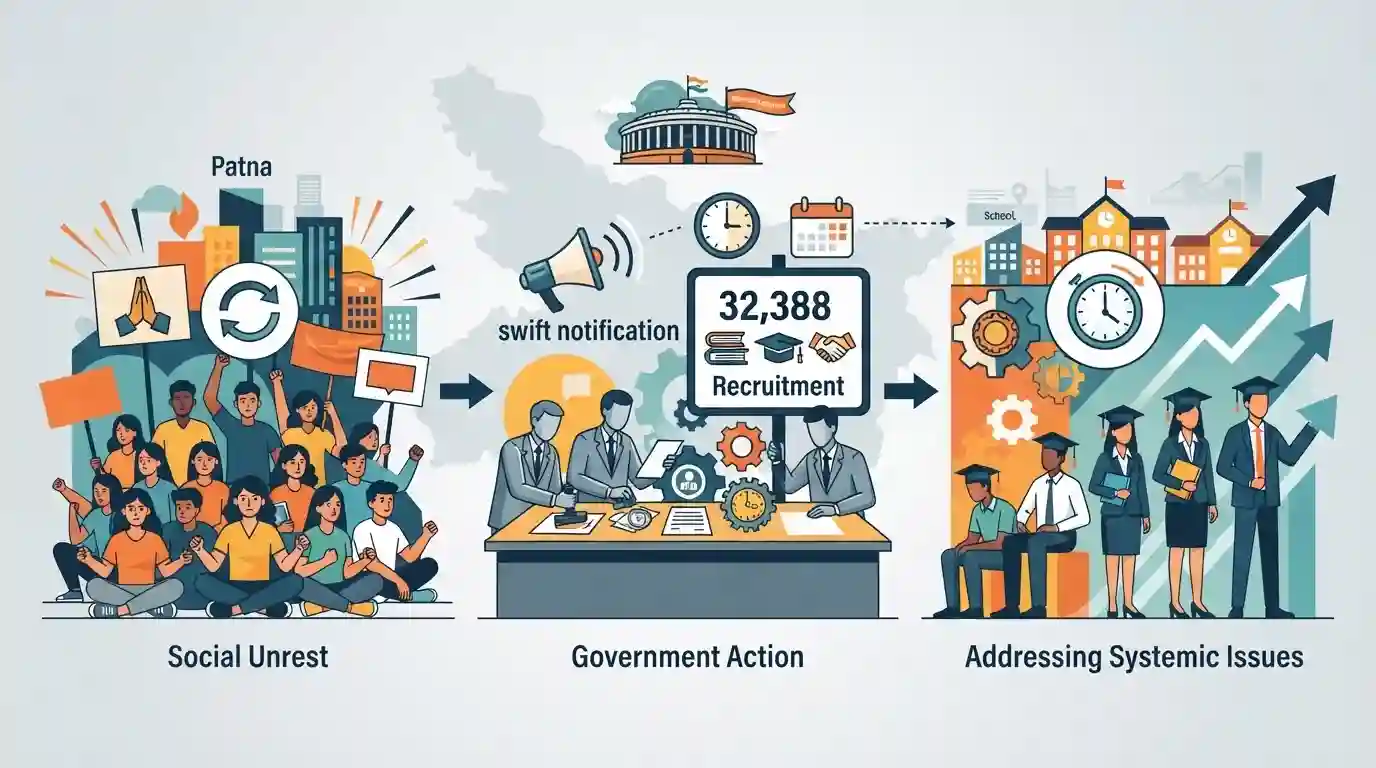
Following an indefinite hunger strike by competitive exam aspirants in Patna, the Bihar government swiftly issued a notification for 32,388 teacher vacancies under the BPSC Teacher Recruitment Examination (TRE) Phase 4.0. The swift action came amidst student threats to besiege the Legislative Assembly during its monsoon session. The protests underscore systemic issues regarding youth unemployment, examination processes, and delayed recruitment cycles in state commissions.
Key Points
- The Bihar government announced 32,388 teacher vacancies under BPSC TRE-4.0 following intense protests by competitive exam aspirants.
- Aspirants staged an indefinite hunger strike at Gardanibagh, Patna, threatening to gherao the Education Minister and besiege the Legislative Assembly during the monsoon session.
- The rapid notification issuance reflects the political pressure surrounding youth unemployment and recruitment transparency in the state.
- Student demands extended beyond TRE-4.0, calling for single-phase examinations, removal of BSSC contractual service weightage, and resolution of the 18-year halt in librarian recruitment.
Important Terms
Teacher Recruitment Examination (TRE) 4.0

The fourth phase of Bihar's mass teacher hiring drive conducted by BPSC. It aims to fill 32,388 teaching posts across primary to senior secondary levels in state government schools.
UPSC context
Highly relevant for BPSC State Affairs, covering public employment generation, education sector initiatives, and youth policy.
Bihar Public Service Commission (BPSC)
The state constitutional body responsible for conducting civil services and other massive recruitment exams, including the TRE, to fill administrative and teaching posts for the Bihar government.
UPSC context
Core polity topic (State PSCs under Article 315) and the exact administrative body evaluating candidates in the BPSC exams.
Bihar Education Department
The state government body responsible for managing public schools, overseeing educational policies, and declaring the administrative vacancies filled through the BPSC TRE.
UPSC context
Tests knowledge of state administrative structure, educational governance, and departmental roles in Bihar State Affairs.
Bihar Legislative Assembly
The lower house of Bihar's bicameral state legislature, comprising elected MLAs who debate state policies, pass laws, and hold the executive government accountable.
UPSC context
Crucial for Bihar Polity questions regarding the state legislature's composition, monsoon sessions, and democratic accountability mechanisms.
Bihar Staff Selection Commission (BSSC)
A state recruitment board tasked with hiring candidates for subordinate Group C and D positions, such as clerks and assistants, across various Bihar government departments.
UPSC context
Important for understanding the state's broader administrative framework and public sector employment boards distinct from the BPSC.
Prelims Trap
Student threats to besiege the Legislative Assembly are fully protected under the fundamental right to protest.
While peaceful assembly is a fundamental right under Article 19(1)(b), besieging (gherao) is coercive and can be restricted under Article 19(3) for public order.
Static Concepts Connected
What are the constitutional provisions governing protests and their restrictions?
- Article 19(1)(b): Guarantees all citizens the fundamental right to assemble peaceably and without arms.
- Article 19(3): Empowers the State to impose reasonable restrictions on assembly in the interest of India's sovereignty, integrity, or public order.
- Coercive protests: Courts have consistently held that coercive tactics like 'gherao' or besieging legislative buildings violate public order and are not constitutionally protected.
How does Bihar's employment landscape compare to national averages (PLFS 2023-24)?
- Low LFPR: Bihar's Labour Force Participation Rate (LFPR) hovers around 55%, lagging significantly behind the national average of 64.3%.
- Public Sector Reliance: Due to a weak private industrial footprint, there is disproportionate reliance on and intense competition for state government jobs (BPSC/BSSC).
Cross-Topic Patterns
Education recruitment & Mission Daksh
The massive recruitment drive under BPSC TRE directly supports qualitative education initiatives like 'Mission Daksh', where teachers provide mandatory personalised mentoring to academically weak students (Classes 3-8).
Demographic Dividend vs Social Unrest
Bihar's low LFPR (55%) combined with a massive youth demographic frequently converts a potential demographic dividend into social unrest, leading to cyclical mass protests over delayed state recruitment.

Expect Bihar's PLFS data (LFPR) or constitutional limits on protest rights (Art 19) to feature in multi-statement Polity or Economy MCQs.
Linked PYQs · 4
Linked PYQs · 4
- 2025BPSC_PRELIMSGS1
What is the primary objective of Bihar’s Mission Daksh?
- 2024-IBPSC_PRELIMSGS1
In April, 2020 the Bihar Education Department started the following program through DD Bihar
- 2025BPSC_PRELIMSGS1
According to PLFS 2023-24, which of the following statements best describe the nature of employment among women in Bihar?
- 2025BPSC_PRELIMSGS1
The constitution of India provides for reasonable restrictions on Fundamental Rights but reasonableness must keep in mind that: 1. The restrictions must be necessary for the protection of the rights of others. 2. The restrictions must be proportionate to the end sought. 3. The restrictions must be reasonable in the light of the circumstances. 4. The restrictions must be in the public interest.
