Sultanganj Buddha statue repatriation and ancient metallurgy heritage
Source:etv-bharat ↗
Why It Matters
The 'Sultanganj Buddha' is a masterpiece of ancient Indian metallurgy and Buddhist art. Knowledge of the 'cire perdue' method, various mudras of Buddha, and the historical geography of Bihar (like Bhagalpur/Sultanganj) are recurring and high-yield topics for BPSC Prelims. Repatriation of antiquities is also a major contemporary cultural diplomacy issue.
Summary
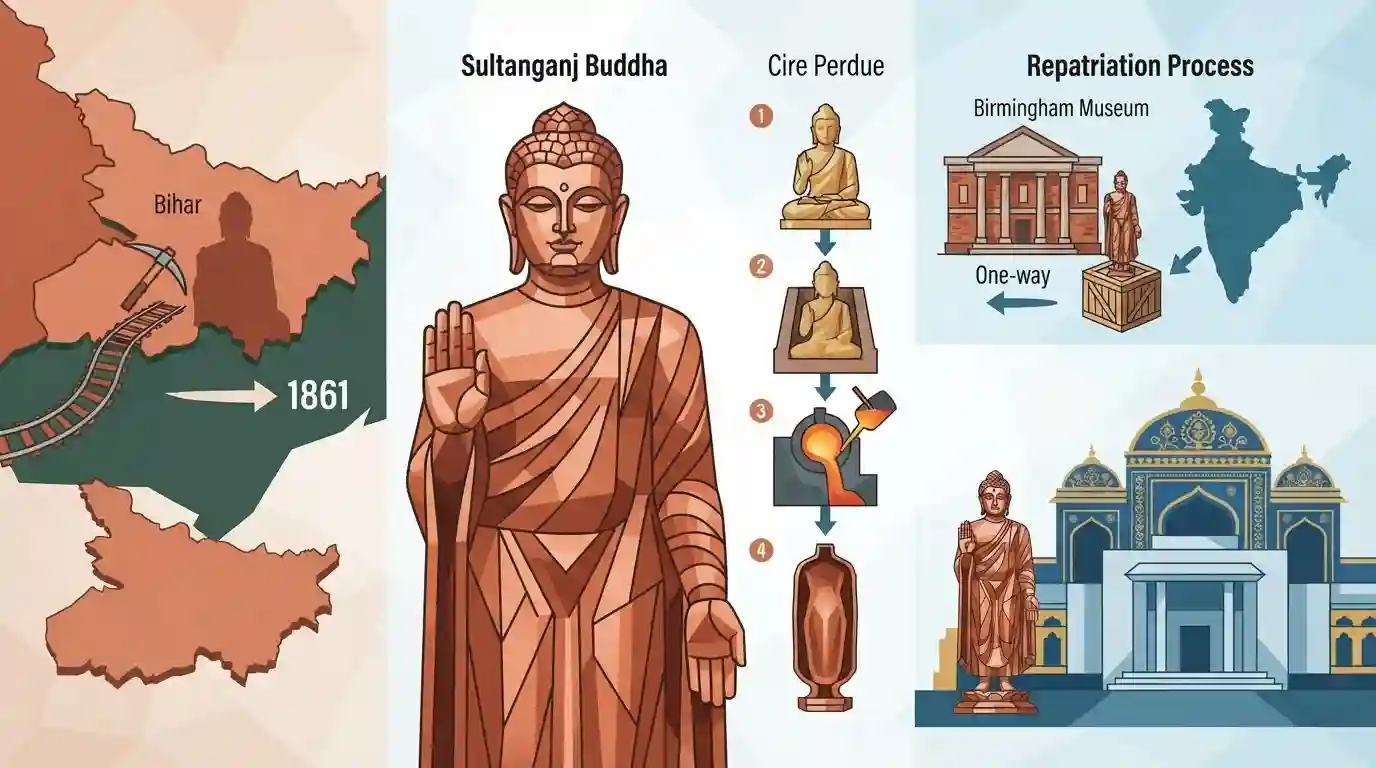
Bihar has initiated the process to repatriate the ancient 'Sultanganj Buddha', a massive 6th-7th century AD copper statue currently housed in the Birmingham Museum. Discovered in 1861 during railway construction in Bhagalpur district, it is the world's largest nearly intact ancient metal Buddha sculpture. The statue exhibits fine craftsmanship through the 'cire perdue' (lost wax) technique and features the Buddha in the 'Abhay mudra'. The move highlights India's ongoing efforts to reclaim its cultural antiquities from foreign institutions.
Key Points
- The Sultanganj Buddha is a 2.3-metre high, over 500 kg copper statue dating back to the 6th-7th century AD (pre-Pala period).
- It was discovered in 1861 by railway engineer E.B. Harris during excavations for the Sultanganj station in Bihar's Bhagalpur district.
- The statue was crafted using the ancient 'cire perdue' or lost wax casting method, retaining its inner clay core mixed with rice husks, enabling precise radiocarbon dating.
- The Buddha is depicted in a standing posture with the right hand in the 'Abhay mudra' (gesture of reassurance) and the left hand gesturing to grant favours.
- The Bihar government is formally demanding its return from the Birmingham Museum, continuing recent trends of repatriating cultural artifacts like the 12th-century Nalanda bronze Buddha returned in 2018.
Important Terms
Sultanganj Buddha

A 7.5-foot-tall copper statue from the 6th–7th century CE representing the world's largest nearly intact ancient metal Buddha, cast using the lost-wax technique in Bihar.
UPSC context
GS Paper I: Art and Culture. Tests knowledge of Buddhist iconography, Gupta-Pala transitional sculpture, and metal-casting traditions.
Abhaya Mudra
A sacred Buddhist hand gesture performed with the right hand raised to shoulder height, palm facing outward, symbolizing fearlessness, reassurance, protection, and peace.
UPSC context
GS Paper I: Art and Culture. Crucial for identifying iconographic hand gestures (mudras) of Buddha and their spiritual meanings in sculpture.
Cire Perdue
An ancient metallurgical casting technique where a wax model is coated with clay, melted away to leave a hollow mold, and filled with molten metal.
UPSC context
GS Paper I: Art and Culture. Tests evolution of Indian metallurgy from Harappan bronze (Dancing Girl) to medieval Buddhist sculptures.
Archaeological Survey of India (ASI)
India's premier agency under the Ministry of Culture, founded in 1861, responsible for archaeological research, excavation, and the conservation of cultural monuments.
UPSC context
GS Paper I & II: Polity and Heritage. Tests institutional frameworks, heritage preservation laws, and efforts in national and international repatriation.
Antiquities and Art Treasures Act, 1972
An Indian legislation regulating the domestic trade, prevention of smuggling, and illegal export of cultural goods/antiquities aged over 100 years.
UPSC context
GS Paper II: Governance and Laws. Tests legal mechanisms, bilateral agreements, and challenges in reclaiming stolen national heritage from foreign museums.
Archaeological Museum Nalanda
An ASI-managed site museum in Bihar housing thousands of antiquities, stone/metal sculptures, and terracotta items recovered from excavations of the ancient Nalanda Mahavihara.
UPSC context
GS Paper I: Art and Culture. Tests understanding of site museums, conservation of Mahayana Buddhist heritage, and ancient residential university ruins.
Prelims Trap
"The Sultanganj Buddha is a prominent example of Chola-era bronze casting."
Aspirants often associate all lost-wax metal sculptures with Chola bronzes. The Sultanganj Buddha is a much earlier Gupta-Pala transitional era sculpture made of copper.
Static Concepts Connected
What is the 'cire perdue' (lost wax) technique used in ancient Indian metallurgy?
- The Process: A wax model is coated with clay and heated. The melting wax drains out, creating a hollow mould into which molten metal is poured.
- Earliest Usage: The 'Dancing Girl' of Mohenjo-Daro (Indus Valley Civilization) is the earliest known Indian artifact utilizing this sophisticated metallurgical method.
- Historical Evolution: While it peaked with the exquisite Chola Nataraja bronzes, it was widely used during the Gupta and Pala periods for monumental copper and bronze deities.
What do the key hand gestures (Mudras) in Buddhist iconography signify?
- Abhaya Mudra: The right hand is raised with the palm facing outward. It symbolizes protection, peace, and the dispelling of fear (seen in the Sultanganj Buddha).
- Bhumisparsha Mudra: The right hand touches the ground. It represents the Buddha calling the Earth to witness his enlightenment under the Bodhi tree at Bodh Gaya.
- Dharmachakra Mudra: Both hands are held against the chest. It signifies the 'turning of the wheel of Dharma', associated with his first sermon at Sarnath.
Cross-Topic Patterns
Antiquity Repatriation + Soft Power
India's push to reclaim stolen artifacts ties into the 1970 UNESCO Convention and reinforces its 'Buddhist soft power' strategy within its broader diplomatic and Act East policies.
Colonial Railways + Archaeological Discoveries
Similar to how the Harappan civilization was unearthed during 1850s railway construction, the Sultanganj Buddha was discovered during colonial railway excavations, highlighting the intersection of colonial infrastructure and heritage discovery.

Expect a multi-statement Prelims question matching ancient metal sculptures (Sultanganj, Nataraja) to their respective eras and materials.
Linked PYQs · 3
Linked PYQs · 3
- 2023BPSC_PRELIMSGS1
In Indian art, the construction of ‘Stupa’, ‘Chaitya’ and ‘Vihara’ is related to which of the following?
- 2023BPSC_PRELIMSGS1
The temple of Deogarh near Jhansi and the sculptures in the temple at Garhwa near Allahabad are the important remains of the
- 2024-IBPSC_PRELIMSGS1
The temple at Deogarh near Jhansi and the sculptures in the temple at Garhwa near Allahabad are important remains of
