Bihar Exceeds Solar Rooftop Targets Under PM Surya Ghar Scheme
Source:timesofindia ↗
Why It Matters
The performance of Bihar in central schemes like PM Surya Ghar and state-level targets for health (TB screening) and social welfare (ration cards) are frequently questioned in BPSC Prelims as indicators of governance, developmental progress, and environmental policy.
Summary
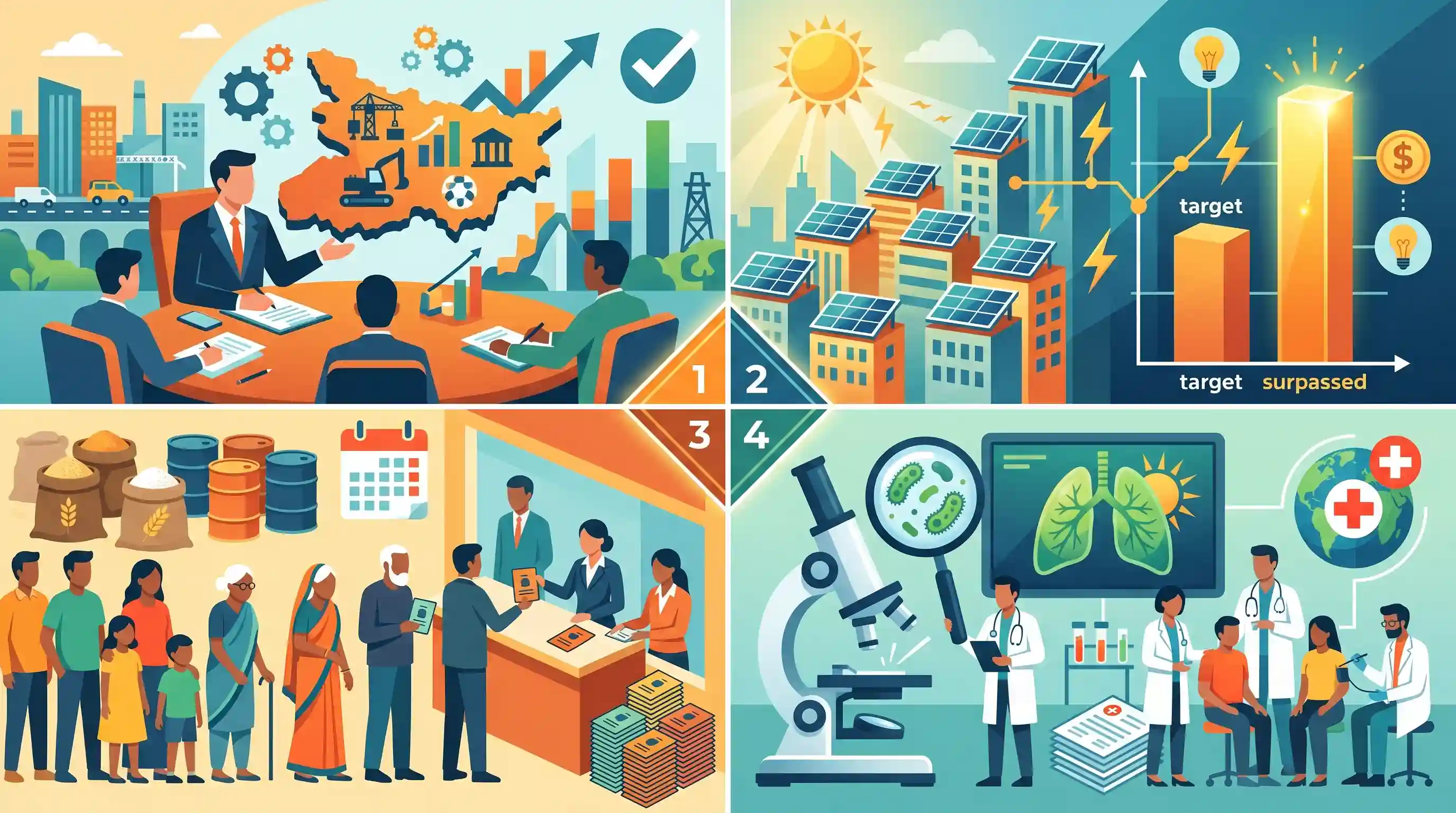
Bihar Chief Secretary Pratyaya Amrit reviewed state progress, noting that Bihar surpassed its PM Surya Ghar Muft Bijli Yojana target by recording 4.03 lakh consumers against a 2.5 lakh target. Implemented via the RESCO model, the solar drive is complemented by directions to issue 11 lakh new ration cards by August 13 and complete TB screenings for 1 crore people under the TB-free Bihar campaign by August 14.
Key Points
- Bihar has surpassed its initial target of 2.5 lakh consumers under the PM Surya Ghar Muft Bijli Yojana, with 4.03 lakh consumers opting for rooftop solar installations.
- The rooftop solar scheme is being executed through the Renewable Energy Service Company (RESCO) model, where private developers make investments to install, own, and maintain the solar systems.
- Names of 55,350 additional solar scheme beneficiaries have been uploaded onto the Utility-Led Aggregation (ULA) portal.
- Chief Secretary Pratyaya Amrit directed officials to issue more than 11 lakh new ration cards under the Public Distribution System (PDS) by August 13.
- Under the TB-free Bihar campaign, a target has been set to complete tuberculosis screening for 1 crore people by August 14, with 16 lakh screenings already completed.
Important Terms
PM Surya Ghar Muft Bijli Yojana

A Central Sector Scheme launched in 2024 to install rooftop solar systems in 1 crore households by 2027, offering up to 300 units of free monthly electricity and financial subsidies.
UPSC context
GS Paper II (Government Schemes) & GS Paper III (Renewable Energy). Tests awareness of clean energy initiatives and welfare schemes.
Renewable Energy Service Company (RESCO)
A clean energy delivery model where a third-party developer installs, owns, and maintains a solar system on a consumer's premises, charging only for the electricity consumed under a long-term contract.
UPSC context
GS Paper III (Energy, Infrastructure). Tests understanding of business models and financial mechanisms promoting private participation in renewable energy.
Utility-Led Aggregation (ULA)
A demand-side model under the PM Surya Ghar scheme where power distribution companies aggregate consumer demand and select developers to install solar rooftops, easing entry for low-income households.
UPSC context
GS Paper III (Infrastructure, Energy Sector Reforms). Tests understanding of innovative energy distribution models, cooperative federalism, and target-based technology adoption.
TB-free Bihar campaign
A state-specific public health mission aligned with India's national goal to eliminate tuberculosis, focusing on massive active case-finding, intensive screening, and ensuring complete treatment coverage.
UPSC context
GS Paper II (Social Justice, Issues Related to Health). Tests knowledge of regional health campaigns and eradication strategies for communicable diseases.
Prelims Trap
Under PM Surya Ghar's RESCO model, consumer-financed capital covers installation, transferring full asset ownership to the household immediately.
Under the RESCO model, a third-party developer finances and owns the system, while the consumer only pays for power consumed, de-risking upfront costs.
Static Concepts Connected
What are CAPEX, RESCO, and Utility-Led Aggregation models in rooftop solar?
- CAPEX Model: Consumer pays upfront, owns the asset, and claims government subsidy directly while bearing operational and maintenance risks.
- RESCO Model: Third-party developer invests, owns, and maintains the system; the consumer pays only for the metered solar power consumed.
- Utility-Led Aggregation: DISCOMs aggregate household demand, managing installations directly to leverage economies of scale for lower-income groups.
How do India's TB elimination targets compare to UN Sustainable Development Goals?
- Target Timelines: India aims to eliminate TB by 2025, five years ahead of the UN SDG 3.3 deadline of 2030.
- WHO Standard: TB elimination is defined by WHO as fewer than one notified case per million population annually.
- Ni-kshay Portal: A unified ICT platform for TB patient tracking, treatment monitoring, and direct benefit transfers for nutritional support.
Cross-Topic Patterns
Federalism and Decentralized Green Energy
Decentralized schemes like PM Surya Ghar show how cooperative federalism drives India's global Net-Zero 2070 commitments through state-level climate action pathways.
Energy Security in Public Health
Reliable rooftop solar power directly supports rural health infrastructure, ensuring uninterrupted electricity for critical diagnostics like TB screenings and cold-chain vaccine storage.

A 2026 question may contrast PM Surya Ghar's RESCO/ULA financial mechanisms with India's 2025 TB elimination milestones.
Linked PYQs · 2
Linked PYQs · 2
- 2023BPSC_PRELIMSGS1
The first ‘floating solar power plant’ has been built at which place in Bihar?
- 2023BPSC_PRELIMSGS1
Bihar Government has planned to make Bihar State ‘pollution-free’ by reducing carbon emissions by which year?
