Bihar Sugarcane Mechanisation Scheme: Portal Subsidies and Equipment
Source:chinimandi ↗
Why It Matters
Understanding state-specific agricultural schemes, mechanization subsidies, and community-level machinery bank models is crucial for analyzing rural development, agro-based industries, and inclusive agricultural growth in Bihar.
Summary
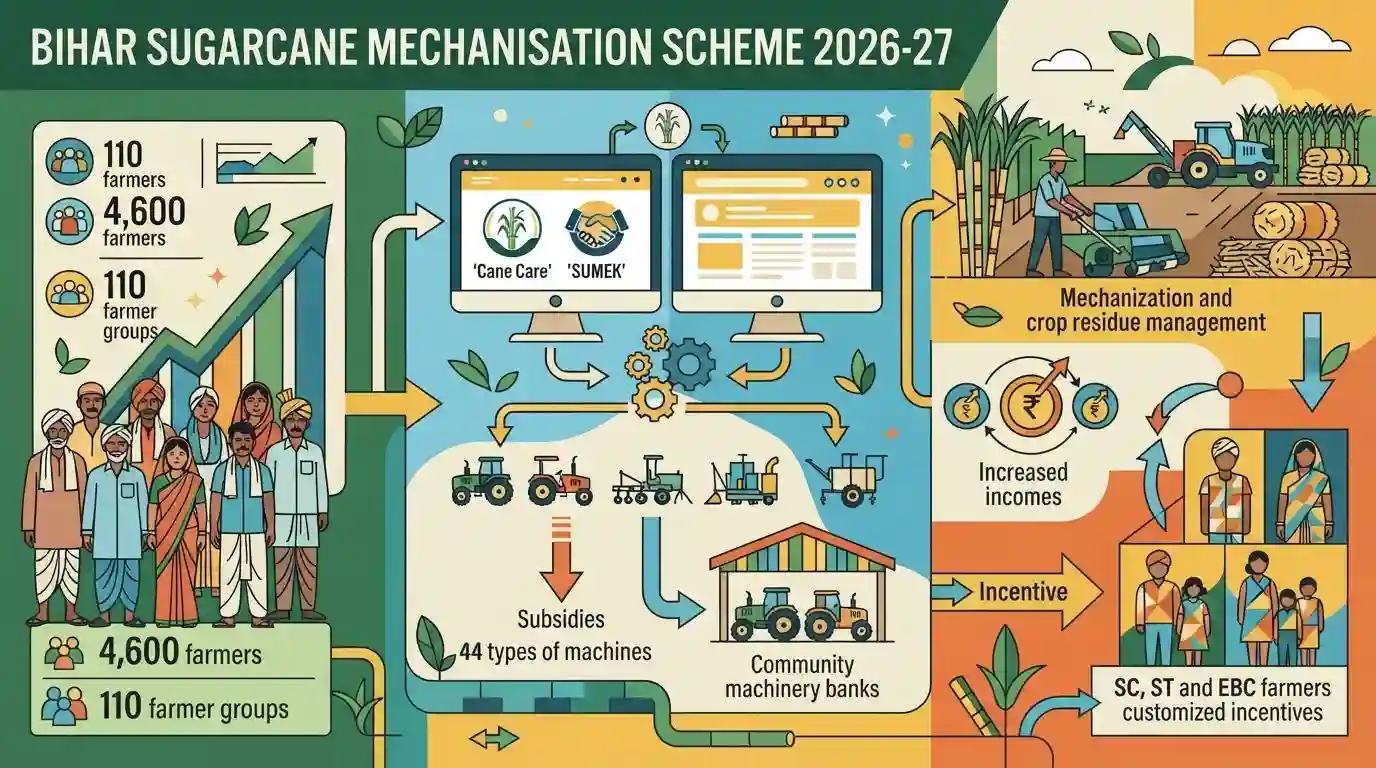
The Bihar Sugarcane Mechanisation Scheme 2026-27 has attracted over 4,600 farmers and 110 farmer groups. Implemented by the Bihar Sugarcane Industries Department, the scheme leverages the Cane Care and SUMEK portals to disburse subsidies on 44 types of agricultural machinery and support the creation of community machinery banks. It targets farm mechanization, crop residue management, and increased incomes, with customized incentives for SC, ST, and EBC farmers.
Key Points
- The Bihar Sugarcane Industries Department is implementing the Sugarcane Mechanisation Scheme 2026-27 to reduce manual labour dependency, cut costs, and improve crop quality.
- Farmers with a valid Sugarcane Farmer ID can apply for subsidies on 44 types of machinery via the Cane Care Portal or the SUMEK Portal. Each farmer is eligible for assistance on up to three machines.
- General category farmers receive up to 40% subsidy on standard machinery, whereas Scheduled Castes (SC), Scheduled Tribes (ST), and Extremely Backward Classes (EBC) receive an additional 10%, taking their subsidy to 50%.
- For crop-residue management and set-treatment devices, subsidies are higher: up to 75% for general category farmers and up to 80% for SC, ST, and EBC farmers. Value-addition tools like sugarcane juice machines are also eligible.
- Eligible groups (such as PACS, JEEViKA groups, ATMA-registered groups, FPOs, licensed jaggery entrepreneurs, and sugar mills) setting up machinery banks can receive up to 80% of project costs, capped at Rs 8 lakh for projects up to Rs 10 lakh.
Important Terms
Bihar Sugarcane Mechanisation Scheme

A state government initiative offering 40% to 80% subsidies on 44 types of modern agricultural machinery to reduce cultivation costs, manage crop residue, and enhance sugarcane productivity in Bihar.
UPSC context
BPSC GS Paper II (Economy/Agriculture). Tests policies on agricultural modernization, farmer welfare, and sustainable farming.
SUMEK Portal
The Sugarcane Mechanisation Application Software (SuMech), an e-governance platform launched by Bihar's Sugarcane Industries Department for transparent online application and management of mechanization subsidies and machinery bank setups.
UPSC context
BPSC GS Paper II (e-Governance/Science & Tech). Tests digital initiatives in agricultural governance and ease of doing farming.
Cane Care Portal
An online portal by Bihar's Sugarcane Industries Department used by individual sugarcane farmers to apply for various developmental schemes, seed subsidies, and agricultural machinery benefits online.
UPSC context
BPSC GS Paper II (Agriculture & Tech). Tests administrative digitization and direct benefit delivery mechanisms for Bihar's farmers.
Primary Agricultural Credit Societies (PACS)
Village-level cooperative credit institutions in India that provide short-term crop loans and input support to farmers, and in Bihar, also act as community machinery banks.
UPSC context
BPSC GS Paper II (Cooperative Sector/Agriculture). Tests rural financial inclusion, cooperative institutions, and grassroots agricultural infrastructure.
JEEViKA
Bihar's flagship rural livelihoods project, implemented by the Bihar Rural Livelihoods Promotion Society (BRLPS), aiming to empower rural women through self-help groups and micro-enterprise development.
UPSC context
BPSC GS Paper II (Social Welfare/Rural Development). Tests poverty alleviation, women empowerment, and community-led developmental programs.
Farmer Producer Organisations (FPOs)
Legal entities formed by primary producers like farmers, weavers, or artisans to leverage economies of scale, improve collective bargaining, and access modern inputs and market networks.
UPSC context
BPSC GS Paper II (Agricultural Marketing/Rural Economy). Tests institutional reforms, collective farming practices, and doubling of farmers' income.
Agricultural Technology Management Agency (ATMA)
A registered society at the district level responsible for technology dissemination, agricultural extension activities, and strengthening research-farmer linkages to modernize farming.
UPSC context
BPSC GS Paper II (Science and Tech/Agriculture). Tests technology transfer, extension services, and decentralized agricultural planning in Bihar.
Prelims Trap
The scheme provides a uniform 40% subsidy for all types of sugarcane machinery across all farmer categories.
Subsidies vary significantly: standard machines get 40-50%, whereas crop-residue management and set-treatment devices get up to 75-80% based on the category.
Static Concepts Connected
Geographical conditions for sugarcane in Bihar
- Climate & Soil: Thrives in hot, humid climates (21-27°C, 75-150cm rainfall) with deep loamy alluvial soils of North Bihar.
- Top Districts: West Champaran leads state production, followed by East Champaran, Gopalganj, and Muzaffarpur.
PACS and JEEViKA in cooperative farming
- Custom Hiring: PACS and JEEViKA self-help groups act as community-level intermediaries to establish custom hiring machinery banks.
- Financial Inclusion: Provides credit access and high-cost farm implements to marginal farmers holding less than one hectare.
Cross-Topic Patterns
Farm mechanisation vs Fragmented holdings
With over 90% marginal landholdings in Bihar, individual mechanisation is unviable. The scheme relies on community machinery banks run by JEEViKA/PACS to pool resources.
Residue management & climate resilience
Higher subsidies for residue management align Bihar's agricultural goals with clean-air initiatives, targeting stubble burning and improving soil organic carbon.

BPSC likely to test specific subsidy slabs (40% vs 80%) and the portal names (SUMEK, Cane Care) in agricultural schemes.
Linked PYQs · 3
Linked PYQs · 3
- 2016BPSC_PRELIMSGS1
'JEEVIKA' is an initiative of Bihar Govt for:
- 2023BPSC_PRELIMSGS1
Which food industry dominates among the agro-based industries in Bihar?
- 2025BPSC_PRELIMSGS1
Before the launch of Kisan Rin Portal (KRP), farmers used to submit manual claims under the Interest Subvention and Prompt Repayment Incentive schemes to which of the following institution/s?
