Sugarcane farmers adopt neem bio insecticide against wild animals
Source:chinimandi ↗
Why It Matters
Demonstrates eco-friendly, sustainable agricultural practices and localized solutions to human-wildlife conflict in Bihar. It also sheds light on state government schemes promoting sugarcane cultivation, relevant for BPSC GS1 Geography and Economy sections.
Summary
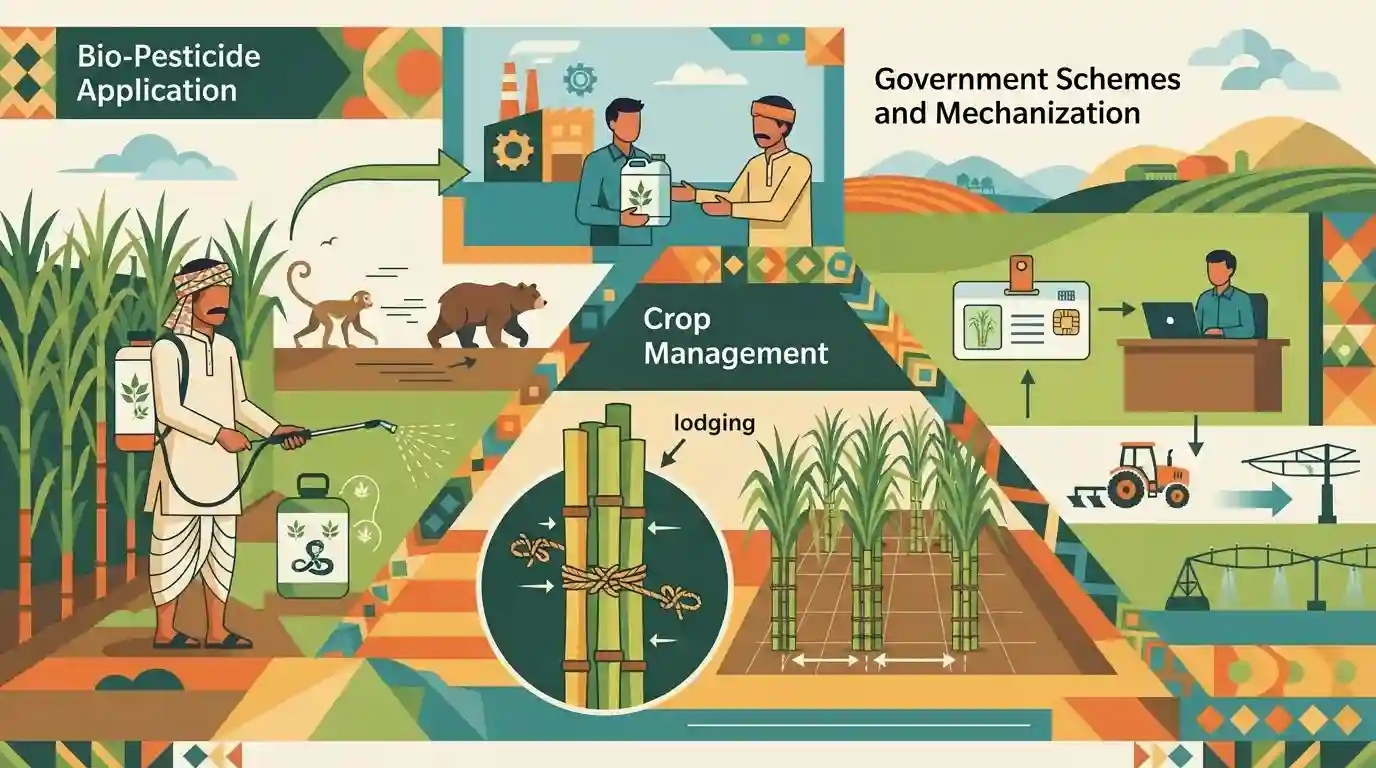
Sugarcane farmers in Bihar, particularly in the Narkatiaganj region, are utilizing a neem-based solution called 'Eksootra Bio Insecticide' (Neem Shake) to protect their crops from wild animals. Distributed by the Narkatiaganj Sugar Mill, this eco-friendly initiative deters animals like monkeys and bears without harming them or the environment. Alongside the bio-pesticide application, agricultural experts advise farmers to practice proper crop tying and row spacing to prevent lodging and yield loss. Additionally, farmers are encouraged to secure a Sugarcane ID to benefit from state schemes related to agricultural mechanisation and area expansion.
Key Points
- Sugarcane farmers in Bihar's forest-bordering regions, such as Gaunaha, are adopting 'Eksootra Bio Insecticide' (Neem Shake) to deter wild animals like monkeys and bears.
- The Narkatiaganj Sugar Mill is distributing this neem-based, eco-friendly solution to prevent crop damage without harming wildlife, with the spray remaining effective for up to 60 days.
- Farmers are advised to tie their sugarcane crops at least twice during the season to prevent lodging, which can reduce yield losses by nearly 20%.
- Maintaining proper spacing between sugarcane rows minimizes side shoots and improves protection against wildlife damage.
- The Bihar Sugarcane Industry Department is encouraging farmers to register for a Sugarcane ID to access subsidies under agricultural mechanisation and area expansion schemes.
Important Terms
Eksootra Bio Insecticide (Neem Shake)

An eco-friendly, neem-based solution adopted by Bihar sugarcane farmers to deter wild animals like monkeys and bears. It offers 60-day crop protection without harming wildlife or the environment.
UPSC context
Relevant for GS-3 (Agriculture/Environment) regarding sustainable crop protection, bio-pesticides, and non-lethal human-wildlife conflict mitigation.
Sugarcane ID
A unique identification system (Farmer Registry) in Bihar that integrates farmers into a digital database, enabling streamlined access to state schemes, subsidies, and agricultural mechanization benefits.
UPSC context
Tests knowledge of e-governance in agriculture and targeted subsidy delivery mechanisms for GS-2 (Governance) and GS-3 (Agriculture).
Crop Lodging
The displacement or bending of crop stems (like sugarcane) to the ground, causing yield loss. Farmers are advised to practice crop tying and proper row spacing to prevent this.
UPSC context
Important for GS-3 (Agriculture). It tests awareness of agronomic practices mitigating weather, growth risks, and preventing yield loss.
Agricultural Mechanisation Scheme
A state-led initiative providing substantial subsidies to farmers for purchasing modern agricultural equipment, thereby boosting farm productivity, reducing labor dependency, and promoting modern cultivation techniques.
UPSC context
Crucial for GS-3 (Agriculture) focusing on technology missions, farm mechanization, and state efforts to double farmers' income.
Sugarcane Area Expansion Programme
A Bihar government scheme aimed at increasing the total acreage under sugarcane cultivation to boost the rural economy, feed local sugar mills, and support allied ethanol production.
UPSC context
Relevant for GS-3 (Agriculture/Economy) regarding cash crop promotion, agro-based industries, and state-level agricultural policies.
Prelims Trap
Neem extracts in agriculture are strictly limited to insect pest control and regulating nitrogen release in fertilizers.
Aspirants often associate Neem solely with insect pest control or urea coating. It is also an effective non-lethal olfactory and taste repellent against larger mammals.
Static Concepts Connected
How is Neem utilized in sustainable Indian agriculture?
- Fertilizer efficiency: Neem-coated urea slows down nitrification, reducing nitrogen leaching into the soil and preventing diversion to non-agricultural uses.
- Bio-pesticide: The active compound Azadirachtin disrupts insect feeding and reproduction without leaving toxic chemical residues on food crops.
- Mammalian deterrent: Its bitter taste and strong odor act as a non-lethal repellent against larger wildlife (like monkeys) on forest fringes.
What are the key agronomic practices specific to Sugarcane cultivation?
- Propping or Tying: Tying stems together prevents 'lodging' (plants falling over) during heavy winds or monsoon rains, minimizing yield loss.
- Earthing up: Gathering soil around the crop base provides mechanical support against lodging, improves aeration, and manages weeds.
- Ratooning: Harvesting by leaving the lower stem and roots intact produces a subsequent crop, saving time and initial planting costs.
Cross-Topic Patterns
Non-lethal HWC Mitigation Strategies
Bio-repellents join bee-fences (Project RE-HAB) as sustainable crop protection strategies on forest fringes, contrasting with ecologically harmful responses like lethal electric fencing.
Digital IDs & Agrarian Subsidies
Like Bihar's 'Sugarcane ID', localized digital farmer registries are increasingly tied to mechanization subsidies, creating traceable databases analogous to PM-KISAN's digitized land records.

Expect a Prelims question mixing Neem's traditional uses (urea coating) with its emerging role as a mammalian deterrent in HWC mitigation.
Linked PYQs · 2
Linked PYQs · 2
- 2023BPSC_PRELIMSGS1
Which food industry dominates among the agro-based industries in Bihar?
- 2025BPSC_PRELIMSGS1
Which of the following is a Kharif crop?
