Bihar Unveils Sugar Policy Offering Land Lease and Incentives
Source:indiatoday ↗
Why It Matters
This policy represents a landmark regional reform in the agro-industrial sector, combining agricultural processing with green energy (ethanol, CBG) and massive capital incentives, crucial for evaluating state-specific economic growth models.
Summary
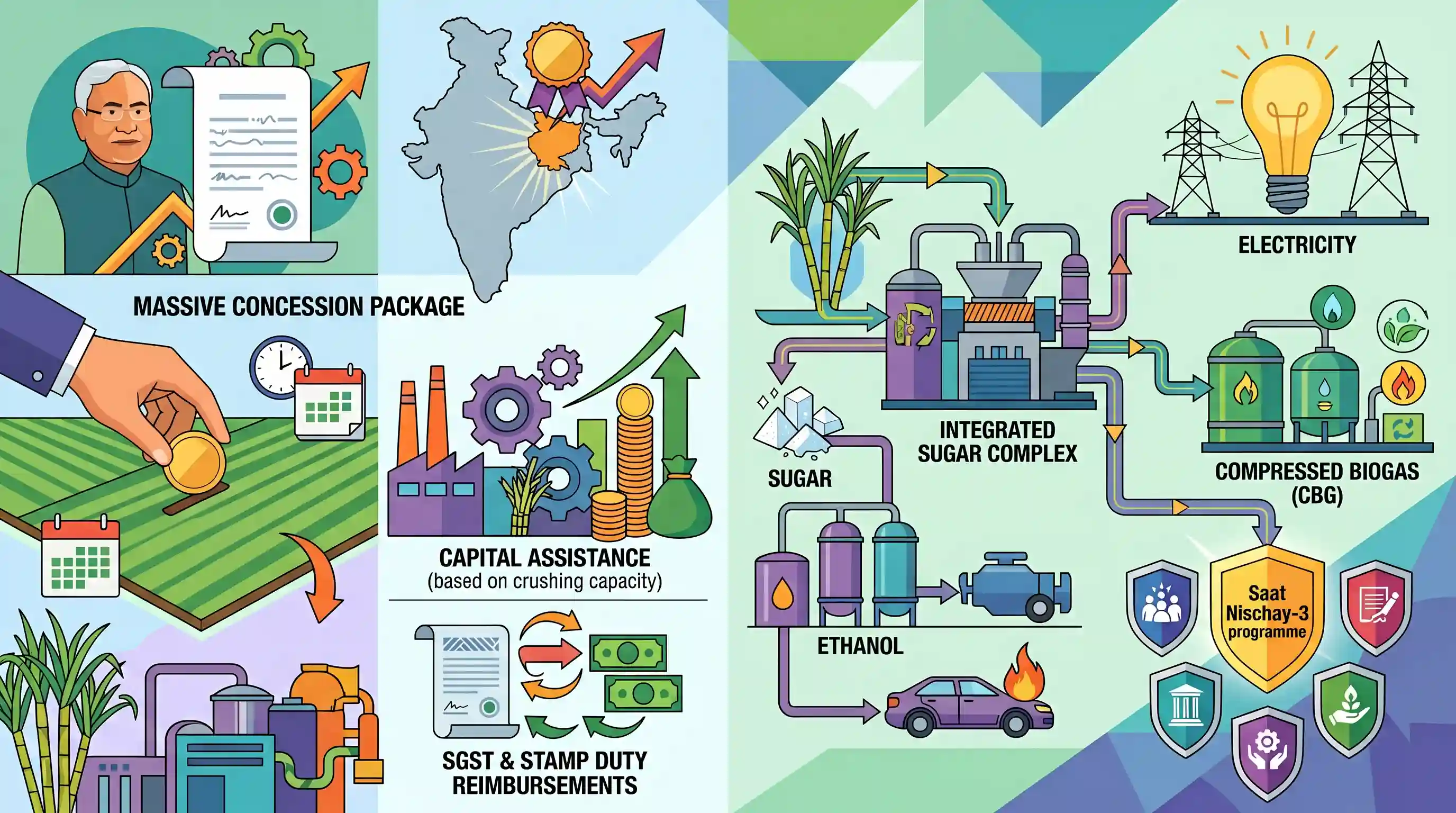
The Bihar government has unveiled the 'Sugarcane Industries Investment Incentive Policy 2026' to attract investors and revive the state's sugar sector. Bihar is the first Indian state to offer such a massive concession package, featuring up to 40 acres of government land on a 30-year lease for a token Re 1, capital assistance of up to Rs 100 crore based on crushing capacity, and full SGST/stamp duty reimbursements. The policy aims to promote 'Modern Sugar Complexes' that integrate sugar production with ethanol, electricity, and compressed biogas (CBG) generation, forming a key component of the state's Saat Nischay-3 programme.
Key Points
- The Bihar government has launched the 'Sugarcane Industries Investment Incentive Policy 2026' to revive closed sugar mills and attract large-scale investment.
- Under the policy, investors can get up to 40 acres of government land on a 30-year lease for a token amount of just Re 1.
- Bihar is the first state in India to introduce such a comprehensive incentive framework for the sugar sector.
- Financial incentives include up to Rs 100 crore in assistance for sugar mills with a crushing capacity of 5,000 Tonnes of Cane per Day (TCD) and up to Rs 70 crore for those with 3,500 TCD.
- The policy offers 100% reimbursement of registration and stamp duty on purchased land and full SGST reimbursement on sugar production for five years.
- Incentives extend to allied industries like distilleries, ethanol production units, power generation, and compressed biogas (CBG) plants, promoting the concept of a 'Modern Sugar Complex'.
- The initiative is aligned with Bihar's Saat Nischay-3 programme, which aims to establish 25 new sugar mills and revive existing ones.
Important Terms
Sugarcane Industries Investment Incentive Policy 2026

A Bihar government policy designed to revive the state's sugar sector by offering key concessions, including up to 40 acres of land on a 30-year lease for a token Re 1 and capital subsidies.
UPSC context
GS III: Agro-based Industries & Industrial Policy. Tests knowledge of state interventions for agricultural value addition and rural development.
Saat Nischay-3 programme
The third phase of the Bihar government's developmental blueprint (2025–2030) focusing on industrial growth, agricultural productivity, employment generation, and social welfare to elevate Bihar into a developed state.
UPSC context
GS II: Government Schemes & Welfare. Tests understanding of sub-national development frameworks, state-led welfare models, and decentralized planning.
Modern Sugar Complex
An integrated industrial ecosystem that combines traditional sugar manufacturing with allied operations such as ethanol distilleries, cogeneration power plants, and compressed biogas production to maximize resource efficiency.
UPSC context
GS III: Renewable Energy & Infrastructure. Tests understanding of bio-refineries, circular economic models, and sustainable agro-processing.
Sugarcane Industries Department
The administrative organ of the Bihar government tasked with regulating the sugarcane sector, fostering modern agro-industrial development, promoting biofuels like ethanol, and protecting farmers' interests.
UPSC context
GS II: Executive Organs. Tests comprehension of administrative departments managing cash crop economies and agribusiness regulations.
Prelims Trap
State Governments declare the Fair and Remunerative Price (FRP), while the Central Government decides the State Advised Price (SAP).
The reverse is true. The Central Government (CCEA) announces the FRP based on CACP recommendations, while individual states declare the SAP, which is usually higher.
Static Concepts Connected
Why is the sugar industry geographically concentrated and classified as a weight-losing industry?
- Sucrose Degradation: Sugarcane starts losing its sucrose content rapidly within 24 hours of harvest, requiring immediate crushing.
- Transportation Economics: Raw cane is bulky and heavy; transporting it over long distances is highly expensive relative to the value of the extracted sugar.
- Weber's Theory: Under Weber's industrial location theory, sugar is a classic material-oriented industry, confining mills to cane-producing tracts.
What is the difference between FRP and SAP in Indian sugarcane pricing?
- FRP (Central): The Fair and Remunerative Price is determined by the Cabinet Committee on Economic Affairs (CCEA) based on recommendations of the CACP.
- SAP (State): The State Advised Price is declared by specific state governments, which is typically higher than the federally mandated FRP.
Cross-Topic Patterns
Sugar co-products + Biofuel targets
Integrating ethanol and compressed biogas (CBG) with sugar mills helps achieve India's E20 blending goals while stabilizing mill revenue against sugar price volatility.
Competitive Federalism + Industrial Policy
State-specific SGST reimbursements and land-lease concessions demonstrate how states bypass central fiscal constraints to attract localized agro-industrial investment.

2026 Mains may evaluate 'Modern Sugar Complexes' as a structural solution to the sugarcane sector's chronic payment arrears.
Linked PYQs · 2
Linked PYQs · 2
- 2023BPSC_PRELIMSGS1
Which of the following statements is true about sugar industry in India?
- 2024-EBPSC_PRELIMSGS1
What is the contribution of agriculture in the Gross Domestic Product (GDP) of Bihar?
