Siwan New Sugar Mill Project and Sugarcane Cultivation Promotion
Source:chinimandi ↗
Why It Matters
Agro-based industries are a focal point for Bihar's economic development and a recurring theme in BPSC Prelims. The revival and expansion of the sugar industry, along with credit support schemes for farmers (like KCC), are critical areas for candidates to study regarding Bihar's economy and geography.
Summary
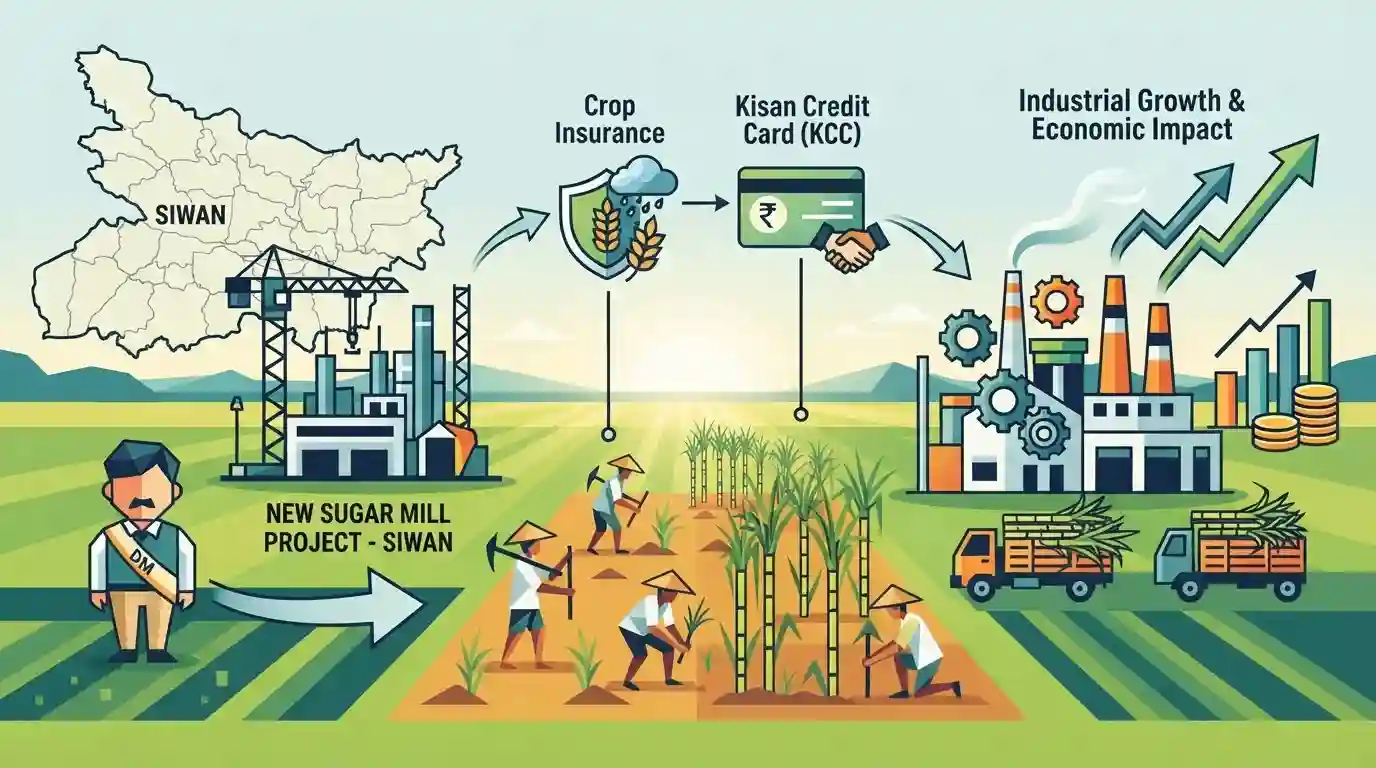
The Bihar government has accelerated efforts to set up a new sugar mill in Siwan district, aiming to boost local industrial growth. To ensure the mill has a steady supply of raw materials, the district administration, led by District Magistrate Vivek Ranjan Maitreya, is actively encouraging farmers to increase sugarcane cultivation. To support this transition, officials are focusing on providing financial security to sugarcane farmers by linking them with schemes such as crop insurance and the Kisan Credit Card (KCC). This development underscores Bihar's ongoing focus on leveraging its agricultural base to develop agro-based industries.
Key Points
- The Bihar government is taking active steps to establish a new sugar mill in the Siwan district.
- To ensure adequate raw material supply, the district administration is encouraging farmers to expand the acreage under sugarcane cultivation.
- Farmers are being integrated with financial support mechanisms like the Kisan Credit Card (KCC) and crop insurance schemes to mitigate agricultural risks.
- The initiative is a significant step towards boosting agro-based industries and rural employment in Bihar.
Important Terms
Kisan Credit Card (KCC)

A credit delivery mechanism launched in 1998 by NABARD providing farmers with timely, affordable, and collateral-free institutional credit for crop cultivation, post-harvest expenses, and allied agricultural activities.
UPSC context
Crucial for GS-3 (Agriculture & Financial Inclusion). Tests awareness of institutional credit mechanisms reducing farmer dependence on informal lenders.
Crop Insurance Scheme (PMFBY)
A flagship government mechanism, primarily the Pradhan Mantri Fasal Bima Yojana (PMFBY), providing comprehensive financial coverage to farmers against non-preventable natural risks from pre-sowing to post-harvest stages.
UPSC context
Relevant for GS-3 (Agriculture). Evaluates understanding of agricultural risk mitigation, farmer income stability, and central welfare schemes.
Agro-based Industries
Industries that utilize agricultural products—such as sugarcane, cotton, or jute—as primary raw materials. They bridge agriculture and manufacturing, driving rural employment, industrial growth, and value addition.
UPSC context
Important for GS-1 (Economic Geography) and GS-3. Tests knowledge of supply chains, rural industrialization, and resource linkages connecting farms to factories.
Prelims Trap
Sugarcane farmers in Bihar pay a 2% premium under PMFBY for their crop insurance.
Bihar opted out of PMFBY and implements the zero-premium Bihar Rajya Fasal Sahayata Yojana (BRFSY). They do not pay the 2% PMFBY Kharif premium.
Static Concepts Connected
Why are sugar mills heavily concentrated near sugarcane producing regions?
- Perishable sucrose: Sugarcane is highly perishable. Its sucrose content begins drying up rapidly, meaning cane must ideally be crushed within 24 hours of harvesting.
- Weight-losing material: The raw material is bulky and loses immense weight during processing, making long-distance transport economically unviable compared to shipping the final refined sugar.
What does the Kisan Credit Card (KCC) scheme currently cover?
- Cultivation and consumption: Covers short-term credit for crop cultivation, post-harvest expenses, produce marketing loans, and farmer household consumption requirements.
- Allied sectors: The scheme's scope was expanded beyond crops to cover the short-term working capital needs of farmers engaged in animal husbandry and fisheries.
- Interest subvention: Provides affordable credit via a 2% Interest Subvention and an additional 3% Prompt Repayment Incentive (PRI), lowering the effective rate to 4%.
Cross-Topic Patterns
State alternatives to Centrally Sponsored Schemes
Bihar's BRFSY replacing PMFBY highlights a growing trend of states tailoring insurance and welfare programs to local fiscal limits and agrarian needs, bypassing one-size-fits-all central schemes.
Agro-industrial shift in Eastern India
States like Bihar are heavily leaning into agro-climatic advantages (sugar, makhana, maize) to drive industrialization, leveraging their fertile Gangetic plains for rural employment and growth.

State opt-outs from PMFBY + KCC's expansion to allied sectors are prime candidates for a multi-statement agriculture finance question.
Linked PYQs · 3
Linked PYQs · 3
- 2018BPSC_PRELIMSGS1
Which type of industries has potentials and prospects in Bihar?
- 2023BPSC_PRELIMSGS1
Which food industry dominates among the agro-based industries in Bihar?
- 2022BPSC_PRELIMSGS1
Which type of banks is proposed to be established for agriculture and rural development in Bihar?
