Bihar State Cooperative Policy: Modernisation and Sugar Mill Revival
Source:indian-masterminds ↗
Why It Matters
This policy is vital for BPSC Prelims as it highlights the state government's latest administrative mechanisms for rural development and agrarian support. The revival of sugar mills in North Bihar (Darbhanga and Madhubani) is historically and economically significant, frequently featuring in questions related to Bihar's geography and industries.
Summary
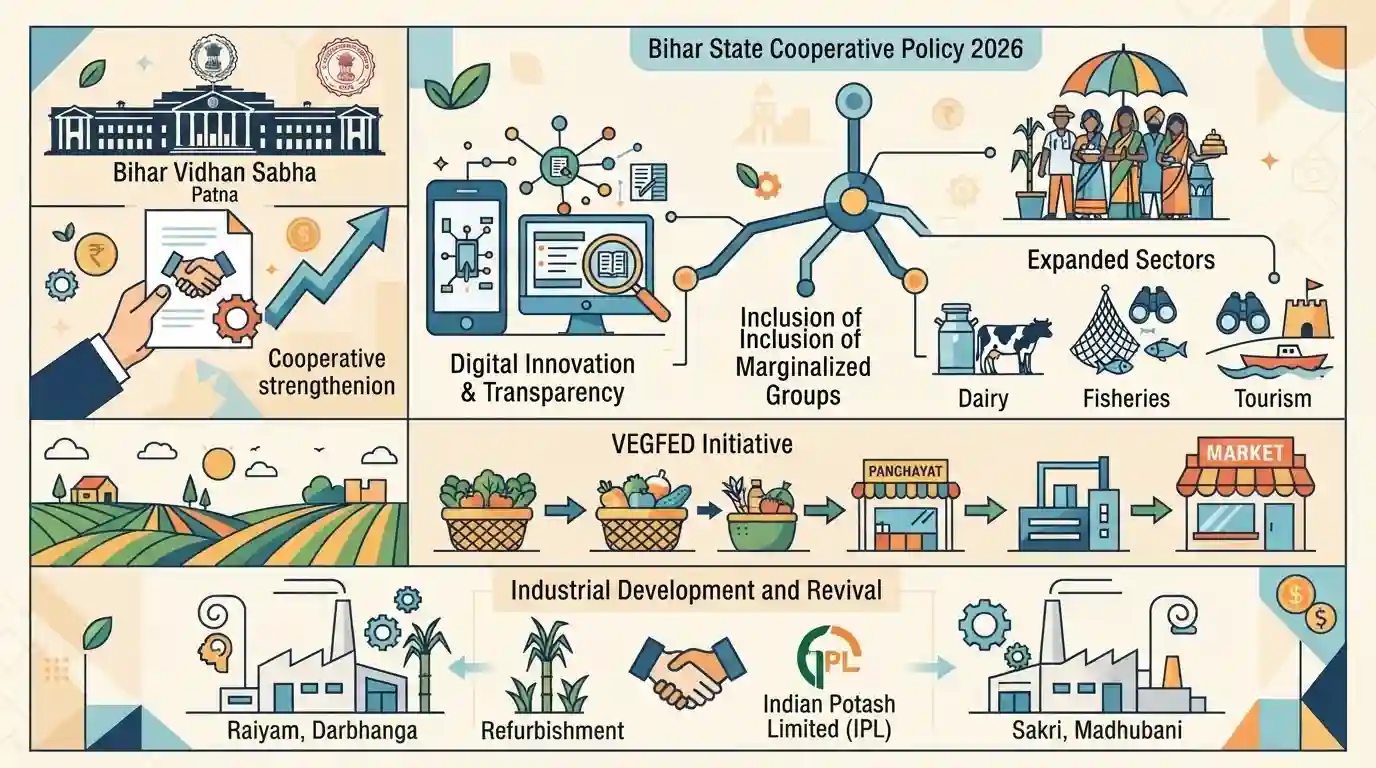
The Bihar Cabinet has given its nod to the Bihar State Cooperative Policy 2026, aimed at modernizing and strengthening cooperative societies across the state. Aligned with the National Cooperative Policy, the initiative focuses on digital innovation, transparency, and the inclusion of marginalized groups. It seeks to expand the cooperative footprint into sectors like dairy, fisheries, and tourism, and boost the vegetable processing and marketing framework (VEGFED) at the panchayat level. In a significant boost to local industry, the Cabinet also approved the revival of two closed sugar mills located in Raiyam (Darbhanga) and Sakri (Madhubani) in partnership with Indian Potash Limited (IPL).
Key Points
- The Bihar Cabinet approved the Bihar State Cooperative Policy 2026 to modernize the cooperative sector with the vision of 'Strong Cooperatives, Prosperous Bihar'.
- The policy aims to expand cooperatives into new sectors like dairy, fisheries, and tourism, and focuses on digital innovation and transparency.
- It emphasizes the empowerment and inclusion of youth, women, backward classes, SCs/STs, and persons with disabilities.
- The policy includes a major push for vegetable marketing by collecting vegetables at the panchayat level through VEGFED.
- The Cabinet also approved the revival of long-closed sugar mills at Raiyam (Darbhanga) and Sakri (Madhubani) in collaboration with Indian Potash Limited (IPL).
Important Terms
Bihar State Cooperative Policy 2026

A state-level policy aimed at modernizing Bihar's cooperative societies through digital innovation and expanding their footprint into new sectors like dairy, tourism, and defunct sugar mill revival.
UPSC context
Relevant for BPSC and UPSC GS-3, highlighting state-level interventions for rural employment, agriculture modernization, and inclusive economic growth.
National Cooperative Policy
A Union Government framework aiming to revitalize India's cooperative ecosystem through governance reforms, digital transformation, and professionalization to realize the vision of "Sahkar se Samriddhi" (Prosperity through Cooperation).
UPSC context
Vital for UPSC GS-2 (Government Policies) and GS-3 (Inclusive Growth), addressing structural challenges in rural credit and agricultural supply chains.
VEGFED (Bihar State Vegetable Processing and Marketing Federation)
A three-tier cooperative marketing federation in Bihar designed to organize vegetable supply chains, reduce post-harvest losses, and ensure farmers receive remunerative prices by connecting them directly to markets.
UPSC context
Crucial for UPSC GS-3 (Food Processing, Supply Chain Management) and BPSC exams, illustrating cooperative models in perishable agricultural commodities.
Indian Potash Limited (IPL)
An agro-industrial entity collaborating with the Bihar government to revive closed cooperative sugar mills by integrating sugar production with ethanol manufacturing, green power, and value-added businesses to support rural livelihoods.
UPSC context
Important for UPSC GS-3 (Industrial Policy, Renewable Energy), showcasing successful public-private partnership models for reviving defunct rural industries.
Prelims Trap
Cooperative societies are governed under the Concurrent List, allowing both Parliament and State Legislatures to pass laws on local cooperative banks.
Cooperative societies operating within a single state are strictly a State Subject (Entry 32). Only Multi-State Cooperative Societies fall under the Union List (Entry 44).
Static Concepts Connected
What are the key constitutional provisions governing cooperative societies in India?
- Fundamental Right: Amended Article 19(1)(c) to declare the right to form cooperative societies as a Fundamental Right.
- Directive Principles: Inserted Article 43B directing states to promote voluntary formation, autonomous functioning, and professional management of cooperatives.
- Part IX-B: Added Articles 243ZH to 243ZT to lay down terms, democratic elections, and audit requirements for cooperative societies.
How is federal jurisdiction divided over cooperative societies?
- State Subject: Cooperative societies operating within a single state's boundaries are listed under Entry 32 of the State List.
- Union Subject: Societies with objects not confined to one state fall under Entry 44 of the Union List (Multi-State Cooperatives).
- Judicial Precedent: In 2021, the Supreme Court struck down parts of the 97th Amendment applying to state-level cooperatives because it was not ratified by state legislatures.
Cross-Topic Patterns
Cooperatives and agricultural supply chains
Integrating local PACS and federations like VEGFED directly addresses supply chain bottlenecks, reducing post-harvest losses and advancing the goals of the PM-Formalisation of Micro Food Processing Enterprises scheme.
PPP models in agro-industrial revival
Collaborative models like the Bihar-IPL partnership for sugar mills reflect a strategic shift toward public-private partnerships to revitalize loss-making public agro-industries.

UPSC is highly likely to test the constitutional division of powers over cooperatives, contrasting Entry 32 (State) with Entry 44 (Union).
Linked PYQs · 3
Linked PYQs · 3
- 2022BPSC_PRELIMSGS1
Which type of banks is proposed to be established for agriculture and rural development in Bihar?
- 2024-IBPSC_PRELIMSGS1
World famous painting is found in which district of Bihar?
- 2023BPSC_PRELIMSGS1
Which one of the following was established as the first programme of community development?
