Statewide Special Drive for Pending Land Mutation Applications
Source:indianmasterminds ↗
Why It Matters
Land-related disputes form a substantial majority of civil and criminal conflicts in rural Bihar. Efficient land record digitisation, Jamabandi correction, and mutation are critical administrative reforms that reduce litigation, empower raiyats (landowners), and improve transparency in land administration.
Summary
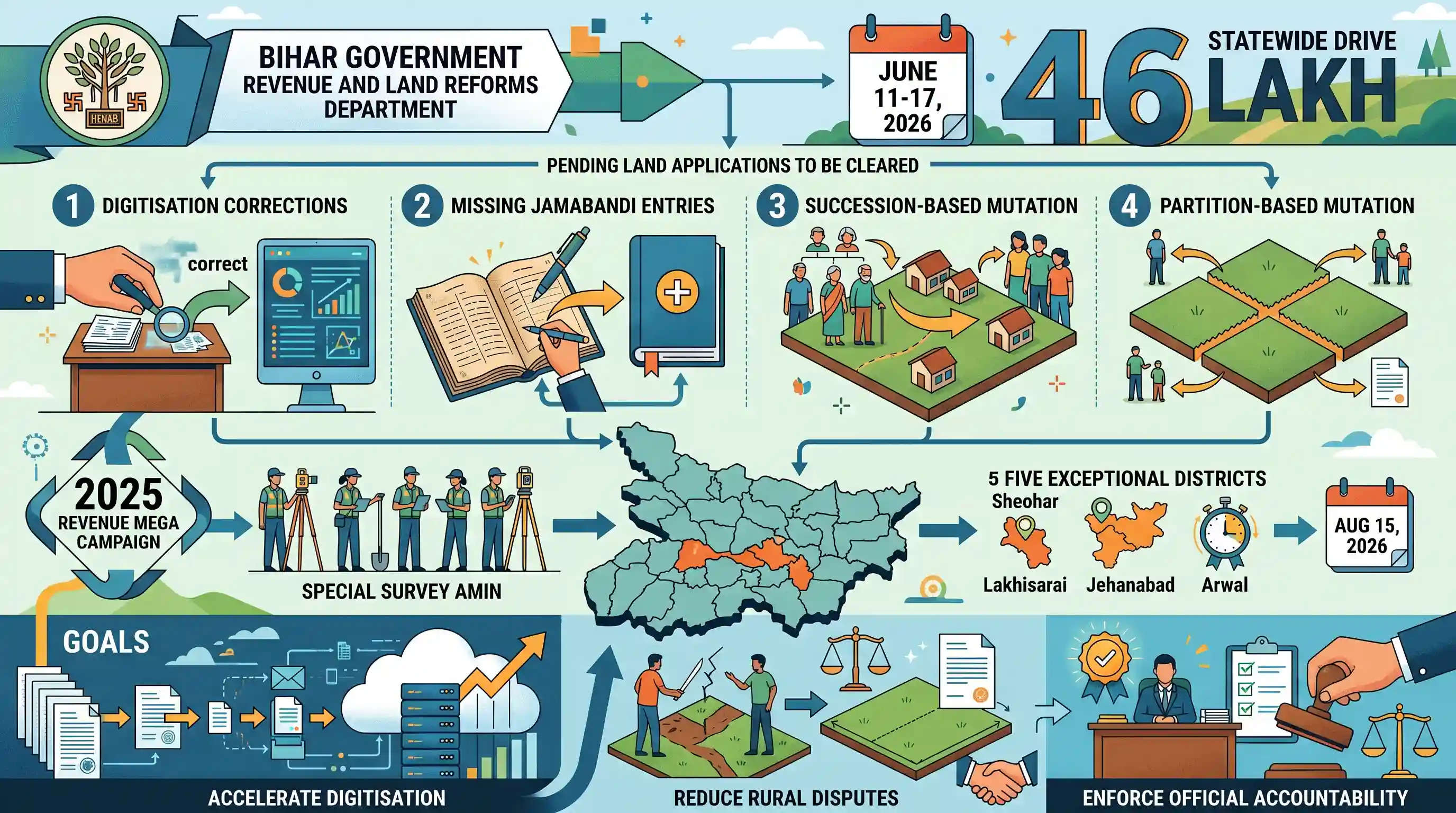
The Bihar Government's Revenue and Land Reforms Department has launched a special statewide drive from June 11 to 17, 2026, to clear 46 lakh pending land applications. These applications, which cover digitisation corrections, missing Jamabandi entries, succession-based mutation, and partition-based mutations, were accumulated during the 2025 Revenue Mega Campaign. Special Survey Amin staff will support the effort in all districts except Sheohar, Sheikhpura, Lakhisarai, Jehanabad, and Arwal, where existing local surveys are slated for completion by August 15, 2026. The drive aims to accelerate digitization, reduce rural land disputes, and enforce official accountability.
Key Points
- Bihar's Revenue and Land Reforms Department announced an intensive statewide campaign from June 11 to 17, 2026, to clear 46 lakh pending land applications.
- The pending applications were collected during the Revenue Mega Campaign held from August 16 to September 20, 2025.
- Key focus areas of the special drive include correction of digitised land records, inclusion of missing Jamabandi entries, succession-based mutation, and partition-based land mutation.
- As of June 2026, 81.91% of the applications have been scanned, but only 26.43% have been successfully uploaded to official portals, representing a significant backlog.
- Special Survey Amin staff will assist in most districts except five: Sheohar, Sheikhpura, Lakhisarai, Jehanabad, and Arwal, where comprehensive land survey work is already ongoing and scheduled to finish by August 15, 2026.
- Strict administrative accountability will be enforced on Circle Officers (COs) and Revenue Officers (ROs) to ensure the time-bound disposal of pending land cases.
Important Terms
Revenue Mega Campaign 2025

A statewide administrative drive in Bihar launched in late 2025 to rectify errors, digitize offline land records, and expedite pending land mutation and partition cases through special village camps.
UPSC context
GS Paper II & III: Governance and Land Reforms. Tests state initiatives for digital public delivery and land conflict resolution.
Special Land Survey (Bihar)
A comprehensive cadastral mapping and land record digitization drive executed in Bihar to establish clear ownership titles, minimize disputes, and update the historic land registers.
UPSC context
GS Paper III: Land Reforms. Tests understanding of spatial land mapping and modern land-record governance.
Jamabandi
The official register of land holdings (Record of Rights) maintained by revenue authorities, detailing the owner's identity, plot dimensions, land categorization, and tax liabilities.
UPSC context
GS Paper III: Agriculture and Land Reforms. Tests awareness of traditional land revenue terminology and modern digital registries.
Land Mutation
The formal administrative process of altering ownership entries in official land records following a transfer of property via sale, inheritance, partition, or gift.
UPSC context
GS Paper III: Land Reforms. Tests administrative procedures for maintaining accurate property registries and mitigating land disputes.
Revenue and Land Reforms Department, Bihar
The state government department responsible for land administration, cadastral surveys, digitization of land records, revenue collection, and executing policy directives related to agrarian land reforms.
UPSC context
GS Paper II: State Executive and Administration. Tests provincial institutional structures for implementing agrarian policies and digital governance.
Prelims Trap
A registered land mutation (Dakhil-Kharij) or Jamabandi entry serves as absolute, conclusive proof of ownership in a court of law.
Mutation (Dakhil-Kharij) entries in revenue records do not confer or extinguish legal title to property; they are purely for tax-assessment and revenue purposes. Title can only be established by a civil court.
Static Concepts Connected
What is the distinction between Presumptive and Conclusive land titling in India?
- Presumptive Titling: Current land records in India offer only a presumption of ownership based on revenue payments, which can be challenged in court.
- Conclusive Titling: The state guarantees the land title and provides compensation in case of disputes, eliminating title-related litigation.
- Policy Transition: India is attempting to transition from presumptive to conclusive titling through digital programs like DILRMP.
What were the structural impacts of Lord Cornwallis's Permanent Settlement (1793)?
- Proprietary Rights: Declared Zamindars as absolute proprietors of the soil, making land a private, saleable, and mortgageable commodity.
- Peasant Subjugation: Stripped cultivators (raiyats) of traditional occupancy rights, reducing them to tenants-at-will subject to arbitrary eviction.
- Sunset Clause: Required fixed revenue payments by a specific date, failing which the estate was immediately auctioned under the 'Sunset Law'.
Cross-Topic Patterns
E-Governance + Rural Judicial Reform
Digitizing mutation and land records directly reduces civil court backlogs, as land disputes constitute over 60% of all pending civil litigation in rural India.
Land Reforms + Caste Mobilization
The failure of physical land redistribution post-1950 directly fueled Bihar's agrarian unrest, Naxalite mobilization, and subsequent caste-based political polarization.

Mains 2026 may link historic Zamindari system vulnerabilities with modern digital land titling (DILRMP) as a tool for rural empowerment.
Linked PYQs · 3
Linked PYQs · 3
- 2022BPSC_PRELIMSGS1
The 'Digital India Award, 2020' was given to the Bihar Government for
- 2011BPSC_PRELIMSGS1
In Bihar, though 'Zamindari' was statutorily abolished in 1952, the social base of land control remained in the grip of:
- 2008BPSC_PRELIMSGS1
Which one of the following is correct about the permanent settlement introduced in Bihar?
