PMEGP Scheme Empowers Small Traders to Become Job Creators in Bihar
Source:ians ↗
Why It Matters
PMEGP is a flagship scheme for micro-enterprise development and employment generation. Understanding its objectives and grassroots impact, particularly in states with high migration like Bihar, is important for questions on poverty alleviation, employment generation, and regional economic development.
Summary
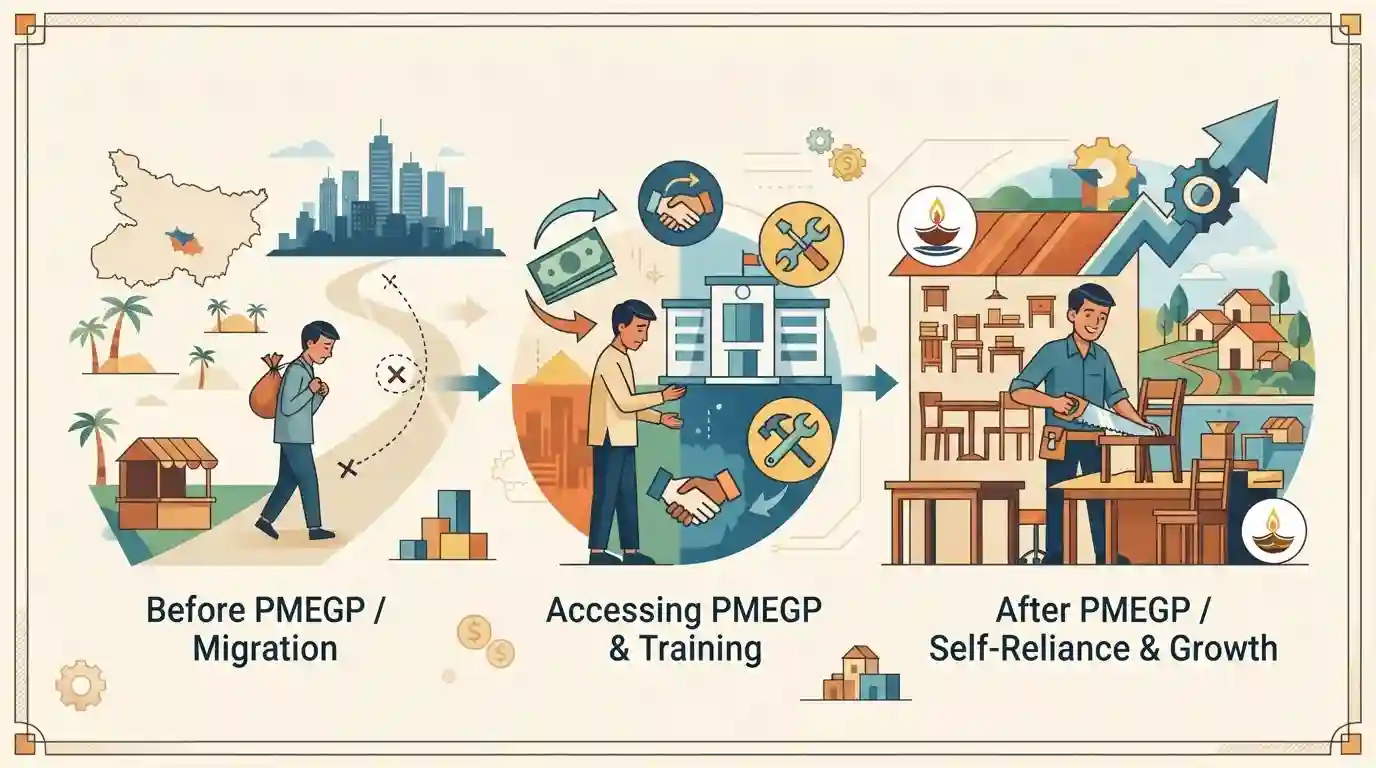
The Prime Minister's Employment Generation Programme (PMEGP) has enabled a small-time trader from Bihar's Sheikhpura district to establish a furniture business and become self-reliant. The central government scheme focuses on creating micro-enterprises in the non-farm sector to generate widespread employment, build sustainable livelihoods, and prevent migration.
Key Points
- The Prime Minister's Employment Generation Programme (PMEGP) is empowering individuals like Suman Kumar from Sheikhpura, Bihar, to establish micro-enterprises and become job creators rather than job seekers.
- PMEGP is a major credit-linked subsidy scheme by the Central Government aimed at promoting self-employment ventures in the non-farm sector.
- The scheme focuses on generating widespread employment opportunities in both rural and urban areas to foster self-reliance, build sustainable livelihoods, and curb distress migration.
- Beneficiaries can access financial assistance to set up businesses, such as furniture manufacturing, thereby boosting local economic activity.
Important Terms
Prime Minister's Employment Generation Programme (PMEGP)

A credit-linked subsidy scheme launched in 2008 by merging PMRY and REGP. Administered by the Ministry of MSME, it funds micro-enterprises in non-farm sectors to generate sustainable employment and prevent rural migration.
UPSC context
GS Paper II (Government Schemes) & GS Paper III (Employment/Growth); tests understanding of financial inclusion and livelihood programs.
Khadi and Village Industries Commission (KVIC)
A statutory body established under the KVIC Act of 1956, functioning under the Ministry of MSME. It serves as the national-level nodal agency to plan, promote, and implement rural development and self-reliance schemes like PMEGP.
UPSC context
GS Paper II (Statutory Bodies) & GS Paper III (Rural Development); tests institutional mechanisms for grassroots level industrialization and employment.
Micro, Small and Medium Enterprises (MSMEs)
Business entities engaged in manufacturing or services, classified under the MSMED Act, 2006 based on investment in plant/machinery and annual turnover. They form the backbone of India's economy, driving employment and regional development.
UPSC context
GS Paper III (Indian Economy/Industrial Sector); highly relevant for questions on employment generation, GDP contribution, and inclusive development.
Rural Non-Farm Sector (RNFS)
All economic activities in rural areas excluding agriculture, forestry, and fishing. This includes manufacturing, services, construction, and trade, acting as a crucial driver for diversifying rural livelihoods and reducing underemployment.
UPSC context
GS Paper III (Indian Economy/Rural Development); tests knowledge of rural employment diversification, agricultural linkages, and migration prevention strategies.
Prelims Trap
PMEGP assistance is available for both setting up new micro-enterprises and the expansion/modernization of existing viable units.
PMEGP strictly targets the establishment of *new* micro-enterprises. Existing units or those seeking expansion/modernization funds are completely ineligible under this scheme.
Static Concepts Connected
What are the key operational features of the PMEGP?
- Nodal Agency: Implemented nationally by the Khadi and Village Industries Commission (KVIC), a statutory body under the Ministry of MSME.
- Exclusivity Clause: Strictly targets the establishment of new micro-enterprises in the non-farm sector; existing units are ineligible for subsidy.
- Subsidy Differential: Provides margin money subsidy up to 35% in rural areas and 25% in urban areas for special category beneficiaries.
What is the Khadi and Village Industries Commission (KVIC)?
- Statutory Status: Established as a statutory organization under the Khadi and Village Industries Commission Act of 1956.
- Nodal Ministry: Functions as an apex organization under the Ministry of Micro, Small and Medium Enterprises (MoMSME).
- Core Mandate: Actively plans, promotes, organizes, and implements programs for the development of khadi and village industries in rural areas.
Cross-Topic Patterns
PMEGP + Distress Migration
Non-farm employment schemes like PMEGP act as vital counter-migration tools, stabilizing rural-urban migration by offering viable local livelihood alternatives.
Credit Subsidies + Financial Inclusion
PMEGP’s bank-driven subsidy model directly connects grassroots rural entrepreneurship to formal credit networks, supporting the Reserve Bank of India's Priority Sector Lending (PSL) goals.

Questions in 2026 may test PMEGP's exclusivity to 'new' units and non-farm sectors, contrasting it with general rural credit schemes.
Linked PYQs · 2
Linked PYQs · 2
- 2022BPSC_PRELIMSGS1
The new ministry proposed in the Bihar Budget for the year 2021-22 focuses on
- 2020BPSC_PRELIMSGS1
Bihar Government launched a new scheme 'Satat Jivikoparjan Yojana' in August 2018. The objective of this scheme is
