Election Commission Special Intensive Revision in Bihar
Source:The Hindu ↗
Why It Matters
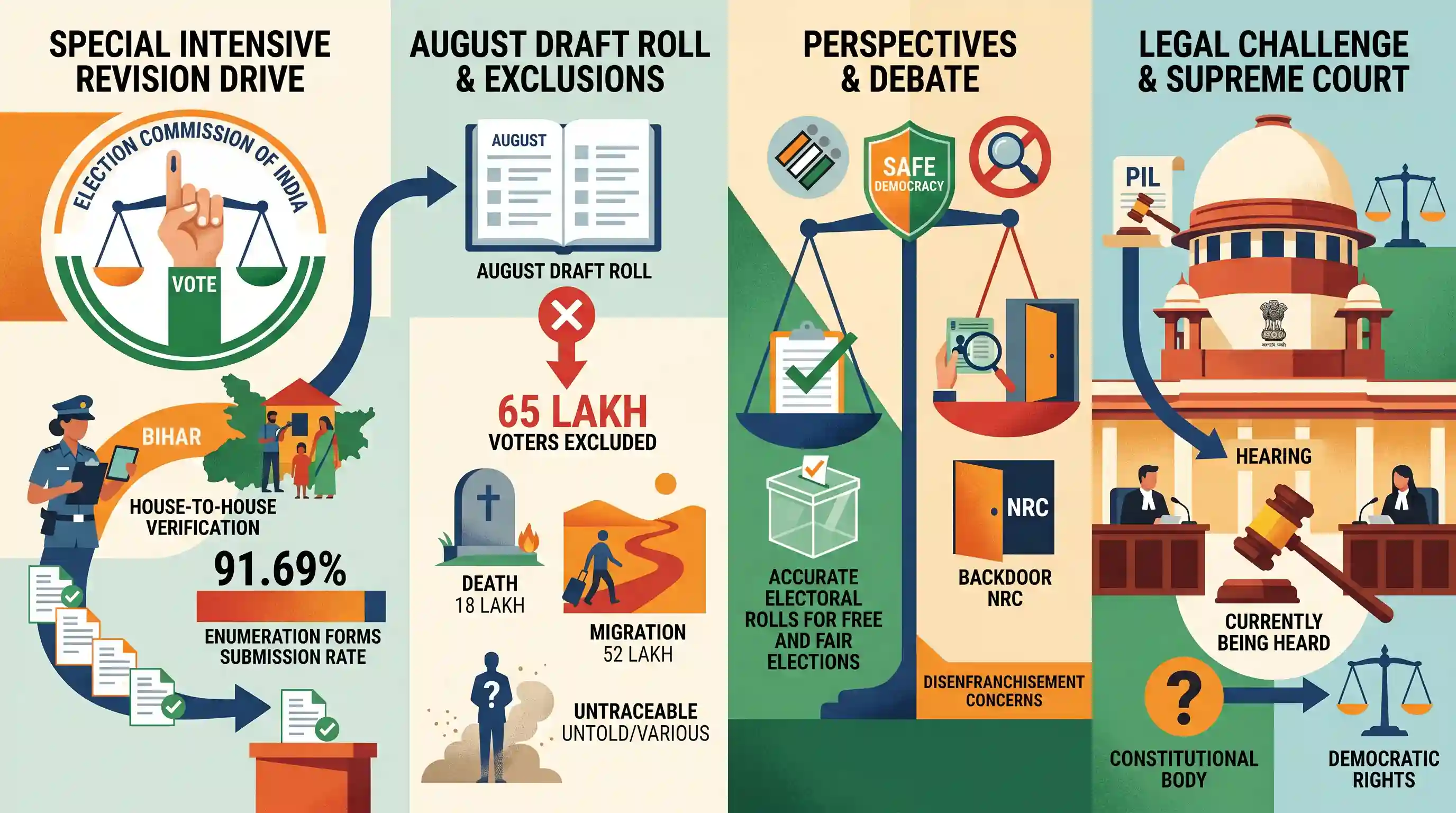
Maintaining accurate electoral rolls is fundamental to ensuring free and fair elections. Understanding the ECI's procedures for voter verification, alongside the legal and political controversies surrounding them, is essential for UPSC aspirants studying governance and electoral reforms.
Summary
The Election Commission of India's Special Intensive Revision (SIR) of electoral rolls in Bihar has recorded a 91.69% submission rate for enumeration forms. The drive aims to update voter lists through house-to-house physical verification, resulting in the likely exclusion of 65 lakh voters from the August draft rolls due to death, migration, or untraceability. While the ECI emphasizes the necessity of accurate electoral rolls for free and fair elections, the opposition has termed the exercise a "backdoor NRC," and a PIL challenging the process is currently being heard by the Supreme Court.
Key Points
- The Election Commission of India (ECI) has conducted a Special Intensive Revision (SIR) of electoral rolls in Bihar, achieving a 91.69% enumeration form submission rate.
- Over 65 lakh voters will be excluded from the upcoming draft rolls, either due to being deceased, permanently shifted, or untraceable.
- The exercise involves extensive house-to-house verification by Booth Level Officers (BLOs).
- Opposition parties in Bihar have criticized the drive, referring to it as an "NRC through the backdoor".
- A Public Interest Litigation (PIL) challenging the legality of the SIR process is pending before the Supreme Court.
Important Terms
Special Intensive Revision (SIR)

A comprehensive door-to-door verification and update of electoral rolls conducted under Section 21(3) of the Representation of the People Act, 1950. It involves fresh enumeration to remove duplicates, deceased, and ineligible voters.
UPSC context
GS Paper II: Electoral Reforms. Tests understanding of administrative procedures to ensure free and fair elections and challenges like mass disenfranchisement.
Election Commission of India (ECI)
A permanent constitutional body (Article 324) responsible for the superintendence, direction, and control of the preparation of electoral rolls and the conduct of all elections to Parliament and State Legislatures.
UPSC context
GS Paper II: Appointment to various Constitutional posts, powers, functions and responsibilities of various Constitutional Bodies.
Supreme Court of India
The highest judicial authority in India, empowered to review the constitutionality of executive actions, such as electoral roll revisions, through Public Interest Litigations (PILs) and writ petitions.
UPSC context
GS Paper II: Judiciary, Separation of Powers, and Judicial Review of administrative/constitutional body mandates.
Electoral Roll
An official list of all citizens within a specific constituency who are eligible to vote. Maintenance and accuracy of this roll are critical for the legitimacy of representative democracy.
UPSC context
GS Paper II: Salient features of the Representation of People's Act. Focuses on voter eligibility and registration processes.
Representation of the People Act, 1950 (RPA)
The legislative framework providing for the allocation of seats, delimitation of constituencies, and the preparation/revision of electoral rolls (notably Section 21 for roll revisions).
UPSC context
GS Paper II: Salient features of the Representation of People's Act, a core legislative pillar for Indian elections.
Booth Level Officer (BLO)
A ground-level election official, typically a government employee, responsible for house-to-house verification, distributing enumeration forms, and ensuring the accuracy of the voter list at the booth level.
UPSC context
GS Paper II: Important aspects of governance, transparency and accountability. Highlights the lowest tier of election administration.
Prelims Trap
"The preparation and revision of electoral rolls are governed by the Representation of the People Act, 1951."
Electoral rolls, delimitation, and voter qualifications are strictly governed by the RPA 1950. The RPA 1951 deals with the actual conduct of elections and candidate qualifications.
Static Concepts Connected
What are the primary matters governed by the Representation of the People Act, 1950?
- Delimitation & Seats: Allocation of seats and the delimitation of Parliamentary and Assembly constituencies.
- Electoral Rolls: Procedures for the preparation, revision, and updating of electoral rolls by the Election Commission.
- Voter Registration: Lays down qualifications for voters and explicitly prohibits registration in multiple constituencies (Sections 17 & 18).
How is the 'Right to Vote' structurally defined in India?
- Constitutional Basis: Article 326 guarantees universal adult suffrage, making the right to vote fundamentally a Constitutional Right.
- Statutory Regulation: The practical exercise of this right, including conditions for voter registration, is heavily regulated by statutory laws like the RPA 1950.
Cross-Topic Patterns
Electoral Rolls + Citizenship Database
Opposition framing SIR as a "backdoor NRC" links routine electoral purging of ASDD (Absent, Shifted, Dead, Duplicate) voters to the highly sensitive syllabus themes of citizenship and the National Register of Citizens.
Voter Roll Cleansing + Right to Privacy
Efforts to cleanse electoral rolls of "ghost voters" frequently intersect with the contentious Aadhaar-Voter ID linkage debate, testing the limitations set by the Puttaswamy Right to Privacy judgment.

Expect a comparative Prelims question distinguishing the exact scope of RPA 1950 (electoral rolls) from RPA 1951 (election conduct).
Linked PYQs · 4
Linked PYQs · 4
- 2017PrelimsGS1
Right to vote and to be elected in India is a
- 2022MainsGS2
Discuss the role of the Election Commission of India in the light of the evolution of the Model Code of Conduct.
- 2017MainsGS2
To enhance the quality of democracy in India the Election Commission of India has proposed electoral reforms in 2016. What are the suggested reforms and how far are they significant to make democracy successful?
- 2024MainsGS2
Examine the need for electoral reforms as suggested by various committees with particular reference to "one nation one election" principle.
