Bihar Signs HUDCO Deal for Greenfield Townships Development
Source:etvbharat ↗
Why It Matters
This massive ₹1 trillion deal represents the largest urban development initiative in Bihar's history, directly addressing its critically low urbanization rate (11.3% in Census 2011, currently ~15.3%). It is highly relevant for BPSC Prelims as the exam regularly questions state urbanization statistics, PSU definitions (like HUDCO), and regional economic growth models.
Summary
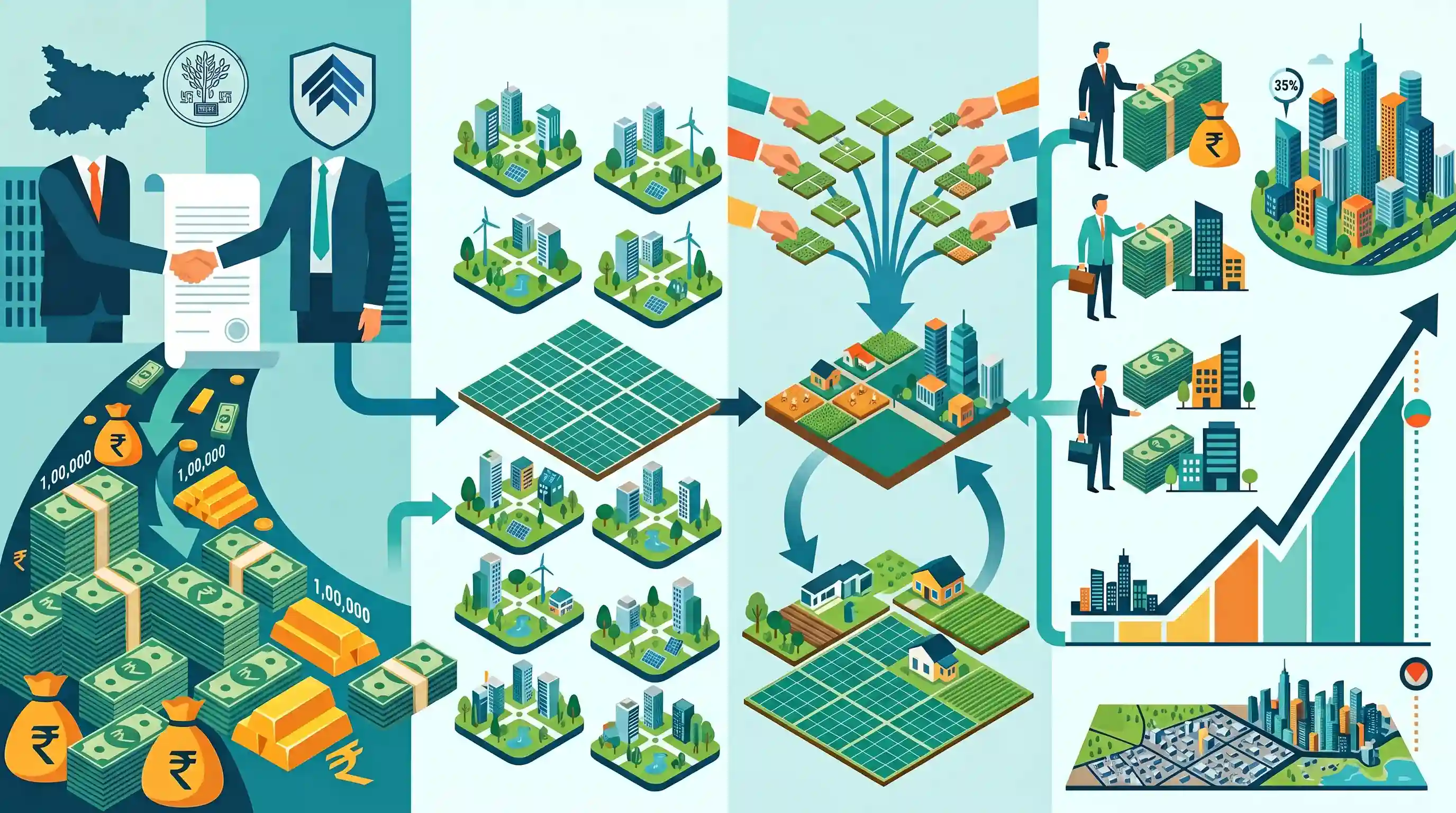
The Government of Bihar has signed an MoU with the Housing and Urban Development Corporation (HUDCO) for a ₹1 lakh crore (₹1 trillion) long-term loan to develop 12 greenfield satellite townships across the state. Implemented over 3 lakh acres using a land-pooling model that benefits farmers, the project aims to attract ₹6 lakh crore in private investment and accelerate the state's urbanization rate towards a target of 35% from its current low levels.
Key Points
- The Bihar government has signed a landmark Memorandum of Understanding (MoU) with the Housing and Urban Development Corporation (HUDCO) for ₹1 lakh crore (₹1 trillion) in long-term financing.
- The financing will be utilized to develop 12 greenfield satellite townships across Bihar, spanning over 3 lakh acres of land.
- The project will follow a land-pooling model, making local farmers stakeholders so they directly benefit from the infrastructure and appreciation of land value.
- The initiative expects to attract an additional ₹6 lakh crore in private investment, boost the construction sector, and generate massive employment.
- The long-term goal of the project is to raise Bihar's urbanization rate to 35%. Currently, as per the 2011 Census, Bihar's urbanization stands at 11.3% (the second lowest in India after Himachal Pradesh's 10%), though it has recently risen to 15.3% as per recent Economic Surveys.
Important Terms
Land Pooling Model

A land-assembly mechanism where landowners voluntarily pool their parcels, which the government develops with infrastructure and returns a portion to owners as higher-value, serviced plots.
UPSC context
GS Paper III (Infrastructure, Land Reforms) and GS Paper I (Urbanization). Tests sustainable planning models bypassing compulsory land acquisition.
Housing and Urban Development Corporation (HUDCO)
A premier public sector enterprise under India's Ministry of Housing and Urban Affairs providing long-term finance and techno-financial assistance for housing and urban infrastructure development.
UPSC context
GS Paper III (Infrastructure, Resource Mobilization). Tests knowledge of key financial institutions driving sustainable urban infrastructure development.
Greenfield Satellite Townships
Newly planned urban settlements developed on previously undeveloped land or on the outskirts of existing cities, designed to ease urban congestion and foster planned regional growth.
UPSC context
GS Paper I (Urbanization) and GS Paper III (Infrastructure). Tests spatial strategies for managing rapid urban sprawl and creating counter-magnets.
Town Planning Scheme (TPS)
A statutory urban planning tool that consolidates fragmented land parcels, designs public infrastructure, and redistributes reorganized, serviced plots to original landowners without compulsory land acquisition.
UPSC context
GS Paper I (Urbanization) and GS Paper II (Government Policies). Tests statutory and decentralized mechanisms used for planned city expansions.
Transfer of Development Rights (TDR)
An urban planning tool where landowners receive tradable certificates allowing them to transfer their developmental rights from conservation zones to designated growth areas.
UPSC context
GS Paper III (Infrastructure) and GS Paper I (Urbanization). Tests innovative, market-based compensation models for urban land conservation.
Prelims Trap
Land pooling models require compulsory state acquisition of land accompanied by immediate cash compensation under the LARR Act, 2013.
Land pooling is a voluntary partnership model. Owners receive developed, high-value reconstituted plots rather than direct cash payouts, avoiding compulsory acquisition processes.
Static Concepts Connected
What is the land-pooling mechanism in urban development?
- Voluntary assembly: Landowners voluntarily hand over fragmented land parcels to a public planning authority for unified infrastructure development.
- Reconstituted return: The agency returns a smaller but fully-serviced, high-value portion of the developed land to original owners, avoiding displacement.
- Fiscal relief: Eliminates the state's need for massive upfront capital payouts required under traditional land acquisition acts.
How does Census of India define and measure urbanization?
- Dual classification: Distinguishes between Statutory Towns (having municipal bodies) and Census Towns (defined by population, density, and non-agricultural male workforce).
- Inter-state disparities: Census 2011 registered India's urbanization at 31.16%, with Goa highest (62.2%) and Himachal Pradesh lowest (10%), followed closely by Bihar (11.3%).
Cross-Topic Patterns
Subnational debt and fiscal federalism
Massive state borrowings from public financial institutions like HUDCO test the limits of state FRBM targets and off-budget liabilities.
Peri-urban dynamics and food security
Converting large agricultural tracts into greenfield townships risks shrinking fertile crop zones, highlighting the conflict between rapid urbanization and food security.
Counter-magnets and spatial justice
Developing satellite townships helps correct severe intra-state spatial disparities, redirecting migration flows away from hyper-congested primate cities like Patna.

UPSC may contrast land-pooling with traditional acquisition, alongside the socio-economic impacts of peri-urban transition in GS-1/3.
Linked PYQs · 2
Linked PYQs · 2
- 2023BPSC_PRELIMSGS1
The urbanization of the State has increased very rapidly in the last ten years. According to the 2011 Census, the level of urbanization in Bihar was just __ percent, which has increased to __ percent at present.
- 1998BPSC_PRELIMSGS1
'HUDCO' means:
