Bihar Sets Sugarcane Crushing Target for Sugar Mills
Source:chinimandi ↗
Why It Matters
Sugarcane is a major cash crop in Bihar, and the sugar industry is a crucial component of its agro-based economy. For BPSC Prelims, knowing the locations of sugar mills, major sugarcane-producing districts (like West Champaran), and recent industrial developments (like new mills in Darbhanga and Madhubani) is highly relevant for state-specific geography and economy questions.
Summary
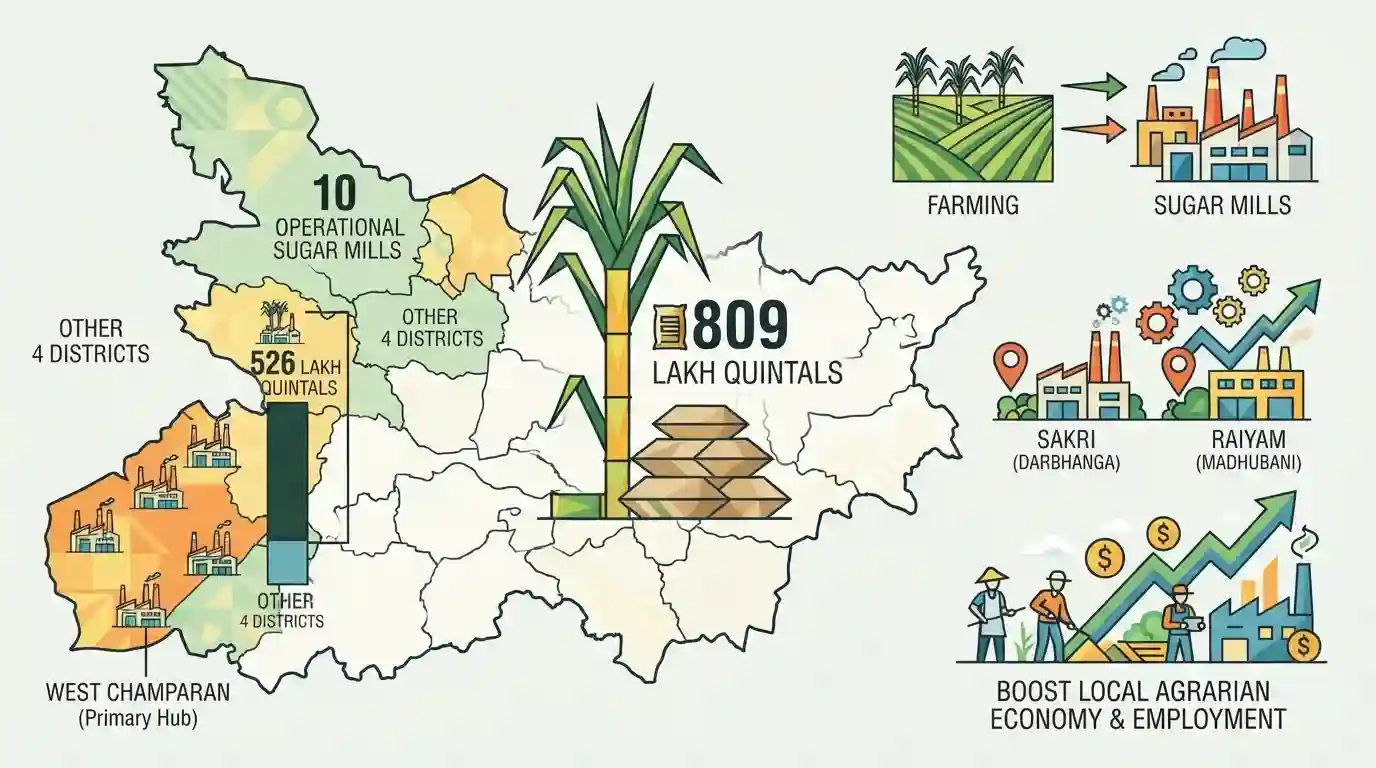
Bihar has established a sugarcane crushing target of 809 lakh quintals for the 2026-27 season, emphasizing the state's focus on agro-based industries. The target will be met by 10 operational sugar mills spread across five districts. West Champaran is the primary hub, hosting five mills and accounting for a massive 526 lakh quintals of the total target. Furthermore, the state is expanding its sugar production capacity with upcoming mills at Sakri (Darbhanga) and Raiyam (Madhubani), which will boost the local agrarian economy and provide employment.
Key Points
- Bihar has set a sugarcane crushing target of 809 lakh quintals for the 2026-27 season across its 10 operational sugar mills.
- West Champaran district accounts for the largest share of the target, with five operational sugar mills tasked to crush 526 lakh quintals of sugarcane.
- Operational sugar mills are located in five districts: West Champaran, Gopalganj, Samastipur, East Champaran, and Sitamarhi.
- New sugar mills are set to begin operations at Sakri in Darbhanga district and Raiyam in Madhubani district.
Prelims Trap
"The British established India's first modern sugar mill in Uttar Pradesh."
Aspirants often associate India's early sugar industry exclusively with the British in UP/Maharashtra, but the Dutch established the first modern mill in Bihar.
Static Concepts Connected
What are the ideal geographical conditions for sugarcane cultivation?
- Temperature: Requires a hot and humid climate with temperatures ranging from 21°C to 27°C.
- Rainfall: Optimal annual rainfall is 75 cm to 100 cm, with irrigation required in areas of lower rainfall.
- Soil type: Thrives best in deep, rich loamy soils that can retain moisture, though adaptable to various soil types.
How is sugarcane pricing determined in India?
- FRP (Fair & Remunerative Price): Announced by the Central government based on CACP recommendations and approved by the CCEA.
- SAP (State Advised Price): Announced by key sugar-producing states (like UP, Bihar, Punjab); usually higher than the Central FRP to protect local farmers.
Cross-Topic Patterns
Sugar Industry & Ethanol Blending Targets
State-level expansion in sugarcane crushing directly supports India's mandate of achieving 20% ethanol blending, shifting mills from purely sugar refiners to critical rural energy producers.
European Trade & Cash Crop Plantations
The 1840 Bettiah sugar mill reflects the Dutch East India Company's early focus on commercializing agriculture (indigo, saltpeter, and sugar) in the fertile Ganga-Gandak river basin.

Sugarcane pricing (FRP vs SAP) paired with state-wise ethanol blending capacities forms a highly probable multi-statement question in 2026.
Linked PYQs · 2
Linked PYQs · 2
- 2023BPSC_PRELIMSGS1
Which food industry dominates among the agro-based industries in Bihar?
- 2018BPSC_PRELIMSGS1
Which type of industries has potentials and prospects in Bihar?
