Bihar BC and EBC Welfare Department Seeks 927 Residential Teachers
Source:The Hindu ↗
Why It Matters
This article outlines major targeted welfare and educational infrastructure schemes (like JNKT hostels and Abhyuday Yojana) by the Bihar government for BC and EBC categories, which are core topics in Bihar polity, governance, and state-specific socio-economic developments.
Summary
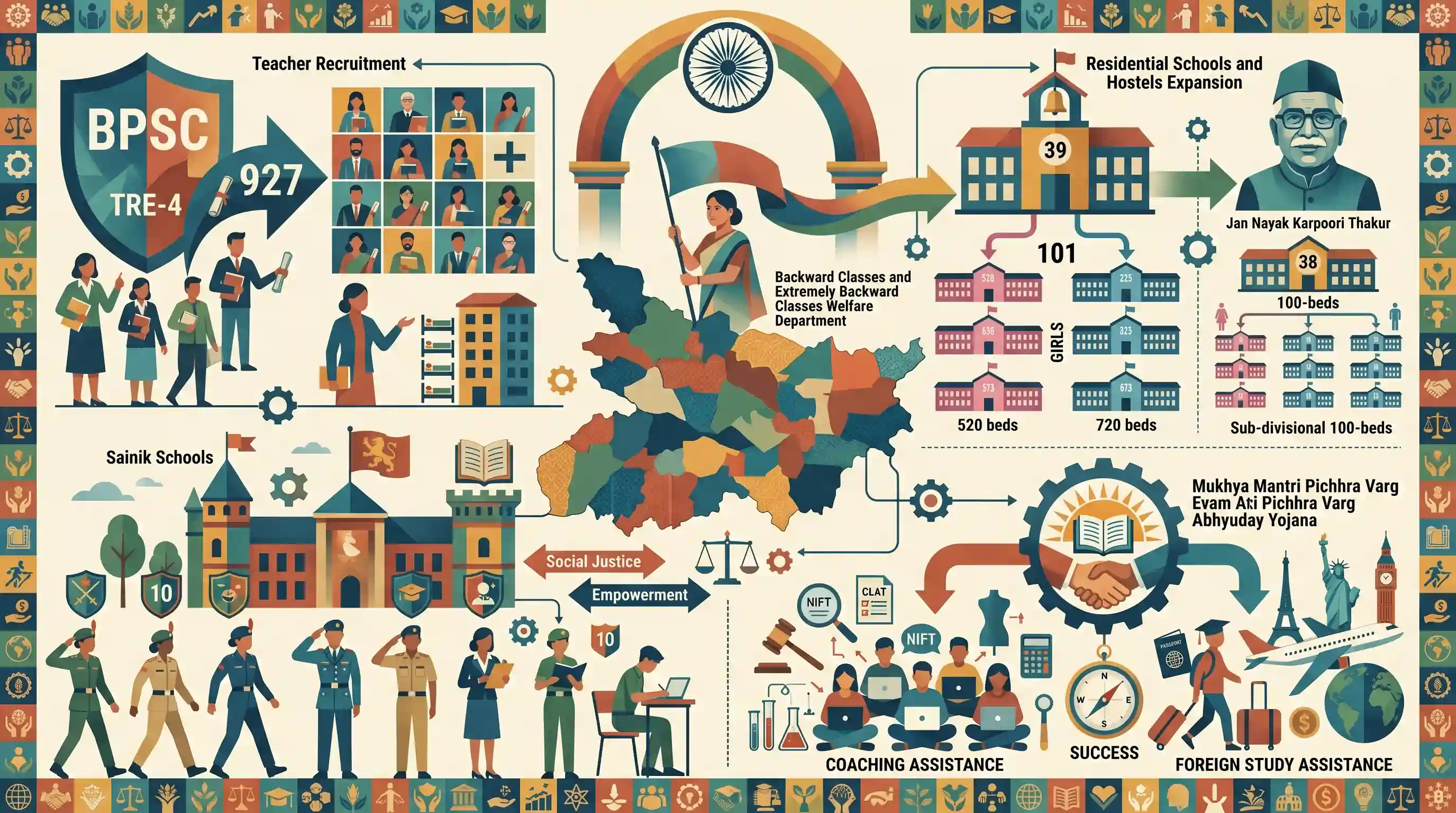
The Bihar Government's BC and EBC Welfare Department, led by Minister Rama Nishad, has initiated a recruitment drive for 927 teachers in Plus Two residential schools via BPSC's TRE-4. Key welfare measures announced include expanding residential schools and Jan Nayak Karpoori Thakur (JNKT) hostels to sub-divisional levels, planning 10 Sainik schools for BC students, and launching the 'Mukhya Mantri Pichhra Varg Evam Ati Pichhra Varg Abhyuday Yojana' to offer coaching and foreign study assistance.
Key Points
- The Bihar government announced a requisition to BPSC to fill up 927 teaching posts for Plus Two girls' residential schools through the Teacher Recruitment Examination (TRE)-4.
- The government plans to set up 520-bed girls' residential schools and 720-bed boys' residential schools at the sub-divisional level, expanding on the 39 district-level schools currently operating.
- To counter the shortage of hostel facilities, 100-bed Jan Nayak Karpoori Thakur (JNKT) hostels will be expanded (for girls at district/sub-divisional levels and for boys at divisional levels); such hostels have been functioning in all 38 districts since 2008-09.
- The state is planning to set up 10 Sainik schools specifically for backward class (BC) category students.
- A new initiative, 'Mukhya Mantri Pichhra Varg Evam Ati Pichhra Varg Abhyuday Yojana', will be introduced to provide coaching for competitive exams like CLAT and NIFT, alongside financial help for studying abroad.
- The department has suggested providing laptops worth up to ₹50,000 to girl students preparing for police/fire service recruitment or studying intermediate/technical courses.
Important Terms
Mukhya Mantri Pichhra Varg Evam Ati Pichhra Varg Abhyuday Yojana

A Bihar government welfare scheme offering specialized competitive coaching, financial grants, and higher education assistance abroad for students belonging to Backward Classes and Extremely Backward Classes.
UPSC context
GS Paper II: Social Justice; tests knowledge of state welfare schemes and educational support systems for marginalized communities.
Teacher Recruitment Examination (TRE)-4
A major competitive recruitment examination conducted by the Bihar Public Service Commission to fill primary, secondary, and senior secondary teacher vacancies in state government schools.
UPSC context
GS Paper II: Governance & Education; tests understanding of state-level public recruitment drives and educational human resource management.
Backward Classes and Extremely Backward Classes Welfare Department, Bihar
The nodal administrative department of the Bihar government responsible for formulating and implementing policies, hostels, scholarships, and development schemes for BC and EBC categories.
UPSC context
GS Paper II: Welfare mechanisms for vulnerable sections; tests knowledge of state-level institutional machinery implementing targeted affirmative policies.
Bihar Public Service Commission (BPSC)
A constitutional body established under Article 315 of the Indian Constitution, responsible for conducting recruitment examinations for state civil services and government jobs in Bihar.
UPSC context
GS Paper II: Constitutional Bodies; tests understanding of the role, mandate, and constitutional provisions (Article 315) governing state-level recruitment.
Prelims Trap
The establishment of Sainik Schools is the exclusive domain of the Ministry of Defence.
While traditional Sainik Schools run under the MoD's Sainik Schools Society, states can independently establish state-funded military-style residential schools for specific welfare categories.
Static Concepts Connected
What is the Karpoori Thakur Formula of reservation?
- Origin and Split: Introduced in Bihar in 1978, it split backward classes into Extremely Backward Classes (EBCs) and Backward Classes (BCs) for equitable quota distribution.
- Layered Quotas: It pioneered reservations for women and economically weaker sections among upper castes decades before national implementations.
- Federal Precursor: It serves as the structural template for current national debates on OBC sub-categorisation under the Rohini Commission.
What constitutional provisions govern backward classes' welfare?
- Article 340: Empowers the President to appoint a Commission to investigate the conditions of socially and educationally backward classes.
- Articles 15(4) & 16(4): Enable the State to make special provisions and reservation in educational institutions and public employment for backward classes.
- Article 338B: Provides constitutional status to the National Commission for Backward Classes (NCBC) via the 102nd Constitutional Amendment Act.
Cross-Topic Patterns
State Welfare vs Fiscal Federalism
Analyzing how intensive state-funded welfare infrastructure (residential schools, laptops) shapes state fiscal health and off-budget borrowing debates in federal finance.
Sub-categorization and Social Justice
How targeting EBCs separately from BCs in educational schemes mirrors the constitutional debate on equitable reservation distribution among OBCs.

The historical evolution of OBC sub-categorisation models and the constitutional role of the NCBC are highly likely GS2 themes for 2026.
Linked PYQs · 2
Linked PYQs · 2
- 2025BPSC_PRELIMSGS1
What is the primary objective of Bihar’s Mission Daksh?
- 2020BPSC_PRELIMSGS1
Bihar Government launched a new scheme 'Satat Jivikoparjan Yojana' in August 2018. The objective of this scheme is
