Bihar Tribal Development Package Proposal for Education and Health
Source:indianmasterminds ↗
Why It Matters
Crucial for understanding Bihar's social welfare framework, central-state financial coordination, and specific development policies targeted at marginalized tribal communities.
Summary
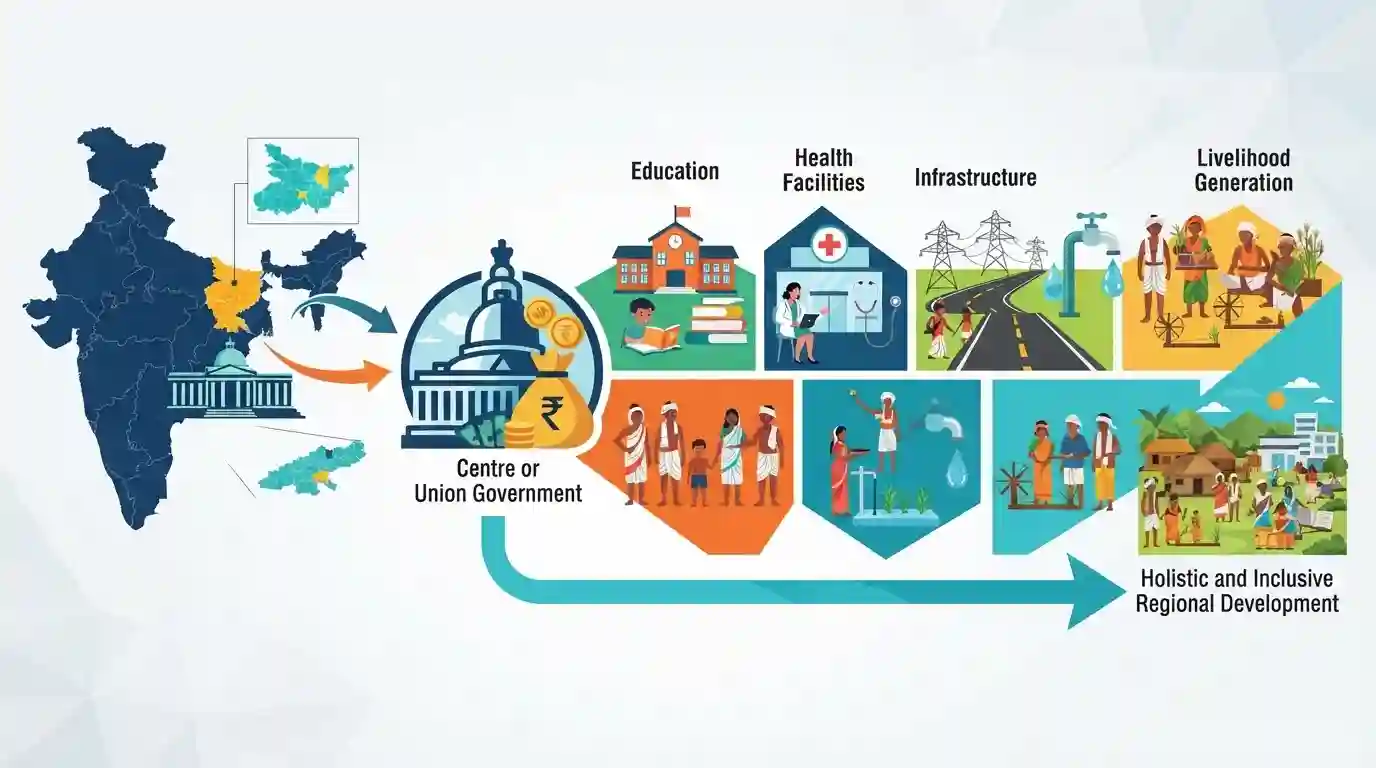
The Bihar government has requested a Rs 100-crore tribal development package from the Centre to enhance infrastructure, education, health facilities, and livelihood generation for tribal communities in the state, ensuring holistic and inclusive regional development.
Key Points
- The Bihar government has sought a Rs 100-crore tribal development package from the central government.
- The funds are primarily aimed at boosting education, health, and livelihood opportunities for the tribal population in the state.
- The initiative focuses on inclusive growth and bridging development gaps for marginalized tribal communities in Bihar.
Important Terms
Tribal Development Package

A special financial allocation requested by the Bihar government from the Centre to upgrade infrastructure, education, health facilities, and livelihood generation for tribal communities.
UPSC context
Crucial for BPSC Paper II (Governance and Social Justice) under welfare schemes for Scheduled Tribes in Bihar.
Bihar Government
The executive branch of the state of Bihar, responsible for administrative governance, policy implementation, and seeking central assistance for regional welfare.
UPSC context
Tests knowledge of state administration, federal relations, and governance initiatives in BPSC Paper II.
Central Government
The federal government of India, which coordinates with state governments on national policies, centrally sponsored schemes, and special financial grants for backward regions.
UPSC context
Important for understanding Indian polity, centre-state financial relations, and national development schemes in BPSC General Studies.
Prelims Trap
Tribal communities in Bihar constitute more than 5% of the total state population post-bifurcation.
Aspirants often assume Jharkhand holds the majority of Bihar's erstwhile tribal population post-2000, but forget that specific pockets like Katihar still have notable ST concentrations (5.9%).
Static Concepts Connected
What are the key constitutional provisions and demographic facts for Scheduled Tribes in Bihar?
- Demographic Share: Census 2011 share is approximately 1.3% of Bihar's total population (around 13.4 lakh), down drastically after the 2000 bifurcation creating Jharkhand.
- District Extremes: Katihar district has the highest ST population percentage (5.9%), while Sheohar district has the lowest (0.01%).
- Largest Tribe: Santhal is the largest ST community in Bihar, making up about 48.5% of the state's total ST population.
- Article 275(1): Grants under this article from the Consolidated Fund of India are used to promote the welfare of STs and raise Scheduled Areas administration levels.
Cross-Topic Patterns
State Reorganisation + Tribal Demographics
The division of Bihar in 2000 shifted demographic realities, concentrating mineral resources in Jharkhand while leaving smaller, dispersed ST pockets like the Santhals and Oraons in Bihar.
Article 275(1) Grants + Fiscal Federalism
Requests for increased grants under Article 275(1) highlight the fiscal federalism debates over Centre-State allocation for vulnerable and marginalized communities.

Expect questions on Bihar's ST demographics (Census 2011 percentages, Katihar/Sheohar extremes, Santhal dominance) or Article 275(1).
Linked PYQs · 2
Linked PYQs · 2
- 2022BPSC_PRELIMSGS1
The value of Human Development Index of Bihar in 2019 was
- 2025BPSC_PRELIMSGS1
Consider the following statements: 1) The proportion of the young population (0-19 years) in Bihar is projected to decline significantly by 2041. 2) Bihar’s demographic dividend is expected to peak around 2041. 3) The elderly population (60+ years) in Bihar is expected to rise more sharply than in India. Select the correct answer using the codes given below:
