Bihar Government Proposes One Hundred Crore Tribal Package
Source:indianmasterminds ↗
Why It Matters
The development highlights Centre-State cooperation in tribal development, federal fiscal transfers under Article 275(1), and targeted health/livelihood schemes like the Dharti Aaba Janjatiya Gram Utkarsh Abhiyan.
Summary
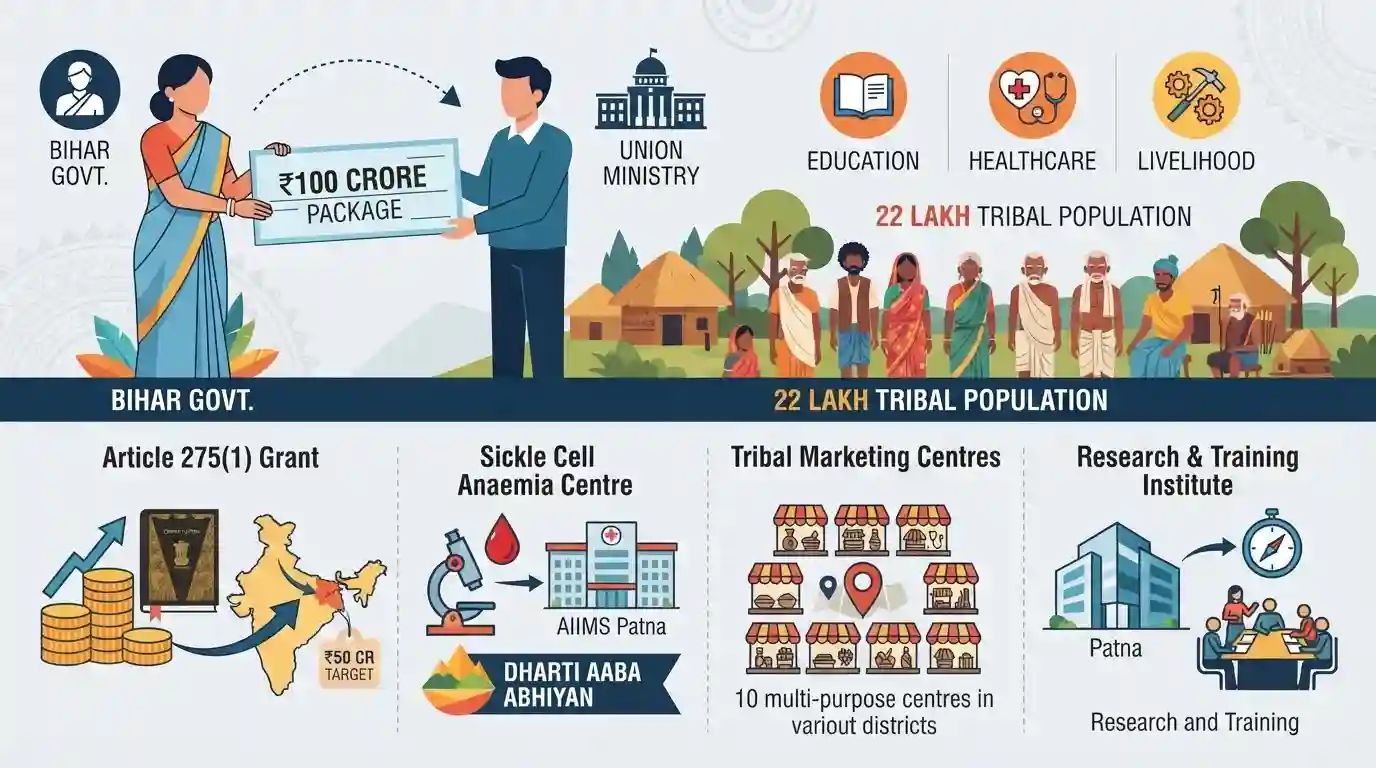
The Bihar Government has proposed a ₹100 crore Tribal Development Package to the Union Ministry of Tribal Affairs. The package aims to uplift Bihar's 22 lakh tribal population by focusing on healthcare, education, and livelihood generation. Major demands include raising Article 275(1) grant-in-aid to ₹50 crore, setting up a Sickle Cell Anaemia treatment centre at AIIMS Patna under the Dharti Aaba Janjatiya Gram Utkarsh Abhiyan, building 10 Tribal Multi-Purpose Marketing Centres across various districts, and completing the Tribal Research and Training Institute in Patna.
Key Points
- Bihar's SC/ST Welfare Minister Lakhendra Kumar Raushan met Union Tribal Affairs Minister Jual Oram to request a special tribal development package of ₹100 crore.
- The package is intended to benefit approximately 22 lakh tribal residents in Bihar through interventions in education, health, and livelihoods.
- Bihar seeks an increase in its Article 275(1) annual tribal welfare grant from the current ₹20.83 crore to ₹50 crore.
- A dedicated Sickle Cell Anaemia treatment centre costing ₹7.86 crore has been proposed at AIIMS Patna under the Dharti Aaba Janjatiya Gram Utkarsh Abhiyan.
- The Bihar government proposed setting up 10 Tribal Multi-Purpose Marketing Centres in various districts (West Champaran, Jamui, Kaimur, Munger, Buxar, Siwan, Gopalganj, Araria, Saran, Madhepura) to promote tribal art and products.
- Funding has also been sought to complete the physical infrastructure of the Tribal Research and Training Institute (TRI) in Patna.
Prelims Trap
"Article 275(1) grants are discretionary funds provided exclusively for the administration of Sixth Schedule tribal areas."
Article 275(1) provides statutory grants charged on the Consolidated Fund of India for ST welfare and raising administration levels in ANY state's Scheduled Areas, not just Sixth Schedule.
Static Concepts Connected
What is the constitutional mandate of Article 275(1) regarding tribal welfare?
- Statutory Grants: Mandates grants-in-aid from the Consolidated Fund of India to states in need of financial assistance.
- Tribal Welfare: Provides capital and recurring sums for schemes promoting ST welfare and upgrading the administration of Scheduled Areas.
- Finance Commission Role: These grants are provided to the states based on the recommendations of the Finance Commission.
What are the clinical and demographic characteristics of Sickle Cell Disease (SCD)?
- Genetic Disorder: An autosomal recessive genetic blood disorder affecting hemoglobin, causing red blood cells to become rigid and sickle-shaped.
- Demographic Vulnerability: Disproportionately affects tribal populations in India due to endogamous marriage practices; India aims to eliminate it by 2047.
- Clinical Symptoms: Causes chronic anemia, severe pain crises, organ damage, and increased susceptibility to infections.
Cross-Topic Patterns
DAJGUA vs PM-JANMAN targeting
UPSC frequently tests the distinction between broad ST welfare initiatives (like the new Dharti Aaba Abhiyan) and hyper-targeted missions for Particularly Vulnerable Tribal Groups (PM-JANMAN).
Fiscal federalism meeting public health
States increasingly leverage constitutional grants under Article 275(1) to target specific regional health bottlenecks (like Sickle Cell Disease), merging fiscal federalism with genetic public health goals.

Expect a 2026 Prelims question testing the mandate of Article 275(1) statutory grants versus discretionary schemes like PM-JANMAN.
Linked PYQs · 2
Linked PYQs · 2
- 2023BPSC_PRELIMSGS1
The Fifth Schedule deals with the governance and protection of the interests of which specific group of people?
- 2023BPSC_PRELIMSGS1
The specifications required for a community to be declared as a Scheduled Tribe are 1. indications of primitive traits 2. distinctive culture 3. shyness of contact with the community at large 4. backwardness and geographical isolation
