Bihar Renewable Energy Proposals and Central Green Corridor Support
Source:uniindia ↗
Why It Matters
The article highlights Bihar's concrete plans and geographical focal points (Jamui, Banka, Aurangabad, etc.) for solar expansion. For BPSC Prelims, understanding these local districts, proposed capacities (like the 150 MW SECI Solar Park), and linkages to national solar and agricultural policies is highly relevant.
Summary
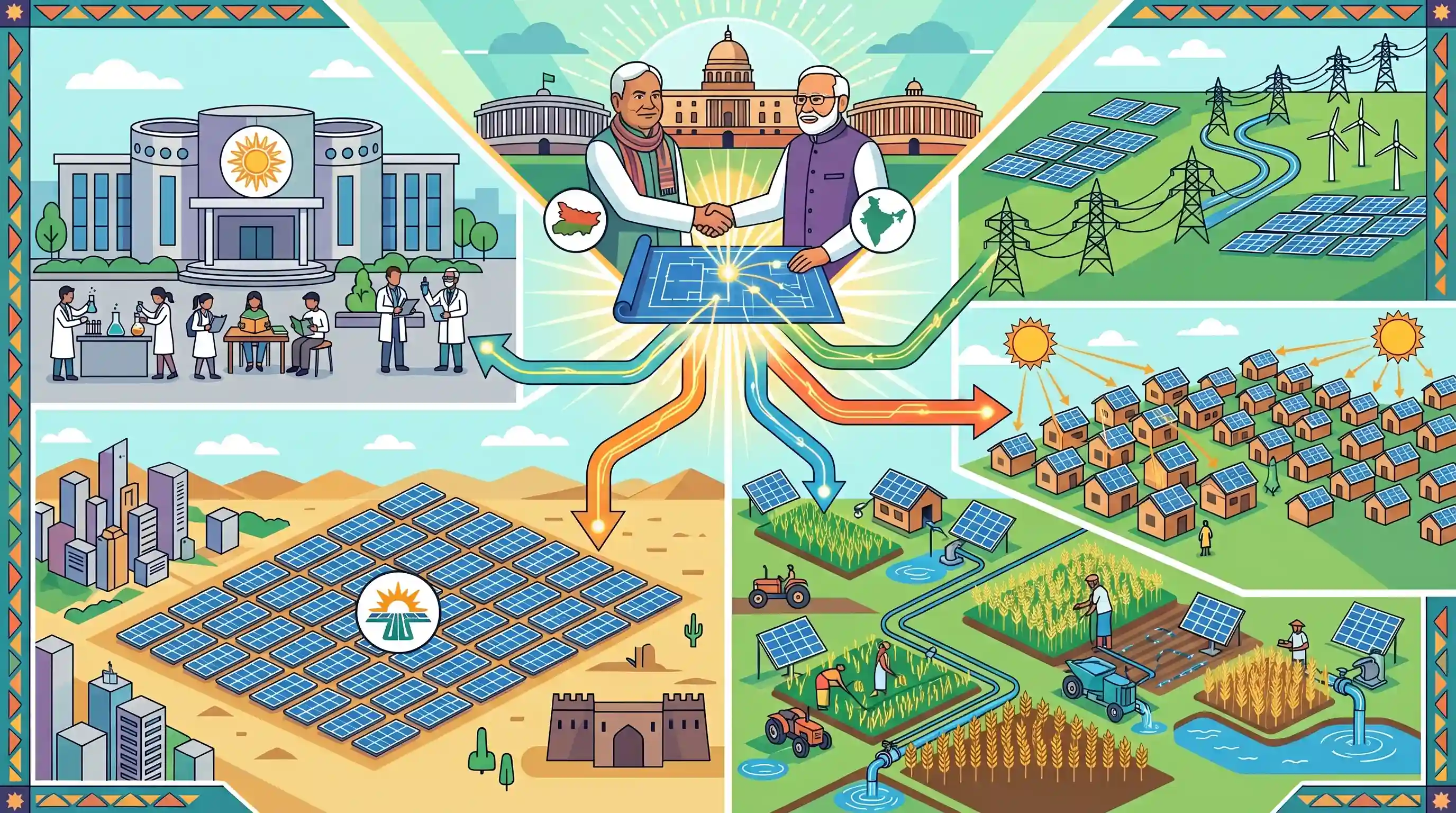
Bihar’s Energy Minister met the Union Minister for New and Renewable Energy to secure financial support for critical renewable energy initiatives. The state’s proposals include a 3,305 MW Green Energy Corridor, expanding the PM Surya Ghar scheme to 1 million Kutir Jyoti consumers, solarising 1,000 agricultural feeders under PM-KUSUM, establishing a 150 MW SECI Solar Park in Aurangabad, and building a regional campus of the National Institute of Solar Energy (NISE).
Key Points
- Bihar Energy Minister Shailesh Kumar (alias Bulo Mandal) met Union MNRE Minister Pralhad Joshi in New Delhi to request central assistance for major green energy projects.
- The state requested financial aid for a 3,305 MW Green Energy Corridor (GEC) and a Battery Energy Storage System (BESS) to evacuate power from solar-rich districts including Jamui, Banka, Lakhisarai, Aurangabad, and Kaimur.
- Bihar proposed scaling up the PM Surya Ghar: Muft Bijli Yojana to cover 1 million Kutir Jyoti consumers in the first phase, up from the approved 250,000 beneficiaries (out of 5.8 million total Kutir Jyoti consumers).
- Under PM-KUSUM Component-C, Bihar requested approval to solarise 1,000 agricultural feeders to boost renewable penetration in farming.
- Other key proposals include setting up a 150 MW Solar Park in Aurangabad through SECI, executing the Bihar Green Hydrogen Policy, and establishing a regional campus of the National Institute of Solar Energy (NISE) in Bihar.
Important Terms
PM Surya Ghar: Muft Bijli Yojana

A central sector scheme launched in 2024 to provide free electricity to 1 crore Indian households by subsidizing residential rooftop solar installations.
UPSC context
GS Paper III (Energy/Infrastructure), testing knowledge of renewable energy access, climate goals, and decentralized power distribution.
PM-KUSUM Scheme
Launched in 2019, this scheme aims to secure water and energy for farmers by subsidizing solar pumps, solarizing grid agricultural pumps, and installing decentralized solar plants.
UPSC context
GS Paper III (Agriculture & Infrastructure), testing knowledge of farm mechanization, clean energy transition, and direct income support.
Kutir Jyoti Scheme
Originally a 1988-89 central initiative for rural poor, revamped by Bihar to provide free electricity up to 125 units and state-funded solar installations to BPL households.
UPSC context
GS Paper II (Welfare Schemes) & GS Paper III (Energy), evaluating state-level poverty alleviation and energy transition models.
Green Energy Corridor (GEC)
An initiative launched in 2015 to construct dedicated transmission systems for integrating and evacuating electricity generated from renewable sources into the national grid.
UPSC context
GS Paper III (Infrastructure & Environment), assessing transmission grid integration, regional grid stability, and renewable energy targets.
Solar Energy Corporation of India (SECI)
A central public sector enterprise under the MNRE, acting as the prime implementing and power-trading agency for India's National Solar Mission and renewable energy projects.
UPSC context
GS Paper III (Infrastructure & Economy), testing understanding of central renewable energy implementation and power procurement models.
National Institute of Solar Energy (NISE)
An autonomous R&D institution under the MNRE, serving as India's apex national center for solar technology research, testing, certification, and skill development.
UPSC context
GS Paper III (Science & Technology / Energy), evaluating technical R&D, standard testing, and skill development in the renewable sector.
Bihar Green Hydrogen Policy
A 2026 state policy targeting 0.10 MMTPA green hydrogen/ammonia production by 2031, promoting electrolyser manufacturing and industrial decarbonisation through dedicated incentives.
UPSC context
GS Paper III (Environment & Economy), testing state-level clean fuel strategies, industrial decarbonisation, and net-zero alignment.
Prelims Trap
PM-KUSUM Component-C is strictly limited to solarising individual grid-connected agricultural pumps owned by individual farmers.
Under Component-C, the government introduced feeder-level solarisation in 2020. This allows states to solarise entire agricultural feeders rather than just individual pumps, making implementation cheaper and highly relevant for states like Bihar.
Static Concepts Connected
What are the three core components of the PM-KUSUM Scheme?
- Component A: Focuses on setting up 10,000 MW of decentralized, grid-connected renewable energy power plants on farmers' barren or fallow land.
- Component B: Focuses on the installation of 20 lakh standalone solar-powered agricultural pumps in off-grid areas.
- Component C: Focuses on the solarisation of 15 lakh grid-connected agriculture pumps, which includes both individual pump solarisation and feeder-level solarisation.
What is the Intra-State Green Energy Corridor (GEC) scheme?
- Core Objective: Aims to facilitate the evacuation of power from renewable energy projects into the state-level grid via dedicated transmission lines.
- Implementation Agency: Implemented by State Transmission Utilities (STUs) with financial assistance in the form of a Central Financial Assistance (CFA) grant.
- Grid Stability: Evacuation of highly intermittent renewable sources like solar and wind requires complementary Battery Energy Storage Systems (BESS) to maintain grid frequency.
Cross-Topic Patterns
Fiscal Federalism in Energy Transition
Land-scarce and financially stressed states require asymmetrical central grants (like GEC and Solar Parks) to transition, revealing how fiscal federalism shapes India's climate commitments.
Agrarian Solarization vs Food Security
PM-KUSUM Component-C feeder-level solarization in fertile states like Bihar helps clean the farm sector's energy footprint without diverting scarce cultivable land for mega-solar parks.

2026 Prelims may test PM-KUSUM Component-C's feeder-level solarization and the funding split of the Intra-State Green Energy Corridor.
Linked PYQs · 2
Linked PYQs · 2
- 2023BPSC_PRELIMSGS1
The first ‘floating solar power plant’ has been built at which place in Bihar?
- 2020BPSC_PRELIMSGS1
The objective of PM-KUSUM Scheme is
